BOZP for agriculture — machinery, animals, pesticides and VTZ inspections
Complete guide to BOZP in agriculture: safety of tractors and machinery, work with animals and biological factors, pesticides and chemical substances, OPP, PZS, VTZ inspections and mandatory training.
Interested in this service?
Leave us your contact and we will get back to you with pricing and dates, usually within 24 hours.
Agriculture is among the sectors with the highest accident rate
Agriculture has long been among the sectors with the highest rate of occupational accidents. Its risk profile stems from a combination of heavy machinery, work with animals, chemical substances, seasonality and work in open, uneven terrain. Tractors and self-propelled machines are particularly hazardous — machine overturn on a slope and entanglement by moving parts (especially an unguarded power take-off (PTO) shaft and cardan shaft) are among the most frequent causes of fatal and serious accidents in the sector.
In the area of occupational diseases, the National Health Information Centre (NCZI) recorded a total of 423 newly recognised occupational diseases in 2024. In agriculture, these are mainly musculoskeletal disorders from long-term and excessive loading, disorders from vibration and noise during machine operation, and transmissible and parasitic diseases (zoonoses) from contact with animals. Systematic BOZP (occupational health and safety) management in this sector is therefore not a formality, but direct protection of the health and lives of people.
Typical hazards in agriculture
An agricultural operation combines the hazards of both crop and livestock production, which additionally change with the season and the weather. That is precisely why it is important to assess and manage risks systematically. Below are the most common risk categories that must be covered by the risk assessment and day-to-day practice on the farm.
Agricultural machinery, tractors and equipment
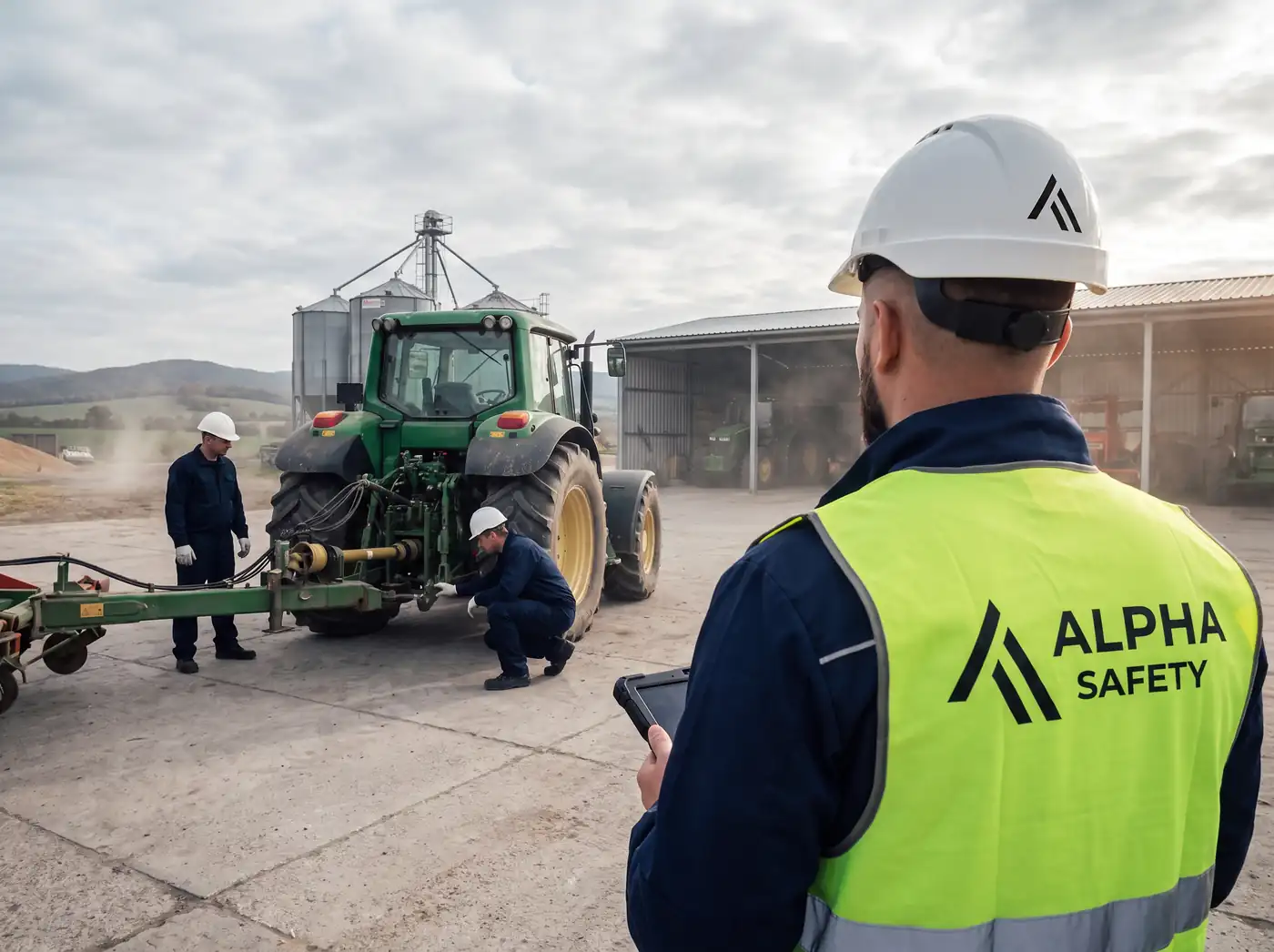
Tractors, combine harvesters, self-propelled forage harvesters, loaders and attached implements carry a risk of overturning, entanglement, crushing and being struck. They are work equipment under Government Regulation No. 392/2006 Coll., which requires them to be kept in a safe condition and used in accordance with the manufacturer's instructions. The critical safeguards are power take-off (PTO) shaft and cardan shaft guards, a functional rollover protective structure (ROPS) and a seat belt. Front-end and telescopic loaders also fall under reserved lifting technical equipment (VTZ) under Decree No. 508/2009 Coll.
Work with animals and biological factors
Keeping and handling animals carries a risk of kicks, crush injuries and bites, as well as the transmission of communicable diseases — zoonoses. Protection of health when working with biological factors is governed by Government Regulation No. 83/2013 Coll., which in Annex No. 1 expressly lists work in agriculture and activities involving contact with animals or products of animal origin. The risk increases when handling large animals, during births and when working in enclosed housing areas.
Chemical substances, dust and hazardous gases
Plant protection products, industrial fertilisers, disinfectants, and also organic dust from grain and feed, are chemical factors under Government Regulation No. 355/2006 Coll. A particular risk is posed by hazardous gases in enclosed spaces — carbon dioxide and oxygen deficiency in silos and during silage-making, and hydrogen sulphide, methane and ammonia in slurry tanks and cesspits. These spaces are among the work activities with an elevated risk of suffocation and poisoning.
Noise, vibration and physical load
Operating tractors and machinery involves exposure to noise, which is governed by Government Regulation No. 115/2006 Coll. (agriculture is listed in it as a typically noisy activity), and to whole-body vibration when driving self-propelled machines under Government Regulation No. 416/2005 Coll. Added to this is manual handling of loads (Government Regulation No. 281/2006 Coll.), work in constrained postures and heat stress during seasonal work.
Safety of agricultural machinery and tractors
Machinery is the most frequent source of fatal and serious accidents in agriculture. Tractors, combine harvesters, self-propelled machines and attached implements are work equipment under Government Regulation No. 392/2006 Coll. The employer is obliged to provide machinery that is suitable for the work in question, kept in a safe condition and fitted with the necessary protective devices, and to ensure that it is operated by instructed and competent persons.
The most common safety shortcomings are missing or damaged power take-off (PTO) and cardan shaft guards, a non-functional or removed rollover protective structure (ROPS), failure to use the seat belt, and carrying a passenger in places not designed for it. Loaders and their lifting mechanism are also reserved lifting technical equipment (VTZ) under Decree No. 508/2009 Coll. and are subject to professional inspections and tests.
Tractor overturn on a slope is one of the leading causes of fatal accidents in agriculture. A functional rollover protective structure combined with a seat belt actually worn is the most effective protective measure — never disconnect or remove them.
Assess the risks for both crop and livestock production. Under § 6 ods. 1 písm. c) of Act No. 124/2006 Coll., the employer is obliged to identify hazards, assess risk and draw up a written risk assessment document for all activities — from field work and machine operation through animal husbandry and feeding to work with plant protection products and storage. The assessment is updated when the technology changes, for seasonal work and when new or seasonal employees are taken on.
Ensure the safety of machinery, tractors and equipment. Tractors, combine harvesters, self-propelled machines and attached implements are work equipment under Government Regulation No. 392/2006 Coll. Ensure power take-off (PTO) and cardan shaft guards, a functional rollover protective structure and seat belt, pre-use checks and maintenance in accordance with the manufacturer's instructions. Front-end and telescopic loaders and their lifting mechanism also fall under reserved lifting technical equipment (VTZ) under Decree No. 508/2009 Coll.
Manage work with animals and biological factors. Keeping and handling animals carries a risk of kicks, crush injuries, bites and transmission of zoonoses. Protection against biological factors is governed by Government Regulation No. 83/2013 Coll., which in Annex No. 1 expressly lists work in agriculture and contact with animals. Ensure safe housing and handling, hygiene facilities, personal protective equipment, and the inclusion of biological factors in the risk assessment and categorisation of work.
Ensure safe work with chemical substances and pesticides. Plant protection products, fertilisers and disinfectants are chemical factors under Government Regulation No. 355/2006 Coll., which sets the maximum permissible exposure limits (NPEL) in the workplace atmosphere. Professional application of plant protection products may only be carried out by a person holding a certificate of professional competence under § 32 of Act No. 405/2011 Coll. Ensure effective OOPP, safe storage, ventilation and records of the products used.
Ensure OPP and the safety of storage facilities, silos and confined spaces. Hay, straw, grain, fuels and dryers pose an elevated risk of fire and spontaneous combustion; ensure preventive fire inspections under § 4 of Act No. 314/2001 Coll. Work in silos, cesspits and slurry tanks is confined-space work with a risk of suffocation and gas poisoning (carbon dioxide, hydrogen sulphide, methane) — it requires special measures, checking the atmosphere and securing the person with a second person standing by.
Arrange VTZ inspections and the occupational health service. Pressure vessels and compressors, gas boiler rooms and dryers, electrical wiring, milking parlours and lifting equipment are reserved technical equipment under Decree No. 508/2009 Coll. and must have valid professional inspections and tests. At the same time, arrange the occupational health service — categorisation of work and preventive medical examinations in relation to work.
Train employees and seasonal workers and maintain documentation. Initial induction on starting and refresher instruction at least once every three years (§ 7 ods. 5 of Act No. 124/2006 Coll.); for the operation of selected machinery and loaders and for work with pesticides, special professional competences and shorter intervals apply. Seasonal and foreign workers must be instructed clearly, in a language they understand.
Work with animals and biological factors
Livestock production brings specific hazards that are often underestimated in the risk assessment. Protection of employees against risks from exposure to biological factors is governed by Government Regulation No. 83/2013 Coll. It applies to activities in which employees are exposed to biological factors and, in Annex No. 1, expressly lists work in agriculture and contact with animals or products of animal origin. The employer is obliged to assess the nature, degree and duration of the exposure and to adopt appropriate measures.
- Injury risks — kicks, crush injuries against structures, bites, being struck by a large animal; births, moving animals and restraining them are the highest-risk activities.
- Zoonoses — transmissible and parasitic diseases passed from animals to humans; they are among the recognised occupational diseases and require hygiene measures and personal protective equipment (OOPP).
- Hygiene facilities — separate areas for changing, washing and eating, to prevent the spread of infection and contamination.
- Categorisation and surveillance — biological factors are reflected in the categorisation of work and in the occupational health service's surveillance of employees' health.
Chemical substances, pesticides and fertilisers
Work with plant protection products, fertilisers and disinfectants is among the activities involving exposure to chemical factors. Protection of health in this work is governed by Government Regulation No. 355/2006 Coll., which in Annex No. 1 sets the maximum permissible exposure limits (NPEL) in the workplace atmosphere. The employer is obliged to assess the risk from chemical factors, give priority to replacing hazardous substances with less hazardous ones, and ensure technical and organisational measures as well as effective personal protective equipment.
- Professional competence for pesticides — professional application of plant protection products may only be carried out by a person holding a certificate of professional competence under § 32 of Act No. 405/2011 Coll.; the certificate is valid for ten years and compliance is monitored by the Central Controlling and Testing Institute in Agriculture (ÚKSÚP).
- OOPP and hygiene — when preparing and applying sprays, protective clothing, gloves, a respirator and eye protection are required in accordance with the safety data sheet and Government Regulation No. 395/2006 Coll.
- Storage — products and fertilisers in a lockable, ventilated store, separate from food and feed, with spill containment trays and a register.
- Hazardous gases — poisoning and suffocation are a risk during silage-making and in slurry tanks; before entry the space must be ventilated, the atmosphere checked, and the person secured by a second person standing by.
OPP — fire protection on the farm
Agriculture involves large quantities of flammable materials — hay, straw, grain, feed, fuels and lubricants — and the use of dryers, boiler rooms and equipment with an open flame. The basic regulation is Act No. 314/2001 Coll. on fire protection. Under § 4, a legal entity and a natural person-entrepreneur are obliged to carry out preventive fire inspections, remove identified deficiencies and comply with measures at locations and in activities with an elevated risk of fire.
A particular risk is the spontaneous combustion of damp hay and straw, and dust fires in dryers and silos. The tasks and establishment of a workplace fire patrol and a fire assistance patrol, as well as the content and scope of their training, are governed by Decree of the Ministry of Interior of the Slovak Republic No. 121/2002 Coll. on fire prevention. Fire documentation, employee training on fire protection and the professional training of patrols are just as important on a farm as the BOZP agenda itself.
- Fire extinguishers must be inspected at least once every 24 months under § 9 of Decree No. 347/2022 Coll.; they must be accessible, including on machinery and in storage areas, and their location marked.
- Dryers and boiler rooms — for activities involving an open flame and combustible dust, a written permit is issued and a fire assistance patrol established where necessary.
- Flammable liquids (diesel, lubricants) are stored and used in accordance with Decree No. 38/2026 Coll., which replaced Decree No. 96/2004 Coll. from 1 April 2026.
- Sanctions: for breaches of fire-protection obligations, a fine of up to 8,298 euros may be imposed under § 59 ods. 1 of Act No. 314/2001 Coll.; for more serious offences, up to 16,596 euros.
PZS for agricultural professions
The occupational health service (PZS) provides surveillance over working conditions and the health of employees. For agricultural professions, the key elements are correct categorisation of work according to health risks and the arrangement of preventive medical examinations in relation to work. Workers are typically exposed to physical load, noise, vibration, dust, and chemical and biological factors — these are reflected in the classification of work into the relevant category.
The categorisation of work into categories 1 to 4 is governed by § 31 of Act No. 355/2007 Coll., with the details set out in Decree No. 448/2007 Coll. The obligation to provide an occupational health service applies from the first employee under § 30 of the same Act; for work categories 1 and 2 a simplified model applies, and certain activities may also be carried out by a safety technician or a public health officer. Preventive medical examinations in relation to work are carried out under § 30e. For agricultural companies, Alpha Safety provides PZS: categorisation of work, surveillance over working conditions and coordination of medical examinations.
VTZ and inspections in agriculture
An agricultural operation contains numerous items of reserved technical equipment (VTZ), which are subject to an inspection regime. Decree No. 508/2009 Coll. in § 4 classifies VTZ according to the degree of hazard into groups A, B and C, and covers pressure, lifting, electrical and gas equipment. Under § 9 and § 13, the safety condition of VTZ after installation and during operation is checked by professional inspection and test; the scope and intervals are set out in the annexes. Missing or out-of-date inspection documentation is often one of the first findings during a labour inspectorate check.
- Pressure equipment — compressors, stationary pressure vessels and air receivers; subject to professional inspections and tests at the intervals set out in the annexes to Decree No. 508/2009 Coll.
- Gas equipment — gas boiler rooms, gas-fired dryers and any biogas plants; tightness and safety checks under the regime for gas VTZ.
- Electrical equipment — wiring of farm buildings, milking parlours, pumps and distribution boards; also checked against standard STN 33 1630:2025, which replaced STN 33 1600 and STN 33 1610 on 1 May 2025 (parallel use permitted until 1 May 2027).
- Lifting equipment — front-end and telescopic loaders, crane arms and manipulators; operation and VTZ inspections by a person holding a valid inspection technician's certificate under § 24 of Decree No. 508/2009 Coll.
Mandatory training in agriculture
Employee education is the foundation of prevention. Under § 7 ods. 5 of Act No. 124/2006 Coll. (as amended by Act No. 114/2022 Coll. effective from 1 January 2023), repeated instruction in BOZP rules must be carried out at least once every three years, unless special regulations lay down a shorter interval. Seasonal and foreign workers must be instructed clearly and in a language they understand before starting work.
Agricultural professions additionally require professional competences — operation of powered industrial trucks and loaders (a licence card under § 16 of Act No. 124/2006 Coll. and refresher professional training), load slingers, electrotechnical competence and professional competence for working with plant protection products under § 32 of Act No. 405/2011 Coll. Contracted instruction may be delivered only by a person holding an authorisation issued by the National Labour Inspectorate — Alpha Safety is authorised to carry out education and training. The costs and time of training are borne by the employer and instruction is carried out during working time.
Fines for breaches of regulations in agriculture
The labour inspectorate may, under § 19 of Act No. 125/2006 Coll., impose on an employer a fine of up to 100,000 euros for breaches of BOZP regulations. If the breach resulted in an occupational accident with a fatal outcome or serious bodily harm, the fine is at least 33,000 euros. Sanctions are triggered by a missing risk assessment, unsecured machinery lacking protective guards, OOPP not provided, out-of-date VTZ inspection documentation, and failure to meet obligations when working with chemical and biological factors.
Accidents involving agricultural machinery and work with animals often have severe consequences. Prevention — functional protective devices, training and inspections — is always cheaper than dealing with the aftermath of damages, sanctions and lost time during the season.
What Alpha Safety will provide for your agricultural company
Alpha Safety s.r.o. is an external provider of comprehensive safety services for agricultural enterprises, farms and cooperatives throughout Slovakia. Instead of handling each area separately, you gain a single partner for the whole of crop and livestock production safety.
- BOZP — external safety service (BTS), risk assessment for both crop and livestock production, operating rules for machinery and complete documentation.
- OPP — fire documentation for farms and storage facilities, employee training on fire protection, professional training of fire patrols and measures for dryers and feed stores.
- PZS — categorisation of work, surveillance over working conditions and coordination of preventive medical examinations, including risks from biological and chemical factors.
- VTZ inspections — professional inspections and tests of pressure, gas, electrical and lifting equipment, including loaders, milking parlours and boiler rooms.
- Training — operation of machinery and loaders, load slingers, work at height, initial and refresher instruction of employees and seasonal workers.
From our practice
In agricultural operations, we most commonly encounter underestimated machine risks — missing power take-off shaft guards, a removed rollover protective structure and failure to use the seat belt. Another typical shortcoming is a token risk assessment that fails to take account of seasonal work, work with animals, or hazardous gases in silos and slurry tanks.
Inspections repeatedly reveal the same findings: unmarked and inaccessible fire extinguishers, missing OOPP when working with sprays, out-of-date inspections of pressure and electrical equipment, and seasonal workers who have not been instructed. Our experience is unambiguous — farms with a functioning BOZP system, regular training and ongoing machine maintenance show a minimum of shortcomings and, above all, fewer accidents.
Related services and resources
Bezpečnosť a ochrana zdravia pri práci
Externá bezpečnostnotechnická služba, posúdenie rizík rastlinnej aj živočíšnej výroby a kompletná dokumentácia BOZP pre poľnohospodárske podniky.
Pracovná zdravotná služba (služba)
Kategorizácia prác, dohľad nad pracovnými podmienkami a koordinácia lekárskych preventívnych prehliadok vrátane rizík z biologických a chemických faktorov.
Revízie VTZ (služba)
Odborné prehliadky a skúšky tlakových, plynových, elektrických a zdvíhacích zariadení vrátane nakladačov, dojární, kotolní a sušičiek.
Ochrana pred požiarmi (služba)
Požiarna dokumentácia fariem a skladov, školenia o ochrane pred požiarmi a odborná príprava protipožiarnych hliadok pre sušičky a sklady krmív.
Sprievodca BOZP
Výkladový sprievodca povinnosťami zamestnávateľa v oblasti bezpečnosti a ochrany zdravia pri práci.
Kurz obsluhy poľnohospodárskych strojov
Doklad na obsluhu vybraných poľnohospodárskych strojov — samochodné rezačky, obilné kombajny aj špeciálne zberové stroje (skupiny 1A–1C) podľa § 16 zákona č. 124/2006 Z. z.
Školenia a kurzy
Obsluha strojov a nakladačov, viazači bremien, práce vo výškach, vstupné aj opakované oboznamovanie — prezenčne aj online.
We operate throughout Slovakia
We provide safety in this sector in all regional and district towns, for example:
Short answer
In agriculture, the employer must assess and document the risks of both crop and livestock production and adopt measures to reduce them. The key elements are ensuring the safety of machinery and tractors under Government Regulation No. 392/2006 Coll., protection against biological factors when keeping animals under Government Regulation No. 83/2013 Coll., and safe work with plant protection products. Refresher instruction of employees is carried out at least once every three years under § 7 ods. 5 of Act No. 124/2006 Coll.
Časté otázky o BOZP v poľnohospodárstve
The most common risks include tractor overturn and entanglement by moving machine parts (especially an unguarded power take-off and cardan shaft), injuries when working with animals, poisoning and suffocation in silos and slurry tanks, exposure to pesticides and fertilisers, and the load from noise, vibration and physical work. Machinery is the most frequent source of fatal accidents.
Yes. Under § 6 ods. 1 písm. c) of Act No. 124/2006 Coll., the employer is obliged to identify hazards, assess risk and draw up a written risk assessment document for all activities — from field work and machine operation through animal husbandry to work with chemical substances. The assessment is updated when the technology changes and for seasonal work.
Initial instruction is carried out on starting, and refresher instruction under § 7 ods. 5 of Act No. 124/2006 Coll. at least once every three years, unless special regulations lay down a shorter interval. For the operation of loaders, load slingers, work with pesticides and electrotechnical competence, special professional competences and shorter intervals apply.
Tractors, combine harvesters and self-propelled machines are work equipment under Government Regulation No. 392/2006 Coll. — they must be kept in a safe condition and used in accordance with the manufacturer's instructions. The key elements are power take-off (PTO) and cardan shaft guards, a functional rollover protective structure and a seat belt. Front-end and telescopic loaders are also reserved lifting technical equipment (VTZ) under Decree No. 508/2009 Coll.
Professional application of plant protection products may only be carried out by a person holding a certificate of professional competence under § 32 of Act No. 405/2011 Coll. The certificate is valid for ten years and compliance with it is monitored by the Central Controlling and Testing Institute in Agriculture (ÚKSÚP). From a BOZP perspective, the products are chemical factors under Government Regulation No. 355/2006 Coll. and require a risk assessment and effective OOPP.
Keeping and handling animals carries a risk of kicks, crush injuries, bites, being struck and the transmission of zoonoses. Protection against biological factors is governed by Government Regulation No. 83/2013 Coll., which in Annex No. 1 expressly lists work in agriculture and contact with animals. The employer provides hygiene facilities, OOPP and the inclusion of biological factors in the categorisation of work.
Yes. The obligation to provide an occupational health service applies from the first employee under § 30 of Act No. 355/2007 Coll. The PZS provides surveillance over working conditions, categorisation of work into categories 1 to 4 under § 31, and coordination of preventive medical examinations in relation to work under § 30e. A simplified model applies to categories 1 and 2.
Reserved technical equipment (VTZ) under Decree No. 508/2009 Coll. is subject to inspection (professional inspections and tests) — pressure vessels and compressors, gas boiler rooms and dryers, electrical wiring, milking parlours and lifting equipment including front-end and telescopic loaders. The intervals are set out in the annexes to the Decree. Without valid inspections and documentation, sanctions may apply.
Under § 4 of Act No. 314/2001 Coll., preventive fire inspections must be ensured and deficiencies removed. A particular risk is the spontaneous combustion of damp hay and straw, dust fires in dryers and fuel storage. Fire extinguishers are inspected at least once every 24 months under § 9 of Decree No. 347/2022 Coll.; for work involving an open flame, a fire assistance patrol is established where necessary.
This is confined-space work with a risk of suffocation and poisoning by hazardous gases — carbon dioxide and oxygen deficiency in silos, and hydrogen sulphide, methane and ammonia in slurry tanks. Before entry, the space must be ventilated, the atmosphere checked, suitable OOPP used, and the worker secured by a second person. These activities must be specifically assessed in the risk assessment document.
Yes. Every employee, including seasonal and foreign workers, must receive initial instruction in BOZP rules under § 7 of Act No. 124/2006 Coll. before starting work. The instruction must be clear and given in a language the worker understands. The employer is responsible for the instruction, which is carried out during working time.
Under § 19 of Act No. 125/2006 Coll., the labour inspectorate may impose a fine of up to EUR 100,000 on an employer for breaching BOZP regulations. If the breach resulted in a fatal accident or serious damage to health, the fine is at least EUR 33,000. Sanctions also apply for unsecured machinery, OOPP not provided and out-of-date VTZ inspections.
Need help with workplace safety?
Contact us today and get a free consultation. Our team of experts will help you find a solution tailored to your needs.