Work-at-height and above-open-depth training
Employees working on roofs, scaffolding, ladders or at the edges of excavations must be familiarised at least once every 12 months under § 3 ods. 1 of Decree No. 147/2013 Coll. We deliver training in person including practical PPE training. A familiarisation record is issued.
Interested in this course?
Leave us your contact and we will get back to you with dates, usually within 24 hours.
What working at height and above open depth is
Work-at-height and above-open-depth training is the familiarisation of employees on ensuring safety and health protection at work where there is a risk of falling. It is based on Decree No. 147/2013 Coll., which lays down details for ensuring occupational safety and health at construction work and related work and details on professional competence to perform certain work activities, and on Act No. 124/2006 Coll. on occupational safety and health.
Under § 2 písm. j) of Decree No. 147/2013 Coll., work at height and above open depth is work in which an employee is exposed to the risk of falling, breaking through or sliding from a height or into a depth. The term therefore does not only cover work high above the ground — it equally includes work at the edges of excavations, pits, tanks and openings where there is a risk of falling in or sliding into the depth.
The training covers typical situations in which employees work at height or above open depth:
- Roofs — work on pitched and flat roofs, at edges, skylights and roof openings.
- Ladders — short-duration work from a ladder, its stability, load capacity and correct positioning.
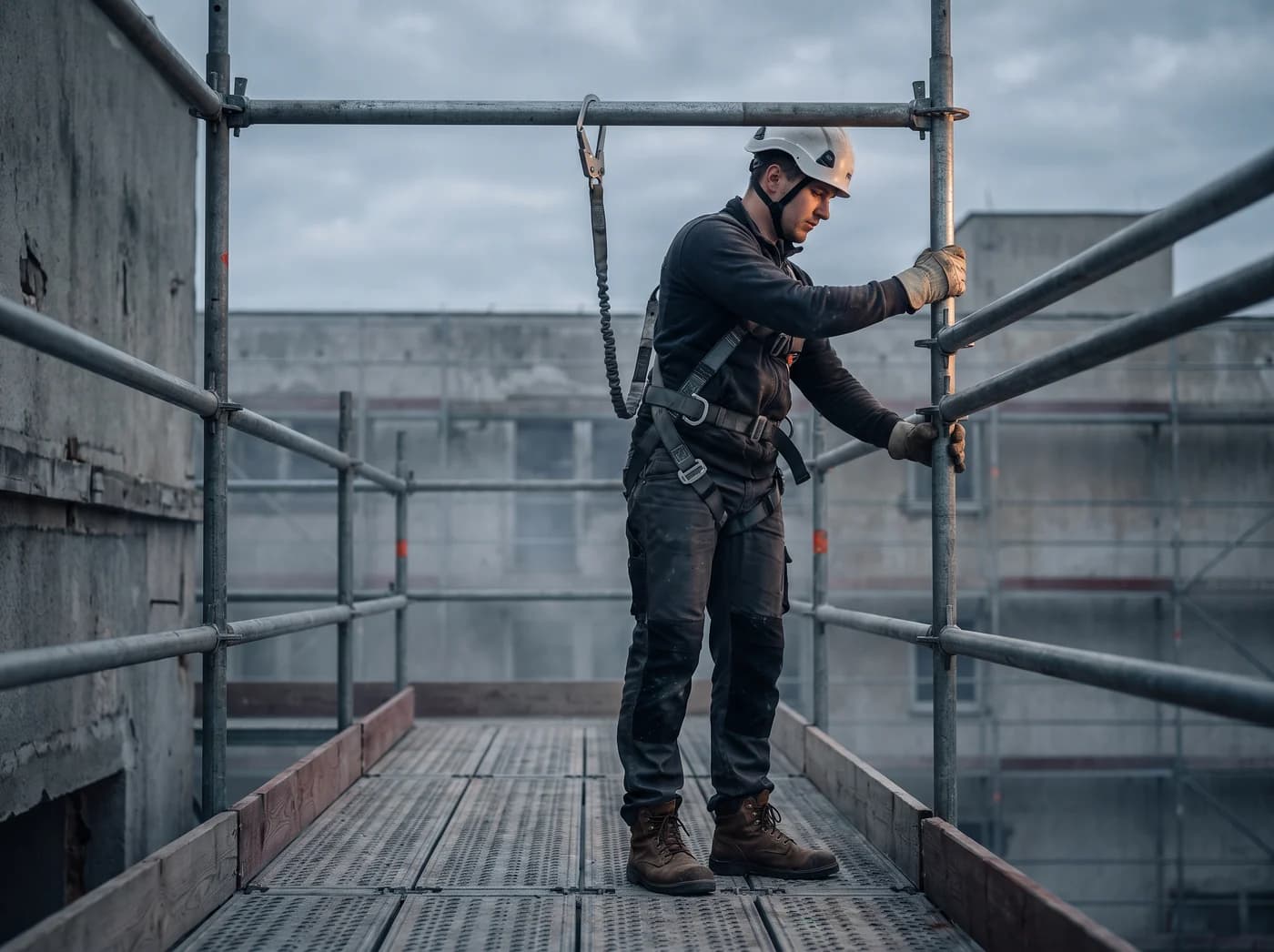
- Scaffolding and auxiliary structures — work on working platforms at height.
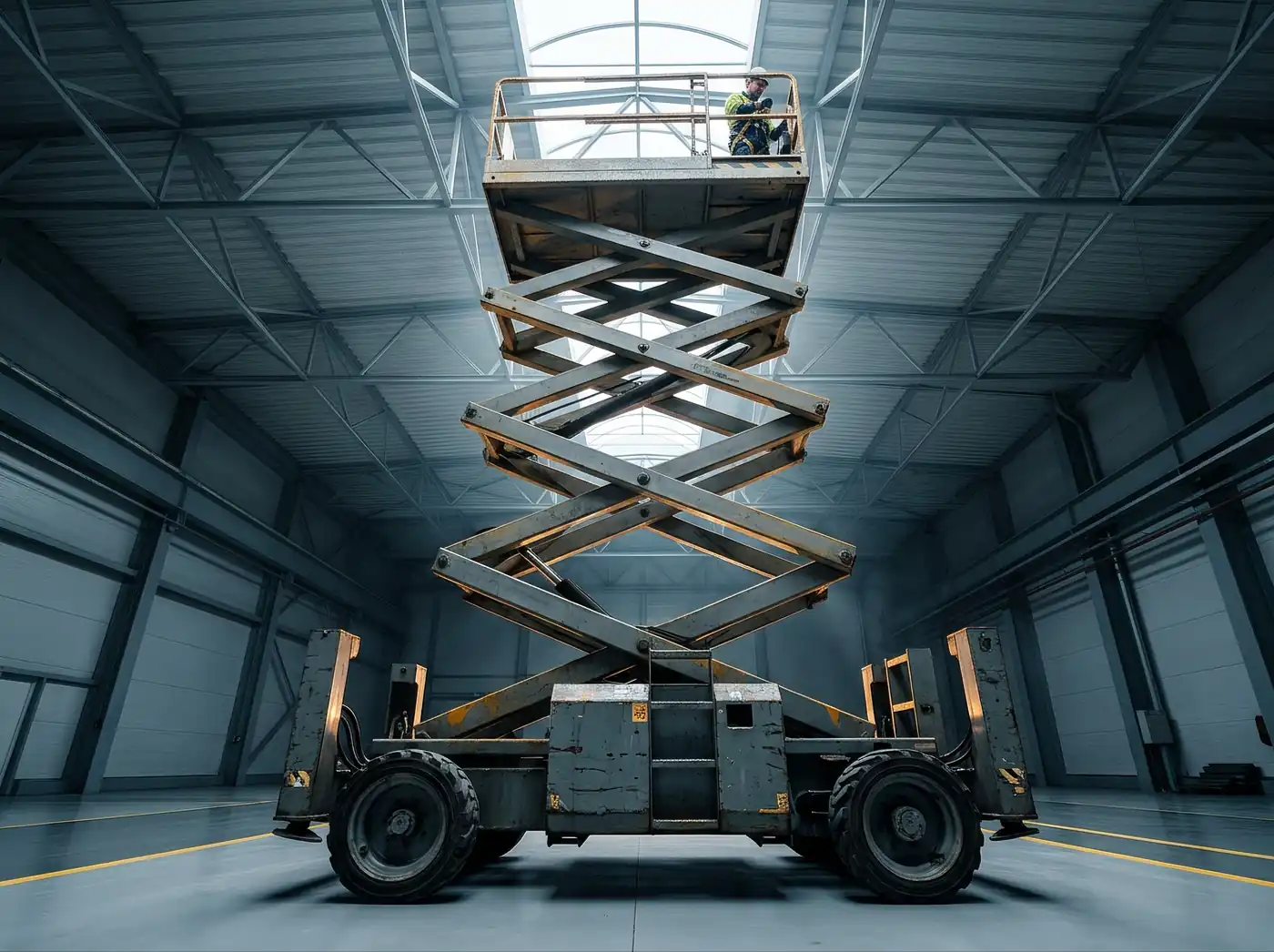
- Mobile elevating work platforms — movement and work in the basket of a platform above open depth.
- Edges of excavations, pits and tanks — risk of falling in or sliding into the depth.
Rope access and climbing techniques are assessed separately and are not the subject of this training. The aim of the training is to ensure that employees at each of these types of work recognise where they are at risk of falling and know how to protect themselves correctly.
Who the training is for
The training is aimed at the employer, who is legally required to familiarise employees working at height and above open depth, as well as at the employee, who carries out such work and needs to know how to protect themselves.
For the company and employer
Under § 7 of Act No. 124/2006 Coll. the employer is required to regularly, comprehensibly and demonstrably familiarise every employee with the regulations on ensuring occupational safety and health and with the risks of their work. For work at height and above open depth this familiarisation is specified by Decree No. 147/2013 Coll. You must be able to present the familiarisation record during a labour inspectorate inspection.
For the employee
Work on a roof, ladder, scaffolding or at the edge of an excavation is among higher-risk work. An employee who can identify fall risks and correctly use fall-protection equipment significantly reduces the probability of serious injury. The training gives them practical confidence in their everyday work.
When the training is mandatory and how often it is repeated
Familiarisation is conducted before an employee is assigned to work at height and above open depth and is then repeated regularly. The frequency for this work is set separately in the decree governing it.
Under § 3 ods. 1 of Decree No. 147/2013 Coll. employee familiarisation is repeated at least once every 12 months. This interval must not be confused with the three-year refresher familiarisation cycle that § 7 ods. 5 of Act No. 124/2006 Coll. sets for other employee familiarisations — for work at height and above open depth the stricter annual interval applies.
Common misconception — 12 months versus 3 years. For most employee familiarisations, § 7 ods. 5 of Act No. 124/2006 Coll. stipulates an interval of at least once every three years. For work at height and above open depth, however, the interval is shorter — at least once every 12 months under § 3 ods. 1 of Decree No. 147/2013 Coll. This is a special provision that takes precedence.
Fall protection — collective and personal
Protection against falling, breaking through or sliding is required at workplaces and passageways above open depth from a height of 1.5 m under Annex No. 6 item 1.1 písm. a) of Decree No. 147/2013 Coll. The method of protection must be chosen according to the nature of the work and the workplace.
Collective protection takes priority
Priority always goes to collective protection, which protects all workers regardless of their active cooperation — guardrails, protective barriers, covers and caps for openings, catch structures and safety nets. Collective means act continuously and do not depend on whether the employee has correctly put them on.
Personal fall-protection equipment
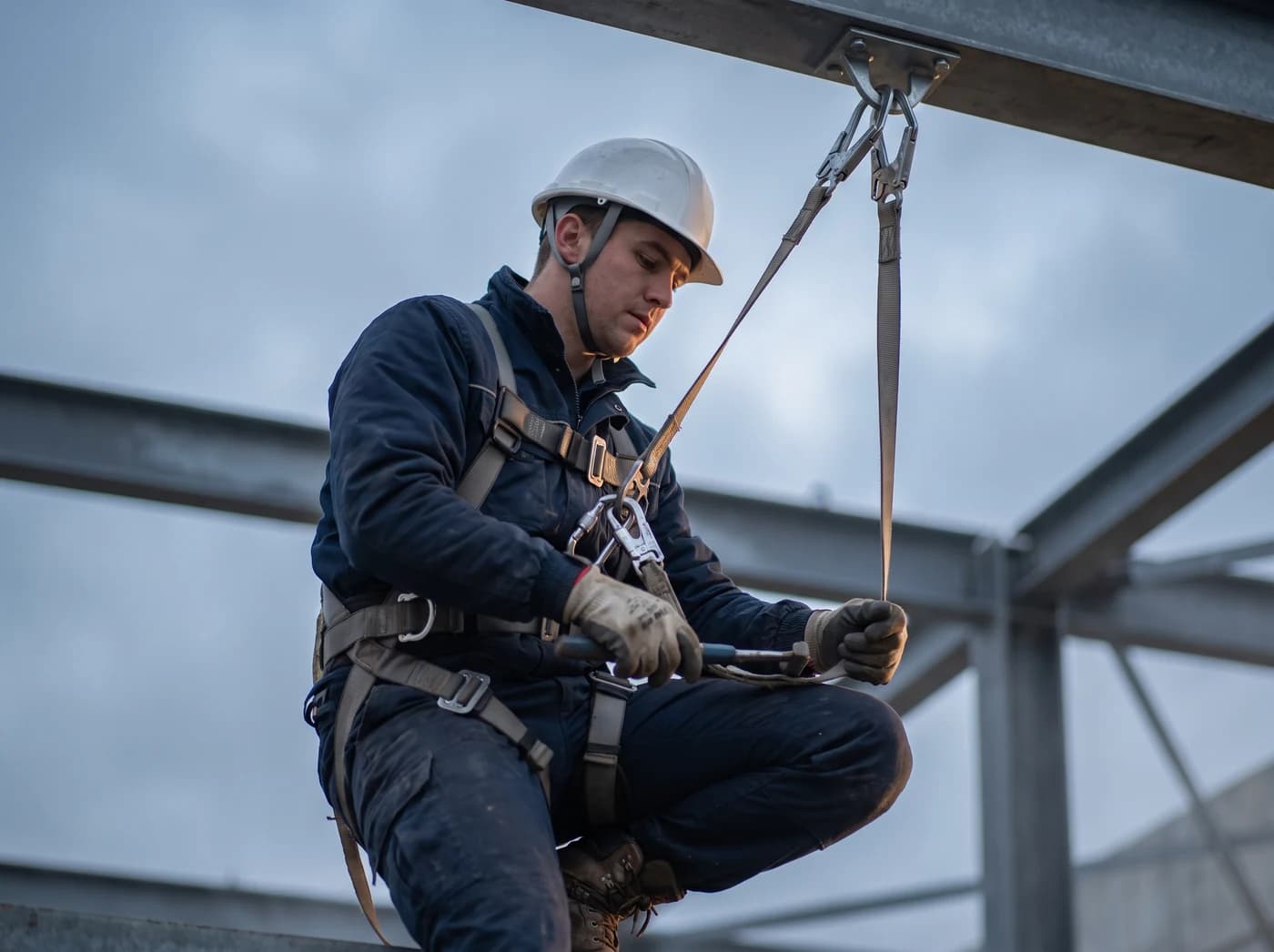
Where collective protection is not possible or is insufficient, personal protective equipment against falls is used. This includes a full-body harness, a fall-energy absorber, connecting and catching devices and anchor points. Participants learn to check these devices before use, put them on correctly and anchor them safely.
- Full-body harness — correctly fitted and fastened, with functional buckles and undamaged straps.
- Fall-energy absorber — limits the force acting on the body when arresting a fall.
- Anchor point — sufficiently strong and positioned to minimise as far as possible the length and consequences of a potential fall.
- Rescue after a fall — a prepared procedure and equipment for the rapid release of an employee caught in the harness.
Training content
The training consists of theoretical preparation and practical training. The scope and emphasis of individual topics are always adapted to the work your employees actually carry out — a roof presents different risks from scaffolding, and scaffolding from the edge of an excavation.
Theoretical part
You cover the legal framework — Decree No. 147/2013 Coll. and the familiarisation obligation under § 7 of Act No. 124/2006 Coll., the definition of work at height and above open depth (§ 2 písm. j)), the risks of falling from height and into depth, the principle of priority of collective over personal protection and the requirements for ladders, scaffolding, platforms and work near excavations. Also included is an explanation of the refresher familiarisation interval of at least once every 12 months (§ 3 ods. 1).
Practical training
The practical part focuses on personal protective equipment against falls. Participants practise the correct fitting and checking of the full-body harness, the use of the fall-energy absorber and connecting devices and the selection and checking of the anchor point. Special attention is paid to the rescue of an employee caught after a fall — why it must be rapid and what equipment and procedure must be prepared in advance. Practical training is delivered in person.
Work near excavations and above open depth
The term 'above open depth' also covers work at the edges of excavations, pits and tanks. Earthworks and excavations are governed by § 10 and Annex No. 2 of Decree No. 147/2013 Coll., which lay down requirements for safety during digging, securing the walls and movement around excavations.
The key requirement is securing excavation walls against collapse. Under Annex No. 2 item 5.5 of Decree No. 147/2013 Coll. the walls of manually dug excavations must be secured (for example by timbering or battered sides) from a depth of more than 1.3 m in built-up areas and more than 1.5 m in non-built-up areas.
The training therefore covers not only work high above the ground, but also safe movement at the edges of excavations, pits and tanks, the risk of wall collapse and burial and the risk of a person falling into an opening or depth. For earthworks, in addition to securing the walls, thought must also be given to safe edges of the excavation, preventing the fall of material onto workers inside and to safe descent into and ascent from the excavation.
Precisely because 'above open depth' is not only a roof or scaffolding but every deeper excavation, pit or tank, it is important for employees to know the hazardous locations at their workplace and to know when there is already a risk of falling or sliding into the depth.
How the training works — procedure
The entire process is led by our team — from the first contact through to the drawing up of the familiarisation record in five steps.
Enquiry You contact us by phone or email and provide the basic details — the number of participants, the type of work (roofs, ladders, scaffolding, platforms, excavations) and the location where you need the training.
Assessment and scheduling Together we assess what types of work at height and above open depth your employees actually carry out and we tailor the scope of training accordingly. We agree a convenient date and format — theory in person or online and practical training in person.
Theoretical preparation The instructor covers the legal framework (Decree No. 147/2013 Coll. and § 7 of Act No. 124/2006 Coll.), the risks of falling from height and into depth, collective and personal fall protection and safe procedures for the specific types of work at your company.
Practical training in fall-protection PPE Participants practise in person the correct fitting and checking of the full-body harness, fall-energy absorber and anchor systems and are familiarised with the procedure for rescuing an employee caught after a fall.
Familiarisation record After completion we draw up a familiarisation record and notify you of the repetition interval of at least once every 12 months under § 3 ods. 1 of Decree No. 147/2013 Coll.
Licence card versus familiarisation — common misconceptions
For ordinary work at height and above open depth no licence card is issued. This is the familiarisation of employees under § 7 of Act No. 124/2006 Coll. and Decree No. 147/2013 Coll., the result of which is a familiarisation record. This training must not be confused with qualifications where a licence card for operation is issued — for example the operation of mobile elevating work platforms. Rope access and climbing techniques are assessed separately and are not the subject of this training.
Work-at-height training builds on the comprehensive OHS safety management of the company. If you need complete employee OHS training or external OHS management, see the occupational health and safety service. For work on scaffolding, the scaffolders' course is also relevant.
| Item | Value | Legal basis |
|---|---|---|
| Definition of work at height and above open depth | risk of falling, breaking through or sliding from a height or into a depth | § 2 písm. j) Decree No. 147/2013 Coll. |
| Legal title for familiarisation | employee familiarisation | § 7 of Act No. 124/2006 Coll. |
| Repetition interval | at least once every 12 months | § 3 ods. 1 Decree No. 147/2013 Coll. |
| Fall protection required from height | from 1.5 m | Annex No. 6 item 1.1 písm. a) Decree No. 147/2013 Coll. |
| Securing walls of manual excavations | from depth > 1.3 m (built-up) / > 1.5 m (non-built-up) | Annex No. 2 item 5.5 Decree No. 147/2013 Coll. |
| Earthworks and excavations | safety requirements at excavations | § 10 and Annex No. 2 Decree No. 147/2013 Coll. |
| Document after training | familiarisation record (no licence card) | § 7 of Act No. 124/2006 Coll. |
What work-at-height training includes
Legal basis
Decree No. 147/2013 Coll. and § 7 of Act No. 124/2006 Coll. — familiarisation before first assignment and at least once every 12 months thereafter.
Interval
At least once every 12 months under § 3 ods. 1 of Decree No. 147/2013 Coll. — stricter than general OHS familiarisation (3 years).
Fall protection
Required from 1.5 m (Annex No. 6 item 1.1 písm. a)). Priority: collective protection (guardrails, barriers); personal PPE where collective protection is not possible.
Theory content
Definition of work at height and above open depth, fall risks, collective and personal protection, ladders, scaffolding, excavations, securing walls from depth > 1.3/1.5 m.
Practical training
Fitting and checking the full-body harness, fall-energy absorber and anchor point; procedure for rescuing an employee caught after a fall.
Document issued
Written familiarisation record — no licence card is issued for ordinary work at height.
Why choose Alpha Safety?
- Practical training in fall-protection PPE in person
- Correct 12-month interval per Decree No. 147/2013 Coll.
- Content tailored to actual work types (roofs, scaffolding, excavations)
- Training throughout Slovakia
- Complete documentation — familiarisation records
Duration
1 hour
Format
Online and in-person
Related courses
Short answer
Work-at-height and above-open-depth training is employee familiarisation under § 7 of Act No. 124/2006 Coll. and Decree No. 147/2013 Coll. It must be repeated at least once every 12 months — a stricter interval than general OHS training. No licence card is issued — the result is a familiarisation record.
Časté otázky – Work at height training
Under § 3 ods. 1 of Decree No. 147/2013 Coll., employee familiarisation for work at height and above open depth must be repeated at least once every 12 months. This is a stricter interval than general OHS familiarisation (3 years under § 7 ods. 5 of Act No. 124/2006 Coll.) — the 12-month interval is a special provision that takes precedence.
Under Annex No. 6 item 1.1 písm. a) of Decree No. 147/2013 Coll., protection against falling, breaking through or sliding is required at workplaces and passageways above open depth from a height of 1.5 m. The protection must be primarily collective (guardrails, barriers) — personal fall-protection PPE is used where collective protection is not possible or is insufficient.
Both terms are defined in § 2 písm. j) of Decree No. 147/2013 Coll. as work in which an employee is exposed to the risk of falling, breaking through or sliding from a height or into a depth. 'At height' refers to work above the level of the working surface (roofs, scaffolding, ladders), 'above open depth' to work near openings and edges where there is a risk of falling in — excavations, pits, tanks, shafts and similar. Both types of work are subject to the same familiarisation obligation and the same interval.
No. For ordinary work at height and above open depth, employee familiarisation is conducted and a written familiarisation record is issued. No licence card is issued. A licence card is required only for specific equipment — for example the operation of a mobile elevating work platform (pohyblive-plosiny) has a separate course with a licence card.
Under Annex No. 2 item 5.5 of Decree No. 147/2013 Coll., the walls of manually dug excavations must be secured from a depth of more than 1.3 m in built-up areas and from more than 1.5 m in non-built-up areas. Work-at-height training therefore also covers safe procedures at excavations and the risk of wall collapse and burial.
The theoretical part covers the legal framework (Decree No. 147/2013 Coll. and § 7 of Act No. 124/2006 Coll.), the definition of work at height and above open depth, fall risks, collective and personal protection and the 12-month interval. The practical part trains the correct fitting and checking of the full-body harness, fall-energy absorber and anchor point, and the procedure for rescuing an employee caught after a fall.
Yes. We deliver both the theoretical and practical parts at your company. The practical training in personal fall-protection equipment is always in person — ideally at your actual workplace so that employees learn to identify fall risks in their real work environment. Contact us with the number of employees and the types of work they carry out.
Basic course from 19,90 € per person (prices exclude VAT). We confirm the exact price based on the number of participants and the training format.
Interested in work-at-height training?
Contact us and we will schedule training directly at your company.