Reserved Technical Equipment (VTZ): a Complete Guide
What reserved technical equipment is, how it is divided into groups A and B, what the intervals for professional inspections and tests are, who may carry out inspections and what fines apply under Decree No. 508/2009 Coll.
What Are Reserved Technical Equipment (VTZ)?
Reserved technical equipment (VTZ) are technical devices that in operation present an elevated risk to the safety and health of people or to property, and for this reason the state imposes a special supervisory regime on them. The primary legislation is Decree No. 508/2009 Coll., which lays down the details for ensuring safety and health at work with pressure, lifting, electrical and gas technical equipment and which designates the technical equipment classified as reserved technical equipment. The Decree is an implementing regulation to Act No. 124/2006 Coll. on occupational health and safety (BOZP). Under § 2 ods. 1 of Decree No. 508/2009 Coll., the Decree applies to pressure, lifting, electrical and gas technical equipment and their components. These four types of equipment form the basic classification. It does not, however, apply to technical equipment that are designated products until they are placed on the market or put into service (§ 2 ods. 2) — the VTZ regime therefore begins only at the operational phase.
Key is the classification by degree of risk. Under § 4 ods. 1 of the Decree, types of technical equipment are divided into group A (equipment with a high degree of risk), group B (higher degree of risk) and group C (lower degree of risk). The decisive provision for understanding the concept of VTZ is § 4 ods. 2: reserved technical equipment means technical equipment of group A and technical equipment of group B. Group C equipment therefore does not fall within the VTZ category — general maintenance and inspection obligations apply to it under the accompanying documentation and technical standards, but not the special VTZ regime. The specific classification of all equipment into groups is contained in Annex 1 of the Decree. The reason for the categorisation is proportionality. A high-output steam boiler, a passenger lift or a high-voltage switchgear can, in the event of a fault, cause fatal injuries or extensive damage, whereas a small appliance does not present such a risk. Accordingly, for group A — the highest-risk equipment — the strictest supervision is required, including official tests carried out by an authorised legal entity, whereas for group B a professional inspection and test by an inspection technician is generally sufficient.
The operator bears the obligations associated with VTZ. Under § 8 of the Decree, the operator means an employer, a natural person who is a business operator and not an employer, and other persons who use technical equipment in carrying out their activities. It therefore does not matter whether the company owns the equipment or leases it — the obligation to ensure a safe condition rests with whoever actually uses the equipment. In the case of residential buildings, the obligations of the employer are fulfilled by the owners' association or the building manager. The Decree must be read together with Act No. 124/2006 Coll. Under § 9 ods. 1 of that Act, the employer is obliged to continuously monitor the safety condition of technical equipment and, at intervals determined by special regulations, to arrange official tests, professional inspections and professional tests of VTZ. Decree No. 508/2009 Coll. is precisely the special regulation that specifies those intervals. Since its adoption it has been amended by Decree No. 435/2012 Coll., Decree No. 398/2013 Coll. and Decree No. 234/2014 Coll.; after the amendment effective from 1 September 2014 no further amendment has followed, and the consolidated text from 2014 remains in force in 2026.
The Four VTZ Groups in Detail
The Decree divides technical equipment into four categories by type, further subdividing each into groups A, B and C. The overview is based on Annex 1 of Decree No. 508/2009 Coll., which has four parts.
Pressure equipment
Pressure equipment operates under overpressure or with media that in the event of a fault may cause an explosion, scalding or the release of hazardous substances. Group A includes, for example, steam and liquid boilers divided into classes I. to IV. by output, fixed pressure vessels with higher parameters, pressure vessels for gas transport (tankers) and pipelines for the distribution of hazardous liquid above set limits. Group B includes, for example, steam-generating equipment with lower parameters (class V.), fixed pressure vessels with lower values, pressurised cylinders and drums and safety accessories. Typical practical examples are compressor air tanks, expansion vessels in heating systems, steam and hot-water boilers and pressure vessels for production lines.
Lifting equipment
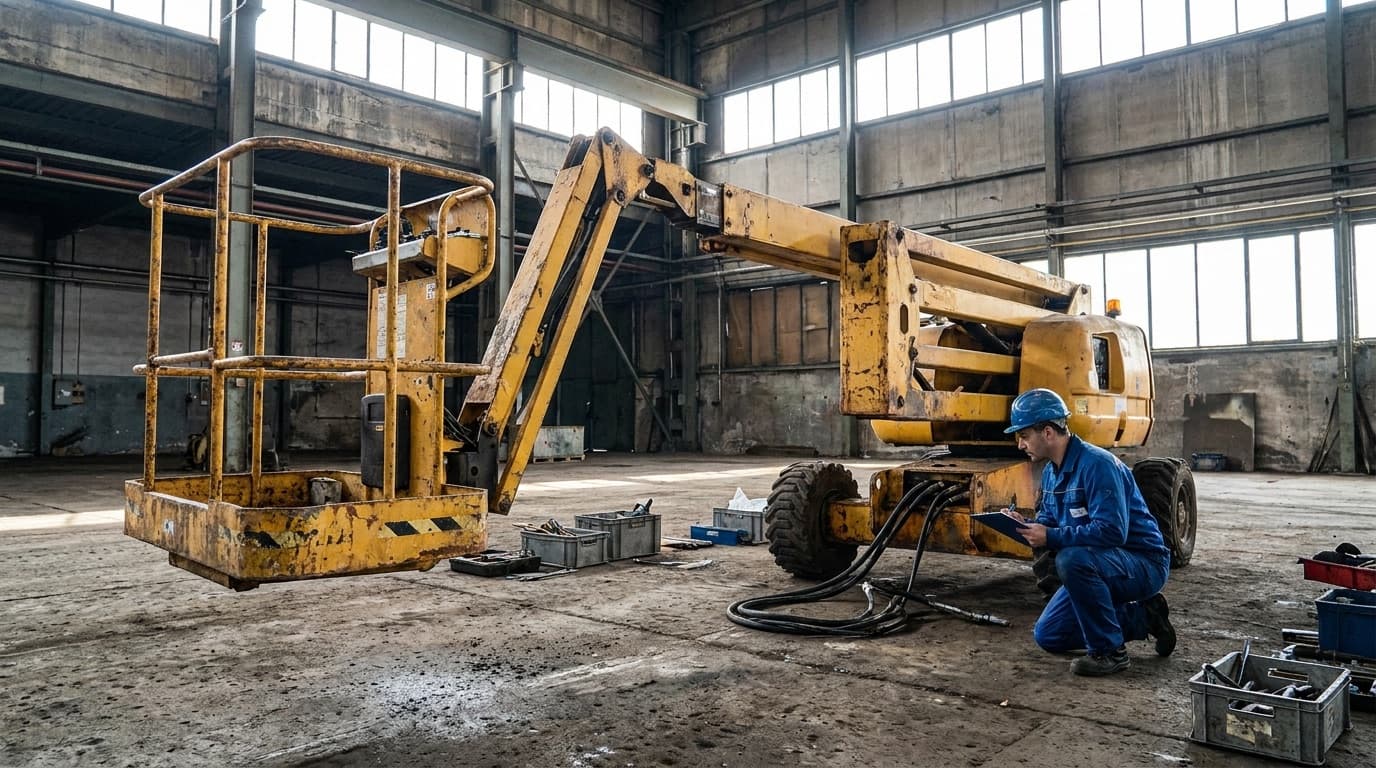
Lifting equipment is used to raise and move loads or persons, and the risk lies primarily in the fall of a load or the failure of a supporting structure. Group A includes, for example, motor-driven cranes and hoists with a lifting capacity above 1,000 kg including crane runways, mobile elevating work platforms with a lifting height above 1.5 m, lifts and lifting platforms permanently attached to a building (particularly passenger and goods lifts carrying persons), construction hoists, rack stackers with operator workstations, escalators and moving walkways, ski tows and technical amusement devices (carousels, roller coasters). Group B includes, for example, cranes and hoists with a lifting capacity up to and including 1,000 kg, lifting mechanisms of transport trucks, vehicle service lifts and vertical lifting platforms for persons with reduced mobility. Group C includes, for example, lifting accessories (ropes, chains, straps, hooks).
Electrical equipment
Electrical equipment presents the risk of electric shock, fire and explosion. Group A includes, for example, electricity-generating equipment with a capacity of 3 MW and above, electricity-converting equipment with an input of 250 kVA and above, AC electrical networks above 1,000 V or DC above 1,500 V, electrical installations in environments with fire or explosion hazard, installations in rooms used for medical purposes and installations in buildings intended for the assembly of more than 250 persons. Group B is defined residually — it includes standard building electrical installations and most lightning protection systems. For VTZ electrical equipment there is a specific requirement: an expert opinion on the documentation is required only for group A equipment (§ 5 ods. 3 of Decree No. 508/2009 Coll.).
Gas equipment
Gas equipment operates with hazardous gases and the risks lie in explosion, poisoning or asphyxiation. Group A includes, for example, gas production equipment with a capacity above 10 Nm³/h, gas storage with a volume above 100 m³, filling of pressure vessels, pressure stations, raising and lowering gas pressure above 0.4 MPa, gas distribution at a pressure above 0.4 MPa and acetylene pipelines, consumption of gas by combustion with a capacity above 0.5 MW and refrigeration with a gas quantity above 25 kg. Group B includes similar equipment with lower parameters — for example, gas distribution up to 0.4 MPa, consumption of gas by combustion from 5 kW to 0.5 MW (which covers most gas boiler houses) and refrigeration with a gas quantity from 3 to 25 kg. Typical examples are gas boiler houses, gas pressure-regulating stations, natural-gas pipelines in buildings and refrigeration circuits.
It is precisely the classification into group A or B that determines whether only a person with a valid licence card may operate the equipment, or only a person with a certificate may carry out repairs, or whether a written confirmation from an inspection technician suffices. Correct classification of equipment into the appropriate group is therefore the first and most important step when drawing up an inspection plan.
Professional Inspections and Tests (OPaOS)
In everyday speech people refer to 'revisions', but the Decree uses the more precise term professional inspection and professional test (abbreviated OPaOS). Under § 13 ods. 1 of Decree No. 508/2009 Coll., a professional inspection and test monitors the safety condition of VTZ after the completion of manufacture, assembly or installation at the future place of operation, reconstruction and repair, and during its operation. OPaOS is carried out within the scope and at the intervals set out in Annexes 5 to 10 and in accordance with safety and technical requirements. What is the difference between an inspection and a test? A professional inspection is a visual and functional check — the inspection technician assesses the condition of the equipment by inspection, measurement and verification of the functionality of safety elements. A professional test is more thorough and usually subjects the equipment to stress (for example, a pressure test of a pressure vessel at a higher pressure or a load test of a crane). A test is therefore carried out at longer intervals than an inspection. For pressure equipment, a distinction is made between an external inspection, an internal inspection and a pressure test; for electrical equipment, OPaOS also relies on STN technical standards.
The second important distinction is between the initial and the periodic (repeat) OPaOS. The initial OPaOS is carried out before the equipment is first put into service — after manufacture, assembly or installation at the future place of operation — and its report is retained for the entire service life of the equipment. The periodic OPaOS is carried out during operation at regular intervals in accordance with the Decree's annexes, and its purpose is to detect wear, ageing and damage. In addition, there is the extraordinary OPaOS — under § 9 ods. 2 písm. c) of the Decree, a safety condition inspection is carried out, for example, before re-commissioning after a shutdown of more than one year, after disassembly and re-assembly, after reconstruction and repair, and if use of the equipment was prohibited by a labour inspector. For group A equipment, an official test and a repeat official test under § 12 of Decree No. 508/2009 Coll. come into play. An official test is carried out before commissioning on VTZ of group A and on selected gas equipment. A repeat official test is carried out at the intervals set out in Annexes 5, 7 and 10, and for electrical equipment at most every ten years of operation (§ 12 ods. 2). An official test and a repeat official test are carried out exclusively by an authorised legal entity, not by an independent inspection technician. Under § 13 ods. 2, an official or repeat official test replaces the professional inspection and test if it was carried out within the same interval.
After carrying out an OPaOS, the inspection technician prepares a report. Under § 16 ods. 2 of the Decree, it must contain, among other things, the name and registered office of the operator, the date of carrying out, the certificate number of the inspection technician, the type of OPaOS, the designation and parameters of the equipment, measurement data, deficiencies identified and their severity, an overall assessment of the equipment's fitness for continued operation and proposed measures for remedying the deficiencies. This report is the key document during a labour inspectorate inspection.
What Are the Intervals for Professional Inspections and Tests?
Intervals are among the most frequently sought information but are also the most complex — the precise intervals are not in the text of the paragraphs but in Annexes 5 to 10 of Decree No. 508/2009 Coll., where they are presented in the form of extensive tables by group and type of specific equipment. When determining an interval, the rule always applies that if the manufacturer's technical conditions specify a shorter interval, that shorter one applies. For electrical installations, under Annex 8 the shorter interval of two tables is used — by type of building and by classification of external influences. The following table gives an indicative overview of the most common intervals for periodic OPaOS during operation. These are always the latest permissible deadlines — a specific piece of equipment may have a shorter interval according to the manufacturer's instructions or external influences.
| Equipment type | Professional inspection | Professional test / pressure test | Repeat official test |
|---|---|---|---|
| Electrical installation — brick residential and office building | 5 years | — | — |
| Electrical installation — school, nursery, hotel, accommodation | 3 years | — | — |
| Electrical installation — buildings for more than 250 persons, high-rise buildings | 2 years | — | — |
| Electrical installation — temporary (construction site) | 0.5 years | — | — |
| Lightning protection — protection level I and II | 2 years | — | — |
| Lightning protection — protection level III and IV | 4 years | — | — |
| Lightning protection — building with explosion hazard zone | 1 year | — | — |
| Fixed pressure vessel (group A) | external 1 year | internal 5 years / pressure 10 years | 10 years |
| Steam/liquid boiler (group A) | external 6 months / internal 1 year | pressure 6 years | 6 years |
| Crane on a permanent crane runway (group A) | 1 year | 2 years | 10 years |
| Passenger/goods lift carrying persons (group A) | 3 months | 3 years | 6 years |
| Gas appliance 5 kW – 0.5 MW (group B) | 1 year | 3 years | not required |
| Gas pipeline distribution (group B) | 3 years | 6 years | not required |
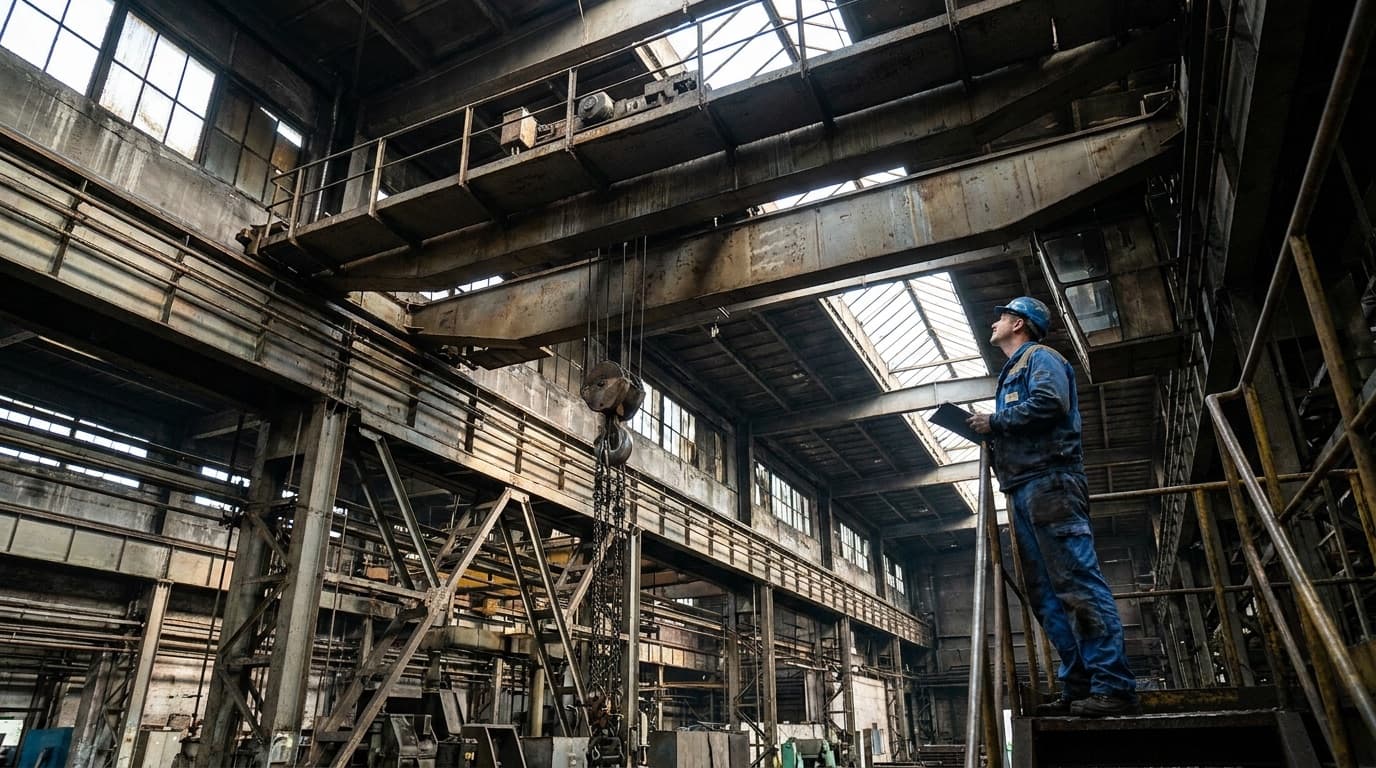
Most cranes run on a permanent crane runway, which is part of the group A equipment. Under note 4 of Annex 7, a permanent crane runway — together with construction, mobile, cable, loading and railway cranes and cranes in hot or aggressive environments — has a professional inspection every year and a professional test every 2 years, so an overhead crane in a hall is inspected annually. The base interval of 2 years / 4 years applies only to a crane without a permanent runway, which is rare in practice.
For electrical installations, the intervals are determined by Annex 8 of the Decree — for brick residential and office buildings 5 years, for schools, nurseries, crèches and accommodation facilities 3 years, for buildings for the assembly of more than 250 persons or high-rise buildings 2 years and for temporary installations on construction sites 0.5 years. For lightning protection systems, the interval for protection level I and II is 2 years, for levels III and IV 4 years and for buildings with an explosion hazard zone 1 year.
For pressure equipment (Annex 5), for a fixed pressure vessel of group A the external inspection is carried out once a year, the internal inspection once every 5 years and the pressure test once every 10 years, and the repeat official test is carried out by an authorised legal entity every 10 years. For steam boilers of group A the intervals are stricter — external inspection once every 6 months, internal inspection once a year and both the pressure test and the repeat official test every 6 years. For gas equipment (Annex 10), for an appliance with a capacity of 5 kW to 0.5 MW a professional inspection is carried out every year and a professional test every 3 years; for gas pipeline distribution, inspection every 3 years and test every 6 years. Given the complexity of the tables and the number of exceptions, we recommend verifying the specific interval for a given piece of equipment directly in the relevant annex of the Decree, or having an inspection plan drawn up by an expert. For electrical installations, the rule also applies that the shorter of the intervals by type of building and by external influences is always binding, so the actual interval may be shorter than the indicative overview shows.
Obligations of the Operator and Employer
The obligations of the operator are set out primarily in § 8 of Decree No. 508/2009 Coll. The operator ensures the safety of the technical equipment if, during its operation, it complies with safety and technical requirements and at the same time fulfils four basic obligations.
- Maintains the accompanying technical documentation of the technical equipment, including records of inspections, checks and tests carried out (§ 8 písm. a)). Documentation under § 6 and Annex 3 contains data on the manufacturer, instructions for operation, maintenance and testing, requirements for the professional competence of the operator and acceptance documents (passport or inspection book, attestations, certificates).
- Maintains a register of the reserved technical equipment with data according to Annex 4 corresponding to the actual state (§ 8 písm. b)). The register contains the name and type designation, manufacturer, serial number, year of manufacture, location and technical parameters. It is the first thing a labour inspectorate inspector typically requests.
- Issues a local operating regulation for the operation of VTZ of group A if the technical documentation does not reflect the actual operating conditions (§ 8 písm. c)).
- Ensures that a safety condition inspection is carried out under § 9 (§ 8 písm. d)) — i.e., timely professional inspections, professional tests and official tests within the prescribed intervals.
A particular and frequently underestimated obligation is the remedying of identified deficiencies. Carrying out the inspection alone is not enough — the operator is obliged to remedy the identified deficiencies. If the inspection technician states in the report that the equipment poses an immediate threat to life and health, it recommends that it be taken out of service (§ 16 ods. 2 písm. i)) and the operator must take it out of service. Before the start of the inspection, the operator is obliged to prepare the equipment for inspection and to ensure the necessary protective measures (§ 9 ods. 3) — for example, to provide access to the switchgear, to disconnect the power supply or to ensure degassing. These obligations are supplemented by the general obligation under Act No. 124/2006 Coll. — under § 6 the employer is obliged to ensure safety and health at work (BOZP) and under § 9 to continuously monitor the safety condition of technical equipment. Documentation, records and inspection reports together form the system by which the operator demonstrates fulfilment of the statutory obligations.
How Are VTZ Operators Trained?
The safety of VTZ does not depend solely on the condition of the equipment, but also on the competence of the people operating it. Under § 17 ods. 1 of Decree No. 508/2009 Coll., only a person with a valid licence card may operate VTZ if it is a steam and liquid boiler of class I. to V., a mobile or tower boom-type crane and a mobile elevating work platform on a motor-powered chassis of group A intended for use on public roads, or a gas technical equipment of group A (with exceptions). For load slinging on group A cranes, a load slinger's licence card is required (§ 17 ods. 2). Other VTZ not listed in § 17 ods. 1 may be operated by a person who holds a written confirmation of verified professional knowledge prepared by an inspection technician (§ 17 ods. 3). A common misconception should be noted here. The written confirmation of professional competence to operate, sling loads or repair equipment not listed in § 17 ods. 1 and § 18 ods. 1 is governed by § 15 ods. 7 of Decree No. 508/2009 Coll. — not § 16 ods. 7, which does not exist at all in § 16 (Inspection technician), as § 16 of the Decree has only paragraphs 1 to 3. The obligation itself to undergo updating professional training does not arise from the Decree but from Act No. 124/2006 Coll.
Under § 16 ods. 8 of Act No. 124/2006 Coll., a natural person who holds a licence card, certificate or confirmation is obliged within five years of its issue to undergo updating professional training with a person authorised for education and training, and to undergo further updating professional training always within five years of completing the previous one. If this obligation is not fulfilled, the licence card, certificate or confirmation loses its validity (§ 16 ods. 12 písm. c)). In addition, the holder is obliged to undergo a preventive medical examination in relation to work, also on a five-year cycle (§ 16 ods. 6); the validity of the document is thus tied to the same interval as the updating professional training. For the employer this means that it must keep track not only of the intervals for inspections of equipment, but also of the validity of the licence cards and certificates of its employees and the dates of their updating professional training and medical examinations. An employee with an invalid licence card may not operate the equipment and their deployment constitutes a breach of regulations, for which a sanction is applicable.
What Fines Apply for Neglecting Obligations?
Compliance with the obligations associated with VTZ is enforced by the labour inspection on the basis of Act No. 125/2006 Coll. on labour inspection. State administration is carried out by the National Labour Inspectorate and regional labour inspectorates. A labour inspector is authorised to enter a workplace without prior notice and to inspect the safety condition of technical equipment, documentation and inspection reports. Fines are governed by § 19 of Act No. 125/2006 Coll. Under § 19 ods. 1 písm. a), the labour inspectorate may impose a fine on the employer of up to EUR 100,000 for breach of obligations arising from occupational health and safety (BOZP) regulations. If an occupational accident resulted from the breach, the Act sets minimum fines — for serious bodily harm at least EUR 20,000 and for death at least EUR 33,000. This differentiation by the consequences of the accident was introduced by Act No. 73/2021 Coll. with effect from 1 April 2021.
For carrying out activities without the required authorisation, certificate, licence card or permit, the labour inspectorate will impose under § 19 ods. 2 a fine of from EUR 300 to EUR 33,000. For serious breach of obligations, the fine ranges from EUR 1,000 to EUR 200,000, and for failure to comply with a measure imposed by a labour inspector from EUR 300 to EUR 100,000. Senior employees and statutory bodies who by their fault breached obligations or gave instructions to breach them may be fined up to four times their average monthly earnings (§ 19 ods. 1 písm. c)). Under § 20, for obstructing the exercise of labour inspection or failure to fulfil reporting obligations an order fine of from EUR 100 to EUR 1,000 may also be imposed. In addition to direct sanctions, indirect consequences also apply. If an accident occurs or damage is caused to equipment that did not have a valid inspection, the insurer may reduce or refuse the insurance payout entirely. In serious cases where the neglect of obligations led to endangerment of life or to an accident, criminal liability of the responsible persons may also come into consideration.
Most Common Mistakes in Practice
Labour inspectorate practice shows that breaches of VTZ obligations follow recurring patterns. Knowing them means knowing how to avoid them.
- Missed inspection deadline. Deadlines run objectively and exceeding them means that the equipment is operated without a valid safety verification. With a large number of pieces of equipment with different intervals, manual tracking is unreliable — a register with automatic reminders is recommended.
- Missing or incomplete documentation. If the equipment passport, operating instructions or proof of a previous inspection is missing, this constitutes a separate breach regardless of the technical condition of the equipment.
- Incorrect classification of equipment into a group. If the operator underestimates the equipment and classifies it in group C instead of B or A, it omits mandatory inspections and exposes itself to the risk of a sanction. The classification under Annex 1 must be assessed professionally.
- Failure to remedy deficiencies identified by the inspection. An inspection report stating deficiencies does not itself fulfil the obligations — the deficiencies must be remedied and the remedy documented. At the next inspection it will also be checked whether and how the deficiencies from the previous OPaOS were remedied (§ 16 ods. 2 písm. f)).
- Operating equipment by an unqualified person — an employee without a valid licence card or with a licence card whose validity has lapsed due to failure to undergo updating professional training.
- Ordering an inspection from a technician without a certificate for the relevant type and group of equipment — such an inspection is invalid and the operator is in the same position as if no inspection had been carried out.
If the VTZ agenda seems opaque, you are not alone. That is precisely why companies are increasingly entrusting inspections, records and deadline tracking to a specialist partner. If you are looking for a turn-key inspection service, read about how our reserved technical equipment service works.
Súvisiace služby a zdroje
Revízie VTZ (služba)
Zabezpečenie odborných prehliadok a skúšok tlakových, zdvíhacích, elektrických a plynových zariadení, vedenie dokumentácie a strážanie lehôt pre vašu firmu.
Bezpečnosť a ochrana zdravia pri práci
Revízie VTZ sú súčasťou kontrolnej činnosti v rámci BOZP — bezpečnosť práce a technické zariadenia pod jednou strechou.
Sprievodca BOZP
Výkladový sprievodca povinnosťami zamestnávateľa v oblasti bezpečnosti a ochrany zdravia pri práci.
Sprievodca ochranou pred požiarmi
Výkladový sprievodca povinnosťami firiem na úseku ochrany pred požiarmi podľa zákona č. 314/2001 Z. z.
Školenia a kurzy
Školenia obsluhy vyhradených technických zariadení, BOZP a ochrany pred požiarmi pre zamestnancov — prezenčne aj online.
Slovník pojmov
Výkladový slovník kľúčových pojmov z VTZ, BOZP, OPP a PZS.
Súvisiace články
Stručná odpoveď
Reserved technical equipment (VTZ) comprises pressure, lifting, electrical and gas equipment that, in operation, presents a high or higher degree of danger to life, health and property. It is defined by Decree No. 508/2009 Coll., under which group A and group B equipment is considered reserved (§ 4 ods. 2). The operator has obligations: it must keep records and documentation and ensure regular professional inspections and professional tests at the intervals set out in Annexes No. 5 to 10.
Časté otázky o vyhradených technických zariadeniach
Reserved technical equipment comprises pressure, lifting, electrical and gas equipment that, in operation, presents a high or higher degree of danger. Under § 4 ods. 2 of Decree No. 508/2009 Coll., equipment classified in group A (high degree of danger) and group B (higher degree of danger) is considered VTZ. Group C equipment is not considered reserved.
The intervals are set by Annex No. 8 to Decree No. 508/2009 Coll. For a masonry residential and office building, the interval for a professional inspection of the electrical installation is 5 years, for schools, nurseries and hotels 3 years, and for buildings for more than 250 persons 2 years. For lightning conductors the interval is 2 years (protection level I and II) or 4 years (level III and IV). The shorter of the intervals according to the type of building and the external influences is always applied.
A professional inspection and professional test of pressure vessels is carried out by an inspection technician holding a certificate for reserved pressure technical equipment (§ 16 ods. 1 of Decree No. 508/2009 Coll.). An official test and a repeated official test of group A equipment is carried out by an authorised legal person under § 14 of Act No. 124/2006 Coll. The inspection technician must hold a certificate for precisely the given type and group of equipment.
For breaching obligations in the field of safety of technical equipment, the labour inspectorate may impose on the employer a fine of up to 100,000 euros under § 19 ods. 1 písm. a) of Act No. 125/2006 Coll. If an occupational accident arises because of a missing inspection, the minimum fine is at least 20,000 euros for serious damage to health and at least 33,000 euros for a death. There is also the risk of refusal of an insurance payout and, in serious cases, criminal liability.
VTZ operating staff who hold a licence card, certificate or document are required to undergo refresher professional training every five years under § 16 ods. 8 of Act No. 124/2006 Coll. If they do not undergo it, the licence card or certificate loses its validity (§ 16 ods. 12 písm. c)). In the same five-year cycle, a work-related preventive medical examination must also be undergone (§ 16 ods. 6).
A professional inspection is a visual and functional check of the condition of the equipment and is carried out more frequently. A professional test is more thorough and usually involves loading the equipment (for example a pressure test of a pressure vessel or a load test of a crane); it is carried out at longer intervals. Together they form the professional inspection and test (OPaOS) under § 13 of Decree No. 508/2009 Coll.
An initial OPaOS is carried out before the equipment is first put into operation — after manufacture, assembly or installation. A periodic (repeated) OPaOS is carried out during operation at regular intervals under Annexes No. 5 to 10 to Decree No. 508/2009 Coll. An extraordinary OPaOS is carried out, for example, after a repair, reconstruction or a shutdown longer than one year under § 9 ods. 2 of the Decree.
Yes. Gas consumption by combustion with an output from 5 kW to 0.5 MW falls, under Part IV of Annex No. 1 to Decree No. 508/2009 Coll., into group B, that is, it is reserved gas technical equipment. Most gas boiler rooms in buildings are therefore subject to regular professional inspections and professional tests of gas equipment.
An authorised legal person is a legal person that holds, for verifying compliance with the safety requirements for technical equipment, an authorisation issued by the National Labour Inspectorate under § 14 of Act No. 124/2006 Coll. It carries out type tests, official tests and repeated official tests and issues expert opinions. It must be independent of design, construction and supply activities.
Yes. Under § 8 písm. b) of Decree No. 508/2009 Coll., the operator is obliged to keep records of the reserved technical equipment with the data under Annex No. 4, corresponding to the actual state. The records contain the name, type, manufacturer, serial number, year of manufacture, location and technical parameters of the equipment. During an inspection it is one of the first documents the labour inspector requests.
An overhead crane and most other group A cranes run on a permanent crane runway, which is part of the equipment. Under note 4 of Annex No. 7 to Decree No. 508/2009 Coll., a permanent crane runway — together with construction, mobile, cable, loading and railway cranes and cranes in hot or aggressive environments — has a professional inspection every year and a professional test every 2 years, so an overhead crane in a hall is inspected annually. The base interval of 2 years / 4 years applies only to a crane without a permanent runway. A repeated official test is carried out by an authorised legal person as a rule every 10 years; if the manufacturer's technical conditions set shorter intervals, those apply.
In an apartment building, the role of operator is performed by the association of owners of flats and non-residential premises, or the administrator. These entities are responsible for inspections of shared equipment such as lifts, lightning conductors, the shared electrical installation and gas distribution. This follows from § 8 of Decree No. 508/2009 Coll. in conjunction with the provisions of Act No. 124/2006 Coll. on the operator's obligations.
Under § 16 ods. 2 of Decree No. 508/2009 Coll., an inspection report must contain data on the operator, the date of performance, the registration number of the inspection technician's certificate, the type of OPaOS, the designation and parameters of the equipment, measurement data, the deficiencies found and their seriousness, an overall assessment of fitness for further operation and a proposal for measures to remove the deficiencies. The report is a key piece of evidence during an inspection.
Yes. The operator's obligations under § 8 of Decree No. 508/2009 Coll. also apply to a natural person who is an entrepreneur and is not an employer, if they use reserved technical equipment to perform their tasks. A sole trader must therefore ensure inspections and keep documentation and records in the same way as an employer.
If the inspection technician finds that the equipment immediately endangers life and health, they propose its removal from operation (§ 16 ods. 2 písm. i) of Decree No. 508/2009 Coll.). The operator is obliged to take such equipment out of service and remove the defect. Operating equipment with an unremoved serious defect is a breach of the regulations and increases the risk of accidents and of sanctions. Turnkey provision of inspections can be found in the VTZ service.
Need help with workplace safety?
Contact us today and get a free consultation. Our team of experts will help you find a solution tailored to your needs.