BOZP: occupational health and safety — a complete guide (2026)
A complete guide to BOZP in Slovakia: what BOZP is, employer's obligations, legislation (Act No. 124/2006 Coll.), categorisation of work, documentation, training, OOPP, occupational accidents, coordinator and labour inspection fines.
What BOZP (occupational health and safety) is and its purpose
BOZP (occupational health and safety) is not a one-off administrative task but an ongoing system of prevention. Act No. 124/2006 Coll., in its § 1, establishes the general principles of prevention and the basic conditions for ensuring occupational health and safety and for eliminating the risks and factors that give rise to occupational accidents, occupational diseases and other work-related health damage. That is the very purpose of the entire field: not to react to accidents, but to prevent them.
In practice, BOZP divides into two connected dimensions. Work safety focuses on the technical and organisational side — safe machinery, workplaces, procedures and equipment that prevent accidents. Health protection focuses on the impact of workplace environment factors on employees' health, such as noise, dust, chemical substances or physical strain that can cause occupational disease. Both dimensions form a single whole, because a safe workplace must also be a healthy workplace.
The obligation to ensure BOZP does not arise solely from Act No. 124/2006 Coll. Its foundation is also laid by the Labour Code. Under § 147 ods. 1 of Act No. 311/2001 Coll. the employer is required, within the scope of its authority, to continuously ensure the safety and health protection of employees at work and to take the necessary measures including prevention. Under § 146 ods. 2 of Act No. 311/2001 Coll. care for the safety and health of employees is an equal and inseparable part of planning and carrying out work tasks. BOZP is therefore not an add-on that can be omitted, but a part of the normal running of a company.
BOZP vs. labour protection vs. PZS
These three concepts are often confused in practice, although they are not identical. Labour protection is the broadest term. Under § 146 ods. 1 of Act No. 311/2001 Coll. it is a system of measures arising from legal, organisational, technical, medical and social measures that create working conditions ensuring occupational health and safety. BOZP is the core of this system and is governed in detail by the separate Act No. 124/2006 Coll.
The occupational health service (PZS) is a separate institution that addresses the health dimension of labour protection. It is regulated by Act No. 355/2007 Coll. and under its § 30a ods. 1 it carries out health surveillance for employees and provides the employer with expert and advisory services in fulfilling its obligations in the field of health protection and promotion at work. In simple terms: BOZP covers safety and overall prevention, while PZS specialises in health surveillance and health-risk assessment. More about the scope of health surveillance can be found on the occupational health service page.
Legislative framework of BOZP in Slovakia
Occupational health and safety in Slovakia does not rest on a single act but on a set of mutually interconnected regulations. The cornerstone is Act No. 124/2006 Coll. on occupational health and safety. Under § 1 of Act No. 124/2006 Coll. this act establishes the general principles of prevention and the basic conditions for ensuring occupational health and safety and for eliminating risks and factors giving rise to occupational accidents, occupational diseases and other work-related health damage.
This act is complemented by the Labour Code and a range of specific regulations and implementing government regulations. The European foundation for the entire field is Council Directive 89/391/EEC on the introduction of measures to encourage improvements in the safety and health of workers at work, which underlies the Slovak framework.
Overview of key regulations:
| Regulation | What it governs |
|---|---|
| Act No. 124/2006 Coll. | General principles of prevention and basic obligations for ensuring BOZP; risk assessment, instruction, safety service |
| Act No. 125/2006 Coll. | Labour inspection, inspector's powers and fines for breach of regulations |
| Act No. 355/2007 Coll. | Health protection at work, categorisation of work and occupational health service |
| Act No. 311/2001 Coll. (Labour Code) | Labour protection as a system of measures and the employer's liability for damage in an occupational accident |
| Act No. 314/2001 Coll. | Fire protection including fire-protection training |
| Government Regulation No. 391/2006 Coll. | Minimum safety and health requirements for workplaces |
| Government Regulation No. 395/2006 Coll. | Personal protective equipment (OOPP) |
| Government Regulation No. 396/2006 Coll. | Construction-site safety and the safety coordinator |
| Decree No. 508/2009 Coll. | Reserved technical equipment and its professional inspections and tests |
| Decree No. 448/2007 Coll. | Work factors in relation to the categorisation of work from the perspective of health risks |
These regulations complement each other. Act No. 124/2006 Coll. lays down the employer's obligations, Act No. 355/2007 Coll. deals with the health aspect of work, the Labour Code in § 147 ods. 1 places on the employer the obligation to continuously ensure the safety and health protection of employees at work, and the implementing government regulations and decrees set out the technical and hygienic details.
Amendments in force in 2025–2026
BOZP regulations are continuously amended, so it is important always to rely on the current consolidated text published on slov-lex.sk, not on unverified secondary sources.
The most significant change in recent times affected the institution of the authorised safety technician. By an amendment to Act No. 124/2006 Coll. effective from 1 January 2023, this institution was abolished. Under the transitional provision in § 39k ods. 3 of Act No. 124/2006 Coll., a natural person holding a valid certificate of an authorised safety technician issued before 1 January 2023 is treated as a natural person holding a certificate of a safety technician. In the practice of the Alpha Safety team we therefore encounter questions about whether older certificates are still valid. Yes, they are — just under the new designation.
We recommend caution regarding other proposed changes. Claims circulate in the media about planned amendments to fines or new obligations that are not yet part of the law in force. Until such changes have completed the legislative process and entered into force, they are not binding on employers. Therefore always verify the actual state of your obligations in the effective text of the regulations at slov-lex.sk, or consult a BOZP specialist.
Employer's BOZP obligations step by step
The employer has precisely defined legal obligations towards employees in the area of BOZP. Under § 6 ods. 8 of Act No. 124/2006 Coll. these duties must be carried out by line managers at every level of management and are an equal and inseparable part of their work obligations. The costs of ensuring BOZP are borne under § 6 ods. 11 of Act No. 124/2006 Coll. by the employer, who must not pass them on to the employee. The following steps form the foundation of a functioning BOZP system within a company.
Assess the risks and draw up a written document. Under § 6 ods. 1 písm. c) of Act No. 124/2006 Coll. the employer is required to identify hazards and threats, assess the risk and draw up a written risk-assessment document for every activity performed by employees. This document is the starting point for all further measures and determines what risks exist at the workplaces and how to reduce them.
Arrange a safety service (BTS). The BTS provides the employer with expert, methodical, organisational and supervisory advisory services in BOZP (occupational health and safety) matters, and its duties are carried out by a safety technician. If the company does not have its own qualified employees, it may contract the safety service from a provider holding an authorisation issued by the National Labour Inspectorate (NIP) (§ 21 of Act No. 124/2006 Coll.).
Arrange an occupational health service (PZS). The employer is required in cooperation with the occupational health service to carry out a health-risk assessment and categorisation of work pursuant to § 30 of Act No. 355/2007 Coll. The PZS (occupational health service) carries out health surveillance for employees and provides the employer with expert and advisory services (§ 30a of Act No. 355/2007 Coll.).
Identify and provide OOPP free of charge. Where the protection of life or health requires it, the employer is required under § 6 ods. 2 písm. b) of Act No. 124/2006 Coll. to provide employees free of charge with effective personal protective equipment (OOPP) and to keep records of its provision. The selection of OOPP is based on the results of the risk assessment.
Train and instruct employees. The employer must instruct employees on safety rules and safe working practices. Refresher instruction must be carried out under § 7 ods. 5 of Act No. 124/2006 Coll. at least once every three years, unless legislation provides for a shorter interval. The company's internal regulation sets the frequency and scope of instruction.
Maintain BOZP documentation. Continuous monitoring and enforcement of compliance with BOZP regulations is the employer's obligation under § 9 ods. 1 of Act No. 124/2006 Coll. Documentation evidences compliance with obligations during an inspection and includes in particular the risk assessment, records of instruction, OOPP register and inspection records.
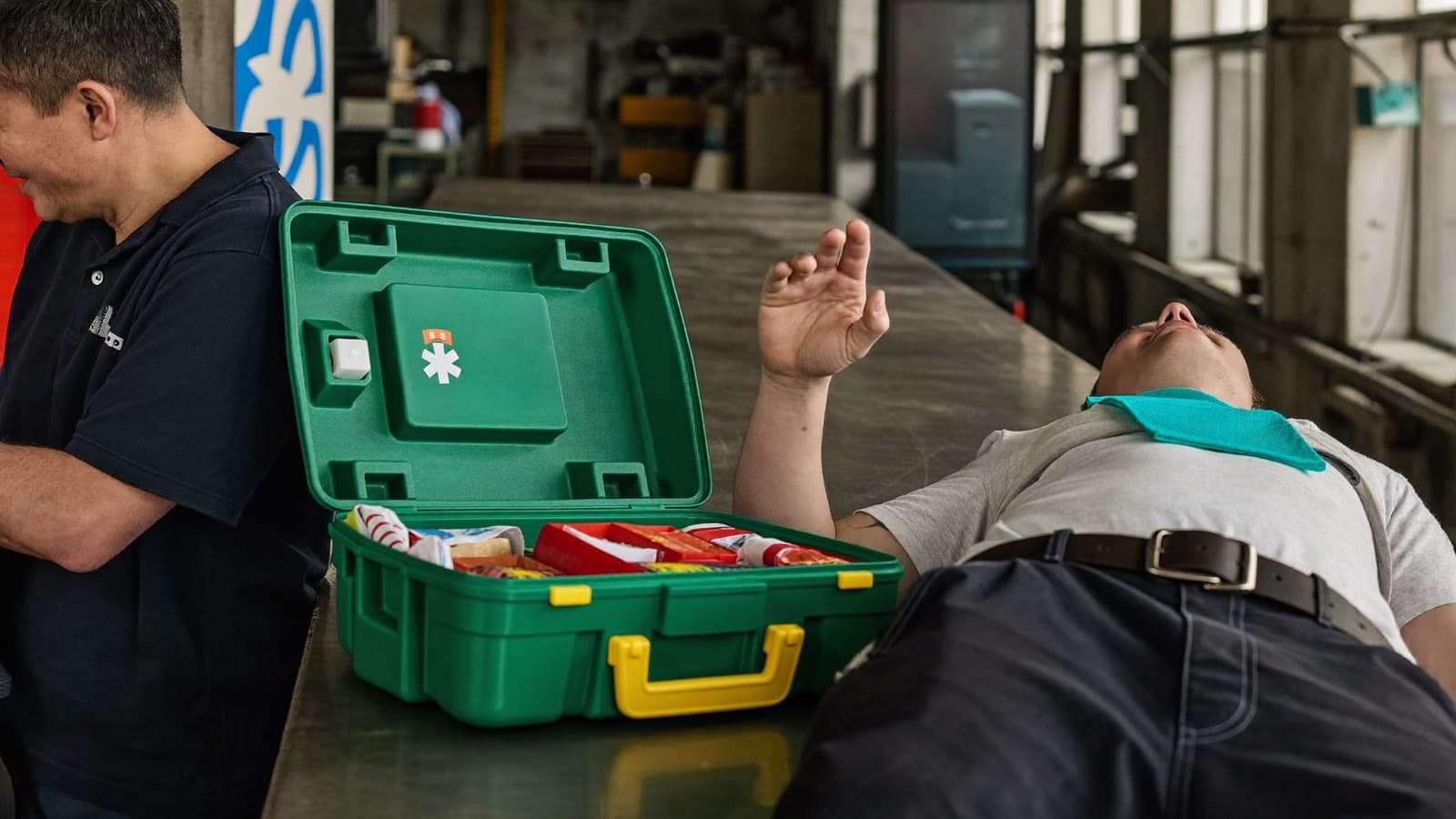
Ensure first aid and an accident procedure. The employer must have a procedure ready for occupational accidents. A registered occupational accident causes incapacity for work lasting more than three days or death (§ 17 ods. 4 of Act No. 124/2006 Coll.); the record is drawn up no later than within eight days (§ 17 ods. 4 písm. b) of Act No. 124/2006 Coll.) and sent within eight days to the competent labour inspectorate (§ 17 ods. 7 písm. a) of Act No. 124/2006 Coll.).
Obligations for a company with 1 employee
BOZP obligations apply from the very first employee, regardless of the form of the employment relationship. They apply equally to an employee in an employment contract and to an employee working on an agreement performed outside an employment relationship. Even a small company with a single employee must therefore assess risks, arrange BTS and PZS, provide OOPP and instruct the employee on BOZP regulations.
The scope of administrative work does differ by company size, however. The written BOZP policy framework and its implementation programme does not have to be drawn up by an employer with fewer than 11 employees, or by an employer whose SK NACE code is not listed in Annex 1 to the act (§ 6 ods. 1 písm. k) of Act No. 124/2006 Coll.). It is sufficient to satisfy one of these two conditions. The other basic BOZP obligations are not affected by this exemption and a small employer fulfils them in full.
Categorisation of work (4 categories)
The categorisation of work assigns every working activity to one of four categories according to the degree of health risk from work factors and the workplace environment. Under § 31 ods. 1 of Act No. 355/2007 Coll. work is assigned to four categories according to the level and nature of work factors and the workplace environment, the assessment of health risks and on the basis of changes in employees' health. The category determines the scope and periodicity of health surveillance and which obligations the employer must fulfil towards employees.
Hazardous work is, under § 31 ods. 6 of Act No. 355/2007 Coll., work assigned to the third and fourth category. Stricter rules apply to such work, including more frequent assessment of health risk.
The details of work factors and workplace environment factors in relation to categorisation and the requirements for proposals to assign work to categories are governed by Decree of the Ministry of Health of the Slovak Republic No. 448/2007 Coll. The proposal for the assignment of a particular activity is prepared by the employer in cooperation with the occupational health service, which prepares the risk assessment opinion. The employer assigns categories 1 and 2 on its own. The assignment of work to the third or fourth category, its reclassification or removal is decided under § 31 ods. 6 of Act No. 355/2007 Coll. by the competent public health authority (regional public health office) on the basis of a proposal from the employer or self-employed person, or on its own initiative.
The four categories by degree of health risk are summarised in the following table.
| Category | Degree of health risk | Examples |
|---|---|---|
| Category 1 | Minimum health risk; work factors do not adversely affect health | Administrative and office work |
| Category 2 | Low health risk; work factors may affect health with long-term exposure | Ordinary retail work, warehouse handling |
| Category 3 | Elevated health risk; hazardous work, factors exceed limit values | Work with higher noise, dust or chemical factors |
| Category 4 | High health risk; hazardous work with the highest level of health hazard | Work with the highest exposure to risk factors |
Correct assignment of work to a category is the starting point for the entire health surveillance system. The frequency of health-risk assessment and the scope of health surveillance provided for employees depend on the category. In Alpha Safety's experience, incorrect or missing work categorisation is among the most frequent shortcomings uncovered by an inspection. Terms such as risk assessment and hazardous work are explained in more detail in the glossary of terms.
Occupational health service (PZS)
The occupational health service carries out health surveillance for employees and provides the employer with expert and advisory services in fulfilling its obligations in the field of health protection and promotion at work. This follows from § 30a ods. 1 of Act No. 355/2007 Coll. The employer is required to arrange the occupational health service for employees regardless of company size — that is, from the very first employee. The scope of surveillance differs depending on which category the work is assigned to.
For work in the first and second category a simplified arrangement is sufficient. The scope of activities of the occupational health service for these categories includes, among other things, participation in organising the training of selected employees in first aid, as stated in § 30ab písm. d) bod 2 of Act No. 355/2007 Coll. For work in the third and fourth category, which is considered hazardous work, a full team of occupational health service specialists is required. Under the act, this team consists of a doctor with the relevant specialisation, a public health officer or other healthcare workers.
The act also sets the intervals at which the health risk arising from exposure to work and workplace environment factors must be reassessed. Under § 30 ods. 1 písm. c) of Act No. 355/2007 Coll. the assessment for work in the second category is carried out at least once every 24 months, and for work in the third or fourth category at least once a year.
The details of the scope and content of occupational health service activities, the composition of the specialist team and the requirements for their professional competence are governed by Decree of the Ministry of Health of the Slovak Republic No. 208/2014 Coll. The obligations of an occupational health service authorisation holder are governed by § 30d of Act No. 355/2007 Coll.
BOZP documentation
BOZP documentation is written proof that the employer is fulfilling its obligations to ensure occupational health and safety. During an inspection it is the first thing a labour inspector asks for. Act No. 124/2006 Coll. does not prescribe a single closed set of documents, but several obligations from which documentation arises. Two basic documents are named directly: under § 6 ods. 1 písm. c) of Act No. 124/2006 Coll. the employer is required to draw up a written risk-assessment document for every activity performed by employees, and under § 6 ods. 1 písm. k) of Act No. 124/2006 Coll. to prepare and update in writing a BOZP policy framework and its implementation programme. The obligation to draw up the policy framework does not apply to an employer with fewer than 11 employees, or to an employer whose NACE code is not listed in Annex 1 to the act; it is sufficient to satisfy one of these two conditions.
The typical scope of BOZP documentation in a small or medium-sized company includes:
- Risk assessment (written risk-assessment document) under § 6 ods. 1 písm. c) of Act No. 124/2006 Coll.
- BOZP policy framework and its implementation programme under § 6 ods. 1 písm. k) of Act No. 124/2006 Coll.
- Operating rules and safe working procedures for individual workplaces and equipment
- List of OOPP based on assessed risks and records of their provision (§ 6 ods. 2 písm. b) of Act No. 124/2006 Coll.)
- Instruction directive setting out the scope and frequency of repeat instruction
- Training and instruction records with employee signatures
- Occupational accident register and records of registered occupational accidents
- First-aid plan for accident and first-aid provision situations
Documentation is not a one-off matter. Under § 9 ods. 1 of Act No. 124/2006 Coll. (supervisory activities) the employer is required to continuously monitor and enforce compliance with BOZP regulations, including the condition of technical equipment and the proper use of OOPP. In Alpha Safety's practice, the most frequent finding during inspections is out-of-date documentation: the risk assessment does not reflect actual workplaces, signatures from training sessions are missing, or the instruction directive has remained unchanged for years. Up-to-date and accurate documentation is therefore not a formality but a practical safety-management tool that also withstands scrutiny by labour inspection.
Risk assessment
Risk assessment is the expert process by which the employer identifies and evaluates hazards threatening employees' health and sets measures to eliminate or reduce them. It forms the foundation of the entire BOZP documentation and every element of the safety system is based on it. Without a quality risk assessment, training, OOPP allocation and operating rules are built on assumptions, not on the actual state of the workplace.
The obligation arises from § 6 ods. 1 písm. c) of Act No. 124/2006 Coll., under which the employer is required to identify hazards and threats, assess the risk and draw up a written risk-assessment document for every activity performed by employees. Risk assessment is also one of the general principles of prevention in § 5 ods. 2 of Act No. 124/2006 Coll., which form the framework for all the employer's preventive measures.
The procedure has four steps:
Hazard identification. For every activity, workplace and piece of work equipment, it is determined what could cause an accident or health damage (mechanical, electrical, chemical, physical and other factors).
Risk evaluation. For each hazard, the probability of harm occurring and the severity of its consequences are assessed.
Determination of measures. In accordance with the general principles of prevention in § 5 ods. 2 of Act No. 124/2006 Coll., priority is first given to eliminating the hazard at its source, and collective protection takes precedence over individual protection.
Written risk-assessment document. The results are recorded in a written document, which is the starting point for the scope of training, the list of OOPP to be issued and the categorisation of work.
Risk assessment is not a one-off exercise. Alpha Safety's practice shows that the document must be updated when technology changes, when a new workplace is introduced, following an occupational accident, and whenever the conditions of work change. Terms such as risk assessment are explained in more detail in the glossary of terms.
BOZP training and instruction
Instructing employees is one of the employer's basic obligations. An employee must be instructed on the regulations and guidelines for ensuring occupational health and safety with every change that affects the risk at their workplace. In practice this means four typical situations: on starting employment, on transfer to a different workplace or different work, when a new technology or new work procedure is introduced, and when a new piece of work equipment is introduced or modified.
In addition to these situations, instruction must be repeated regularly. Here a key provision comes into play that distinguishes a properly set-up company from one that relies on outdated information. Under § 7 ods. 5 of Act No. 124/2006 Coll. the employer sets by internal regulation the frequency of repeat instruction so that it is carried out at least once every three years, unless occupational health and safety legislation provides for a shorter interval. This interval has applied following amendment No. 114/2022 Coll. effective from 1 January 2023. Many sources and some companies still quote a two-year interval, which is incorrect. For certain hazardous types of work a special regulation may set a shorter interval, so the interval is always assessed against the specific type of work as well.
From Alpha Safety's perspective, effective training rests on three pillars. The first is regularity — observing the statutory interval and reflecting it in the internal regulation. The second is clarity, because instruction should genuinely help employees work safely, not merely fill in a form. The third is verifiability — a written signed record showing who was instructed, when and on what subject. It is precisely the absence of verifiability that is the most frequent problem during a labour inspection.
A special regime applies to education and training in the field of labour protection. Under § 27 ods. 3 of Act No. 124/2006 Coll. education and training in the scope of the individual activities listed in Annex 2 may be organised and carried out only on the basis of an authorisation issued by the National Labour Inspectorate (NIP). An exception applies for schools and for an employer that trains its own employees and line managers within the defined scope. The overview of specific courses and training is designed to match the actual needs of the workplace and the legal requirements.
OPP and first-aid training
Alongside BOZP training, the employer also has a separate obligation in the field of fire protection. Under § 4 písm. e) of Act No. 314/2001 Coll. the employer is required to provide training and knowledge testing on fire protection for employees and persons who, with its knowledge, are present in its premises and spaces; the content, scope and intervals of training are determined by the implementing decree.
A separate topic is the preparation of employees to provide first aid. Organising training of selected employees in first aid is, under § 30ab písm. d) bod 2 of Act No. 355/2007 Coll., part of the scope of activities of the occupational health service, thereby linking the field of training with health surveillance of employees.
OOPP (personal protective equipment)
Personal protective equipment (OOPP) consists of devices that protect the employee from risks that cannot be eliminated by technical or organisational measures. Entitlement to OOPP arises where the protection of the employee's life or health at a particular activity requires it. Under § 6 ods. 2 písm. b) of Act No. 124/2006 Coll. the employer is required to provide employees free of charge with effective personal protective equipment as needed and to keep records of its provision.
The key phrase is free of charge. Under § 6 ods. 11 of Act No. 124/2006 Coll. the costs of ensuring occupational health and safety are borne by the employer, who must not pass these costs on to the employee. The employee therefore does not pay for the OOPP issued and has no obligation to obtain it at their own expense. The selection of specific OOPP is based on the results of risk assessment, which identifies the hazards at individual workplaces.
Typical OOPP include head protection (safety helmets), eye and face protection (goggles, visors), hearing protection (ear defenders, earplugs), respiratory protection (respirators, masks), hand protection (gloves), foot protection (safety footwear) and full-body protection (protective clothing, fall-arrest harnesses). The conditions for provision and the characteristics of OOPP are governed by Government Regulation No. 395/2006 Coll.
Standard work clothing, uniforms and footwear are not personal protective equipment (§ 1 ods. 3 písm. a) of Government Regulation No. 395/2006 Coll.). The employer provides work clothing or work footwear only in environments where they are subject to extraordinary wear or extraordinary soiling that renders them unusable within a period of less than six months (§ 2 ods. 5 of Government Regulation No. 395/2006 Coll.). This distinction helps in practice to avoid disputes over what the company must cover as protection and what already constitutes the employee's standard equipment.
Occupational accidents and occupational diseases
An occupational accident is damage to health or the death of an employee that occurred while performing work tasks or in direct connection therewith. In terms of severity we distinguish a fatal accident, an accident causing serious bodily harm and a mass accident in which several persons are injured simultaneously. A separate category is the registered occupational accident. Under § 17 ods. 4 of Act No. 124/2006 Coll. this is an accident that caused incapacity for work lasting more than three days, or the death of an employee as a result of an occupational accident. The threshold is therefore incapacity for work of more than three days, not three or more days.
The procedure for an occupational accident follows a clear structure. The employer arranges first aid and medical treatment for the injured person, documents the accident site as far as possible in its unaltered state and determines the causes. For a registered occupational accident, statutory time limits follow. The employer is required to draw up a record of the registered occupational accident no later than within eight days from the day on which it learned that it is a registered occupational accident, pursuant to § 17 ods. 4 písm. b) of Act No. 124/2006 Coll. This record must then be sent within eight days to the competent labour inspectorate or the competent supervisory authority pursuant to § 17 ods. 7 písm. a) bod 1 of the same act. The template for the record of a registered occupational accident is set out in the annex to Decree No. 500/2006 Coll. Maintaining records and correctly completing the report are areas in which the safety service genuinely helps employers.
Current figures illustrate the scale of the problem. According to the Report on the State of Labour Protection for 2024, published annually by the National Labour Inspectorate (NIP), a total of 7,888 occupational accidents were registered in Slovakia. Of this number, 7,808 were other registered occupational accidents — that is, accidents with incapacity for work of more than three days, excluding fatal accidents and accidents causing serious bodily harm. In 2024, 25 fatal occupational accidents were recorded, five more than in 2023. Serious occupational accidents causing grave injury to health numbered 55, a decrease of four cases compared with the previous year. In the field of occupational diseases, according to the National Centre of Health Information, 423 newly recognised occupational diseases were reported in Slovakia in 2024, of which 215 were in women and 208 in men. These data serve as the baseline for risk assessment at a specific workplace.
Compensation and employer liability
The employer is liable for damage arising from an occupational accident or occupational disease. Under § 195 of Act No. 311/2001 Coll. (Labour Code), if an employee suffers damage to health or death through an accident while performing work tasks or in direct connection therewith, the employer with whom the employee was in an employment relationship at the time of the occupational accident is liable for the resulting damage. The employer's liability for compensation is objective, and the possibilities of relief from it are governed by the Labour Code in the following provisions.
In addition to compensation from the employer, the injured employee also claims accident benefits from the Social Insurance Agency, which flow from the employer's statutory accident insurance. In the case of a serious breach of regulations, negligent conduct may also lead to the liability of line managers — not only in employment law but, where the statutory conditions are met, in criminal law as well. Thorough prevention and orderly BOZP documentation therefore protect not only employees' health but also the employer itself.
Construction-site safety coordinator
On construction sites where several companies are working simultaneously, an obligation arises to appoint a safety coordinator. This obligation is imposed by Government Regulation No. 396/2006 Coll. on minimum safety and health requirements for construction sites.
When a safety coordinator is required
Under § 3 ods. 1 of Government Regulation No. 396/2006 Coll. the developer appoints one or more safety coordinators for every construction site on which more than one employer (or more than one natural person who is a sole trader and is not an employer) will carry out work. In other words, if more than one contractor meets on a site, a coordinator is legally required.
A separate notification obligation attaches to this. Under § 3 ods. 3 of Government Regulation No. 396/2006 Coll. the developer submits to the competent labour inspectorate a written notification before work commences if the planned duration of work on the site will exceed 30 working days and at the same time more than 20 natural persons will be working on it, or if the planned scope of work will exceed 500 person-days. Each of these two thresholds is sufficient on its own to trigger the notification obligation.
Who may be the coordinator
Under § 6 ods. 1 of Government Regulation No. 396/2006 Coll. the safety coordinator may be a person authorised to act as site manager, a person authorised to exercise construction supervision, or a safety technician. The act also establishes a restriction: a person authorised to act as site manager may not be the safety coordinator on a site on which they are simultaneously acting as site manager. The coordinator oversees compliance with safe working practices across all companies on the site and links their working procedures so that they do not endanger one another.
Providing this function is a specialised activity. More about it can be found on the service page construction-site safety coordinator.
Fines and labour inspection checks
Compliance with BOZP regulations in workplaces is monitored by labour inspectorates. Where a breach of obligations is found, they may impose significant sanctions on the employer, whose upper limits are among the highest in employment law.
Under § 19 ods. 1 písm. a) of Act No. 125/2006 Coll. a fine of up to 100,000 euros may be imposed on the employer for breach of obligations. If, as a result of the breach, an occupational accident causing serious bodily harm occurred, the fine is at least 20,000 euros, and if an employee died, at least 33,000 euros. These are lower limits that the act establishes as the mandatory minimum.
For a serious breach of regulations, a fine of between 1,000 and 200,000 euros may be imposed under § 19 ods. 2 písm. b) bod 1 of Act No. 125/2006 Coll. The same upper limit applies to illegal employment under § 19 ods. 2 písm. a) bod 1 of Act No. 125/2006 Coll., where the fine ranges from 4,000 to 200,000 euros, and for simultaneous illegal employment of two or more persons it is at least 8,000 euros.
Sanctions are not limited to the company as a whole. Line managers and the statutory body may, under § 19 ods. 1 písm. c) of Act No. 125/2006 Coll., be fined up to four times their average monthly earnings. A natural person at the workplace who obstructs the exercise of labour inspection may be fined between 65 and 650 euros by the labour inspectorate under § 20 ods. 2 of Act No. 125/2006 Coll.
| Sanction | Range | Provision |
|---|---|---|
| Breach of obligations by employer | up to 100,000 euros | § 19 ods. 1 písm. a) zák. č. 125/2006 Z. z. |
| Accident causing serious bodily harm | at least 20,000 euros | § 19 ods. 1 písm. a) zák. č. 125/2006 Z. z. |
| Accident causing death of employee | at least 33,000 euros | § 19 ods. 1 písm. a) zák. č. 125/2006 Z. z. |
| Serious breach of regulations | 1,000 to 200,000 euros | § 19 ods. 2 písm. b) zák. č. 125/2006 Z. z. |
| Illegal employment | 4,000 to 200,000 euros | § 19 ods. 2 písm. a) zák. č. 125/2006 Z. z. |
| Line manager and statutory body | up to four times average monthly earnings | § 19 ods. 1 písm. c) zák. č. 125/2006 Z. z. |
| Obstruction of inspection (natural person) | 65 to 650 euros | § 20 ods. 2 zák. č. 125/2006 Z. z. |
Sanctions are not merely a theoretical threat. According to the Report on the State of Labour Protection for 2024, labour inspectorates imposed 2,489 fines with final force totalling 5,636,169 euros. The most effective defence against a fine is documented BOZP compliance and a functioning safety service that keeps regulations up to date.
How a labour inspection check proceeds
Labour inspection checks are either planned according to the annual programme or carried out on the basis of a trigger, most commonly an occupational accident, an employee complaint or an anonymous report. After an occupational accident causing serious bodily harm or a fatal accident, an inspection is generally the norm.
The labour inspector's powers are governed by § 12 of Act No. 125/2006 Coll. During the exercise of labour inspection, an inspector is authorised in particular to enter premises and workplaces freely and at any time, to require the employer to provide information, explanations and documentation, to take samples, to order the removal of identified shortcomings and, in justified cases, to prohibit the use of work and operational facilities. The employer is required to cooperate with the inspector. In Alpha Safety's experience, the strongest preparation for an inspection is documentation that is kept and updated continuously, not documentation prepared only after an inspection has been announced.
External vs. internal BOZP (BTS)
An employer may arrange the safety service by two routes: through its own qualified employee (a safety technician in an employment relationship), or by contracting it out to an external provider. Both forms are governed by Act No. 124/2006 Coll.
Contracted performance is subject to stricter conditions. Under § 21 ods. 8 of Act No. 124/2006 Coll. the safety service may only be provided on a contracted basis by a natural person who is a sole trader or a legal entity holding an authorisation issued by the National Labour Inspectorate (NIP). A self-employed natural person who is not an employer may provide it without that authorisation under § 21 ods. 8 if they are a safety technician. The duties of the safety service itself (expert, methodical, organisational, supervisory, coordinatory and educational advisory work) are, under § 22 ods. 1 and 2 of Act No. 124/2006 Coll., performed by a safety technician and where needed by another prevention and protection specialist as well. Note on terminology: the institution of authorised safety technician was abolished from 1 January 2023; persons holding the original certificate are by law treated as safety technicians.
The external safety service brings the expertise of several specialists, continuously updated knowledge of legislation and lower fixed costs, since the company does not pay a permanent employee or their ongoing training. An in-house technician, on the other hand, is at the workplace every day, knows the operation in detail and responds immediately. The choice depends on company size, the level of risks and the frequency of changes at workplaces. For small and medium-sized companies the external service is generally more efficient; larger operations with high risk often combine an in-house technician with external support.
BOZP and SZČO (sole trader without employees)
A self-employed person (SZČO) who carries on business without employees is not an employer and is therefore not subject to the full range of employer obligations under § 6 of Act No. 124/2006 Coll. (for example the obligation to instruct employees or to draw up a BOZP policy framework in relation to themselves). The BOZP act does, however, apply to them. Under § 2 ods. 2 písm. b) of Act No. 124/2006 Coll. this act also applies to a natural person who is a sole trader and is not an employer, and to their lineal relatives, siblings and spouse if they participate in carrying out their business tasks.
The specific obligations are defined in § 12 ods. 4 of Act No. 124/2006 Coll., under which a natural person who is a sole trader and is not an employer is subject, with appropriate modifications, to the obligations under § 12 ods. 2 písm. a) to m) and ods. 3 of the same act — that is, obligations analogous to those of an employee. These include in particular compliance with occupational health and safety regulations, use of work equipment and personal protective equipment in accordance with the instructions and relevant documentation, submission to occupational health examinations where required by the regulations, and reporting of shortcomings that could pose a safety risk.
The situation changes in two cases. If a sole trader takes on even a single employee, they become an employer and are then subject to the full range of obligations under § 6 of Act No. 124/2006 Coll., including risk assessment, documentation and instruction. And if they carry out work at another employer's workplace — for example as a subcontractor on a construction site — under § 2 ods. 2 of Act No. 124/2006 Coll. the rules of that workplace also apply to them; where there are several contractors on one site, a construction-site safety coordinator also becomes involved.
Most common BOZP mistakes by companies
When implementing and auditing BOZP, the Alpha Safety team repeatedly encounters the same shortcomings. These include in particular:
- Missing or out-of-date risk assessment. The employer is required to identify hazards and threats, assess the risk and draw up a written risk-assessment document for every activity performed by employees pursuant to § 6 ods. 1 písm. c) of Act No. 124/2006 Coll. The document is often either missing entirely or does not reflect the actual processes and changes at the workplace.
- Formal training without knowledge verification. Instruction is carried out with only an attendance-sheet signature, with no real verification that the employee understood the content. Yet instruction must be repeated at least once every three years under § 7 ods. 5 of Act No. 124/2006 Coll., unless special regulations provide for a shorter interval.
- Missing or unissued OOPP. The employer is required to provide free of charge effective personal protective equipment as needed and to keep records of its provision under § 6 ods. 2 písm. b) of Act No. 124/2006 Coll. In practice it is precisely the records that are missing, or the equipment does not correspond to the actual risks.
- Overdue inspections of technical equipment. Professional inspections and professional tests of reserved technical equipment must be carried out within the prescribed intervals. Inspections of reserved technical equipment according to the applicable schedule will help you.
- Missing BOZP documentation. Without comprehensive and up-to-date documentation the company cannot demonstrate compliance with its obligations during an inspection.
From our practice
During labour inspection checks the most frequent problem is precisely out-of-date risk assessment and formal training that does not reflect the actual state of the workplace. These two shortcomings are the ones the company can remedy most quickly and with the greatest impact on safety and on the outcome of a potential inspection.
What affects the price of BOZP services
The price of occupational health and safety services is not a flat rate. It depends on the actual complexity that fulfilling statutory obligations requires for a specific employer. An indicative price is therefore always determined by an assessment of the specific operation. The following factors have the greatest bearing on the scope of work.
Number of employees determines the volume of work: each employee means additional instruction, records and monitoring of protective equipment use. At 11 or more employees (and also for a smaller company whose SK NACE code is listed in Annex 1 to the act) an additional obligation arises to prepare and update in writing a BOZP policy framework under § 6 ods. 1 písm. k) of Act No. 124/2006 Coll.
Work category is critical. Work assigned to the third or fourth category is hazardous (§ 31 ods. 6 of Act No. 355/2007 Coll.) and requires more frequent health-risk assessment — at least once a year, compared with at least once every 24 months for the second category (§ 30 ods. 1 písm. c) of Act No. 355/2007 Coll.).
Number of premises and their locations increases the scope of site visits, risk assessments for all activities (§ 6 ods. 1 písm. c) of Act No. 124/2006 Coll.) and on-site supervisory activities.
Presence of reserved technical equipment brings an additional agenda of professional inspections and professional tests depending on their type (§ 13 of Decree No. 508/2009 Coll.). It is also linked to the scope of inspections of reserved technical equipment.
Industry sector and risk level, scope of documentation and the choice between in-house and external service also affect the complexity. Where there are several contractors on a site, a construction-site safety coordinator is also required.
The most accurate picture of scope and price comes from a no-obligation consultation within the safety service.
BOZP by sector
A company's risk profile depends on the industry. Risk assessment under § 6 ods. 1 písm. c) of Act No. 124/2006 Coll. must therefore be based on the specific activities, not on a generic template.
Construction is among the highest-risk industries. Falls from height, burial in excavations, machinery accidents and manual handling dominate. Where there are several contractors on one site, an obligation arises to appoint a construction-site safety coordinator. More in the section on construction.
Industrial manufacturing brings risks from moving machinery parts, noise, dust and chemical factors. Work assigned to the third or fourth category is common; under § 31 ods. 6 of Act No. 355/2007 Coll. such work is hazardous work subject to stricter health surveillance. Details in the section on industry.
Administration and offices have a lower accident rate, but eye strain from screens, inappropriate ergonomics and prolonged sitting occur. The obligation to assess risks and instruct employees applies here as well.
Transport and storage is associated with injuries from manual handling, forklift truck operation and traffic incidents. Falls of persons in work areas were, according to the Report on the State of Labour Protection for 2024, the most frequent source of registered occupational accidents (2,358 cases, 30.20%).
Food service and HoReCa faces burns, cuts, slips on wet floors and work in a hot environment. More in the section on gastronomy.
Healthcare is characterised by biological risks, patient handling and psychological strain. In 2024, 423 newly recognised occupational diseases were reported in Slovakia, underscoring the importance of health surveillance across all sectors.
Conclusion
Occupational health and safety is not a one-off task but an ongoing system of obligations. The employer must under § 147 ods. 1 of the Labour Code (Act No. 311/2001 Coll.) continuously ensure the safety and health protection of employees and under § 6 of Act No. 124/2006 Coll. identify hazards, assess risks, maintain documentation and provide personal protective equipment; employees must also be regularly instructed on BOZP regulations under § 7 ods. 5 of the same act. These tasks cannot be deferred: neglecting them increases the risk of occupational accidents and exposes the company to fines and liability during a labour inspection.
Expert BOZP management brings two essential benefits. It prevents accidents and at the same time keeps the company ready for an inspection, so you identify shortcomings before the inspector does.
If you are unsure whether your compliance is set up correctly, arrange a no-obligation consultation with the experienced Alpha Safety team. We will assess your situation and propose the next steps. More about our safety service can be found on the service page.
Súvisiace služby a zdroje
Bezpečnostnotechnická služba
Externé zabezpečenie BOZP pre vašu firmu — autorizovaný bezpečnostný technik.
Pracovná zdravotná služba
Zdravotný dohľad nad vplyvom práce na zdravie zamestnancov podľa § 30a.
Koordinátor bezpečnosti na stavenisku
Povinný koordinátor pri viacerých zhotoviteľoch na jednom stavenisku.
Revízie vyhradených technických zariadení
Odborné prehliadky a skúšky elektro, plyn, tlak a zdvíhacie zariadenia.
Kurzy a školenia BOZP
Vstupné aj opakované oboznamovanie zamestnancov a vedúcich pracovníkov.
Slovník pojmov
Výkladový slovník kľúčových pojmov z BOZP, OPP, PZS a VTZ.
Súvisiace články








Stručná odpoveď
Occupational health and safety (BOZP) is the set of legal, technical, organisational and health-related measures that prevent occupational accidents, occupational diseases and other work-related damage to health. This area is governed primarily by Act No. 124/2006 Coll. Responsibility for ensuring BOZP rests with the employer, from their very first employee.
Časté otázky o BOZP
BOZP is occupational health and safety, that is, the system of measures that protect employees from occupational accidents, occupational diseases and other damage to health. Act No. 124/2006 Coll. in § 1 lays down the general principles of prevention and the basic conditions for ensuring BOZP and for eliminating risks at work.
Every employer must ensure BOZP from their first employee, regardless of the size of the company or the sector. Under § 147 ods. 1 of Act No. 311/2001 Coll., the employer is obliged to continuously ensure the safety and health protection of employees at work and to take the measures necessary for that purpose, including prevention.
The employer must apply the general principles of prevention under § 5 of Act No. 124/2006 Coll., assess risks and draw up a written risk-assessment document under § 6 ods. 1 písm. c), provide training, supply protective equipment and continuously monitor compliance with the regulations under § 9.
Refresher familiarisation of employees is carried out at least once every three years, unless special regulations lay down a shorter period. This interval is set by § 7 ods. 5 of Act No. 124/2006 Coll. The employer regulates the frequency by an internal rule. For certain hazardous work, regulations may require shorter intervals.
The labour inspectorate may impose a fine of up to 100,000 euros on an employer under § 19 ods. 1 písm. a) of Act No. 125/2006 Coll. For a serious breach of the regulations the range is from 1,000 to 200,000 euros. Where an occupational accident results from the breach, the fine is at least 20,000 euros for serious damage to health and at least 33,000 euros for a death.
Categorisation of work assigns work into four categories according to the level of work factors and the assessment of health risks. It is governed by § 31 of Act No. 355/2007 Coll. and implementing Decree No. 448/2007 Coll. Hazardous work is work classified in the third and fourth categories under § 31 ods. 6.
Yes. The obligations relating to health protection at work under § 30 ods. 1 of Act No. 355/2007 Coll. are tied to the employer without setting any minimum number of employees, so they apply from the first employee. The extent of health surveillance varies according to the category of work. More in the section on the occupational health service.
The developer appoints a safety coordinator for every construction site on which more than one employer or more than one self-employed person will work. This obligation is laid down by § 3 ods. 1 of Government Regulation No. 396/2006 Coll. Details can be found under the construction-site safety coordinator service.
Personal protective equipment is provided by the employer free of charge under § 6 ods. 2 písm. b) of Act No. 124/2006 Coll. The costs associated with ensuring BOZP are borne by the employer and may not be passed on to the employee, as set out in § 6 ods. 11. A closer definition of OOPP is contained in Government Regulation No. 395/2006 Coll.
A registered occupational accident is an accident that caused incapacity for work lasting more than three days or the death of an employee. This follows from § 17 ods. 4 of Act No. 124/2006 Coll. The employer draws up a record no later than within eight days; the template for the record is laid down by Decree No. 500/2006 Coll.
BOZP addresses safety at work, accident prevention and technical risks through the safety service. The occupational health service under § 30a of Act No. 355/2007 Coll. carries out health surveillance of the effect of work factors on the health of employees. BOZP is a technical-organisational area, PZS is a health one. Both are separate obligations of the employer.
The employer may familiarise its own employees itself. However, if you wish to provide education and training in the field of labour protection to other entities to the extent of Annex No. 2, you need an authorisation issued by the National Labour Inspectorate under § 27 ods. 3 of Act No. 124/2006 Coll. An exception applies to training your own employees.
Compliance with BOZP regulations is inspected by the labour inspectorate under Act No. 125/2006 Coll. The inspector is entitled to enter workplaces freely, request documentation and order the removal of deficiencies under § 12. For the classification of hazardous work into the third and fourth categories, the competent regional public health authority also decides.
Professional inspections and professional tests of reserved technical equipment are carried out to the extent and at the intervals set out in Annexes No. 5 to 10 to Decree No. 508/2009 Coll. The specific intervals depend on the type and environment of the equipment. More under the inspections of reserved technical equipment service.
The employer is liable for damage in the event of an occupational accident under § 195 of Act No. 311/2001 Coll. Benefits are provided to surviving dependants by the Social Insurance Agency. The labour inspectorate may impose a fine of at least 33,000 euros for a death (and at least 20,000 euros for serious damage to health) under § 19 ods. 1 písm. a) of Act No. 125/2006 Coll. Criminal liability of the responsible persons is also possible.
Need help with workplace safety?
Contact us today and get a free consultation. Our team of experts will help you find a solution tailored to your needs.