First-aid training
Every employer is required to designate and train a sufficient number of employees for first aid under § 8 ods. 1 písm. a) bod 3 of Act No. 124/2006 Coll. We deliver training directly at your company — theory and practical training in CPR, AED and stopping bleeding.
Interested in this course?
Leave us your contact and we will get back to you with dates, usually within 24 hours.
What workplace first-aid training is
Workplace first-aid training is professional preparation of employees after which they are able to act in the event of an occupational accident or a sudden medical condition — to recognise a life-threatening situation, call for emergency medical assistance, perform cardiopulmonary resuscitation and stop bleeding until professional help arrives. It is intended for companies of every size that want trained people at their workplaces capable of providing first aid, thereby fulfilling the statutory duty and genuinely protecting the health of their employees.
First aid is a set of simple procedures that save lives in the first minutes after an accident or sudden event — that is, at a time when professional rescue is not yet on the scene. Those minutes are decisive: when circulation ceases, the chances of survival decrease with every minute without resuscitation. The aim of the training is therefore to prepare employees so that they can react immediately and correctly. This company training is part of the care for occupational safety and health and complements OHS training and fire protection training.
Beware of confusion with the driving course. An accredited first-aid course for applicants for a driving licence falls under the jurisdiction of the Ministry of Health and is governed by special regulations on providers and first-aid courses. Our training is company first-aid training in the workplace under § 8 of Act No. 124/2006 Coll. — it prepares designated employees for accidents and sudden conditions in a specific work environment, not for the issue of a document for a driving licence.
The employer's duty to provide first aid
The provision of first aid in the workplace is not voluntary — it is a statutory duty of the employer that forms part of the measures for the protection of life and health in emergency situations.
What § 8 of Act No. 124/2006 Coll. requires
Under § 8 ods. 1 písm. a) bod 3 of Act No. 124/2006 Coll. on occupational safety and health the employer is required to designate and train, through professionally competent persons, and regularly re-train a sufficient number of employees for the provision of first aid, for the performance of rescue work and for evacuation. The Act therefore combines in a single obligation three mutually linked tasks — first aid, rescue work and evacuation — and requires that designated employees be prepared for them professionally and regularly.
How many employees and how often
The Act deliberately does not specify an exact number of hours or a fixed interval for repetition. It speaks of a 'sufficient number' of employees and their 'regular' training — the specific assessment is left to the employer, who derives it from the company's size, the nature and risks of the work, the number of workplaces and the shift pattern. For frequency, in practice the general refresher familiarisation cycle of at least once every three years under § 7 ods. 5 of the Act is used. Since practical skills, in particular resuscitation, fade rapidly without practice, we recommend repeating training more frequently.
| Item | Value | Legal basis |
|---|---|---|
| Obligation to designate employees for first aid | determined by the employer | § 8 ods. 1 písm. a) bod 3 of Act No. 124/2006 Coll. |
| Number of trained employees | 'sufficient number' (assessed by employer according to risks) | § 8 ods. 1 písm. a) bod 3 of Act No. 124/2006 Coll. |
| Who provides training | professionally competent person | § 8 ods. 1 písm. a) bod 3 of Act No. 124/2006 Coll. |
| Duration (number of hours) | not specified by law — according to the needs and risks of the workplace | — |
| Frequency | 'regularly'; in practice linked to the cycle of at least once every 3 years | § 8 ods. 1 písm. a) bod 3 + § 7 ods. 5 of Act No. 124/2006 Coll. |
| Related tasks | first aid, rescue work and evacuation together | § 8 ods. 1 písm. a) bod 3 of Act No. 124/2006 Coll. |
What you will learn on the training
The content of the training is built around the chain of survival — the sequence of steps that, if performed in the correct order and promptly, most increases the injured person's chances of survival. Participants acquire both theory and practical skills, and the content is always tailored to the actual risks of your workplace.
Cardiopulmonary resuscitation and AED
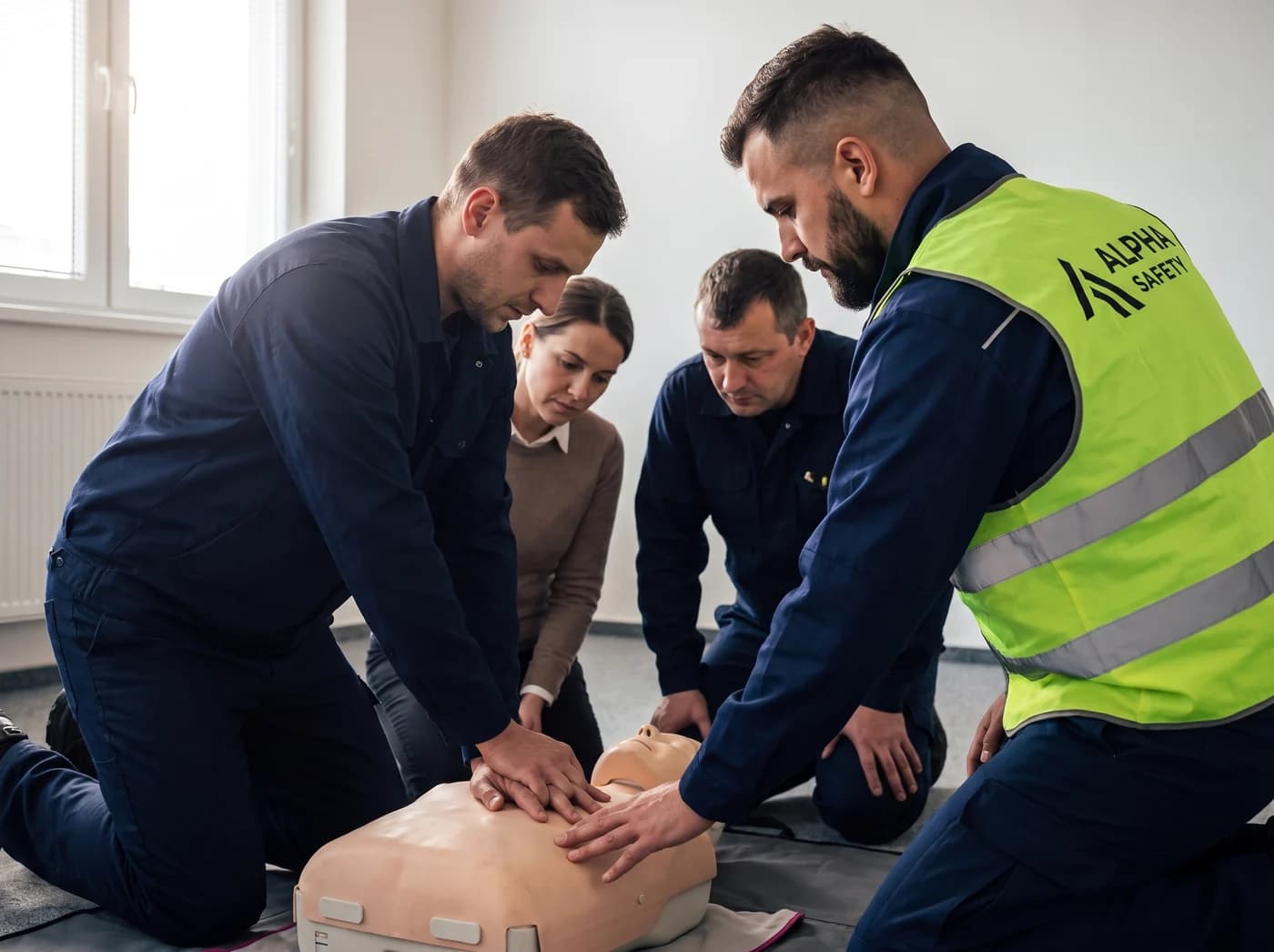
Participants learn to recognise cessation of breathing and circulation, correctly compress the chest and perform artificial respiration in an adult, child and infant and to operate an automated external defibrillator (AED) if available at the workplace. Resuscitation is practised on a manikin so that employees acquire the correct frequency and depth of compression and gain the confidence to act even under stress.
Resuscitation is precisely the skill that is most decisive for survival and at the same time fades most rapidly without repeated practice. We therefore devote the most time to it and practise it repeatedly, so that the employee can start chest compressions without hesitation and maintain them until the paramedics arrive or breathing resumes.
Stopping bleeding and treating injuries
Severe blood loss is among the immediate threats to life. You will therefore learn to manage external and arterial bleeding and to treat the most common occupational injuries:
- Bleeding: pressure on the wound, pressure bandage and the use of a tourniquet for massive arterial bleeding.
- Wounds, burns and chemical burns: treatment of open wounds, burns and chemical burns that occur in operations.
- Fractures and injuries: immobilisation of a limb, procedure for open fractures and spinal injury.
- Shock: recognition and management of a shock state and anti-shock measures.
Sudden conditions and calling for help
In addition to injuries, sudden medical conditions also occur in the workplace — loss of consciousness, choking and airway obstruction, electric shock, heart attack, stroke or collapse. Participants learn to recognise them and respond correctly, including placing the person in the recovery position. We emphasise correctly calling for emergency medical assistance — line 155 and emergency line 112 — what to report to the operator, how to guide the paramedics to the location and how to cooperate with them until they arrive.
How to provide first aid — procedure
During the training participants acquire a simple and memorable sequence of steps to follow in the event of an accident or sudden condition in the workplace — from ensuring safety through to handing the casualty over to the paramedics.
Enquiry You contact us by phone or email and provide the basic details — the number of employees you wish to train, the nature and main risks of your operation and the location where you need the training.
Scheduling and scope agreement Together we agree a convenient date and scope of training and advise you on how many employees it is appropriate to designate and train to fulfil the obligation to maintain a sufficient number of persons capable of providing first aid. We tailor the content to the risks of your workplace.
Theoretical preparation The instructor explains the principles of first aid, the chain of survival, the correct procedure for calling emergency medical services on line 155 and emergency line 112 and the procedures for the most common occupational accidents and sudden medical conditions. This part can also be completed online.
Practical training Participants practise cardiopulmonary resuscitation and operation of an automated external defibrillator on a resuscitation manikin, stopping bleeding and treating wounds, and go through scenario exercises from your company's environment. The practical part is delivered in person.
Confirmation and record After completion we issue a confirmation of training and draw up a record with the date, content and list of participants, which proves fulfilment of the obligation under § 8 of Act No. 124/2006 Coll. We also advise you of the suitability of regular repetition to maintain employees' skills.
Organisation of first aid in the company
Trained employees are only one part of preparedness — for workplace first aid to actually work, it must also be backed up by equipment and organisation. § 8 of Act No. 124/2006 Coll. links first aid with rescue work and evacuation, so we regard it as part of the overall emergency response system.
Designated employees and first-aid kit
The employer designates specific employees responsible for providing first aid so that a prepared person is always present in every shift and at every workplace. This includes an available and stocked first-aid kit placed at a known and marked location, the contents and checking of which we go through with employees. For higher-risk workplaces we recommend considering an automated external defibrillator (AED) as well.
Emergency plan and link to evacuation
For clear action in the event of an accident, a sequence of steps is used — who provides first aid, who calls the rescue service and who directs the paramedics. We link these procedures with evacuation and fire protection training so that they flow seamlessly into each other during an emergency. Our OHS service can also help in setting up the whole system.
As a result, first aid does not remain only with trained individuals, but becomes a functional part of company safety — employees know where to find the first-aid kit and AED, whom to call and how to act until the emergency medical service arrives. It is precisely this preparedness in the first minutes that is most decisive in determining whether an accident at the workplace ends well.
How we will deliver the training
We will tailor the training to the size and risks of your company. The theoretical part can also be completed online; practical training in resuscitation and treatment of injuries, however, takes place in person — ideally directly at your premises, in the environment your employees are familiar with.
We do not tie the scope of training to a fixed number of hours, because the law does not specify one — instead we set it so that participants genuinely master the key procedures for the risks of their workplace. After completion we issue a confirmation and a record that proves fulfilment of the obligation under § 8 of Act No. 124/2006 Coll. and advise you of the suitability of regular repetition.
What workplace first-aid training includes
Legal basis
§ 8 ods. 1 písm. a) bod 3 of Act No. 124/2006 Coll. — obligation to designate and train a sufficient number of employees for first aid, rescue work and evacuation.
Number of employees
Law does not specify an exact number — 'sufficient number' assessed by employer by company size, risks and shift pattern.
Interval
Regular re-training — in practice linked to the cycle of at least once every 3 years (§ 7 ods. 5); more frequent repetition recommended to maintain skills.
Theory content
Chain of survival, CPR principles, AED operation, stopping bleeding, shock, sudden conditions (heart attack, stroke, choking), calling emergency services (155, 112).
Practical training
CPR on resuscitation manikin, pressure bandage, tourniquet, recovery position, scenario exercises. Always in person.
Document issued
Confirmation of training completion and familiarisation record with participant list.
Why choose Alpha Safety?
- Practical training with resuscitation manikin
- Content tailored to the risks of your workplace
- Links to OHS training and OPP training
- Training throughout Slovakia
- Complete documentation — training record
Duration
4 hours
Format
Online and in-person
Related courses

Short answer
Workplace first-aid training is a statutory duty of the employer under § 8 ods. 1 písm. a) bod 3 of Act No. 124/2006 Coll. The employer designates a sufficient number of employees, trains them through a professionally competent person and re-trains them regularly. Training covers CPR, AED operation, stopping bleeding and calling emergency medical services.
Časté otázky – First aid training
Yes. Under § 8 ods. 1 písm. a) bod 3 of Act No. 124/2006 Coll., the employer is required to designate and train, through professionally competent persons, and regularly re-train a sufficient number of employees for the provision of first aid, for rescue work and for evacuation. The obligation therefore applies to every employer regardless of company size or type of activity.
The Act does not specify an exact number — it speaks of a 'sufficient number'. The employer determines this from the company's size, the nature and risks of the work, the number of workplaces and the shift pattern. In practice, the aim is to ensure that a trained person is always present in every shift and at every workplace.
The law does not specify a fixed interval — it speaks of 'regular' re-training. In practice, the general refresher familiarisation cycle of at least once every three years under § 7 ods. 5 of Act No. 124/2006 Coll. is used. Since practical skills (especially resuscitation) fade rapidly without practice, we recommend repeating training more frequently, ideally once every 1–2 years.
Training covers cardiopulmonary resuscitation (CPR) and AED operation (practised on a resuscitation manikin), stopping bleeding and treating wounds, burns and chemical burns, shock recognition and management, action at sudden conditions (loss of consciousness, choking, heart attack, stroke) and correct calling for emergency medical assistance (line 155 and emergency line 112).
No. Our training is workplace first-aid training under § 8 of Act No. 124/2006 Coll. for designated employees. The accredited first-aid course for driving licence applicants falls under the jurisdiction of the Ministry of Health and is governed by special regulations. We do not issue documents for the driving licence — our training prepares designated employees for emergencies in the work environment.
Partly. The theoretical part (principles, procedures, calling for help) can be completed online. The practical part — cardiopulmonary resuscitation on a manikin, fitting the harness, treating wounds — must be delivered in person. We recommend delivering the entire training in person for maximum benefit, but we adapt the format to your possibilities.
We issue a confirmation of training and draw up a familiarisation record with the date, content and list of participants. This record proves compliance with the obligation under § 8 of Act No. 124/2006 Coll. during a labour inspectorate inspection. No separate licence card is issued — the proof is the record of completion.
Yes. We deliver first-aid training directly at your premises. In-person training at the actual workplace means employees learn to identify emergency situations in their real environment and know where the first-aid kit and AED are located. Contact us with the number of employees and we will agree a suitable date and scope.
Basic course from 21,90 € per person (prices exclude VAT). We confirm the exact price based on the number of participants and the training format.
Interested in first-aid training?
Contact us and we will schedule training directly at your company.