Education and training of load binders
Get your load binder licence. We'll teach you and your employees how to safely sling, hang and place loads — complete the theory online and the practical part in person. The course concludes with a valid load binder licence.
Interested in this course?
Leave us your contact and we will get back to you with dates, usually within 24 hours.
What the load slinger course is
The load slinger course is professional training for workers who sling and attach loads to lifting equipment when working with cranes and hoists. It combines a theoretical and practical component and concludes with a knowledge assessment and practical examination. It is aimed both at individuals who want to obtain a qualification and at companies that must ensure loads are only slung by authorised workers.
Load slinging is a separate professional competence, distinct from operating the crane itself. The credential a load slinger needs depends on the classification of the lifting equipment: for group A equipment it is a load slinger's licence card, for group B equipment a written document from an inspection technician. Operating the crane itself is covered by the lifting equipment and crane operator course; details on the equipment can be found in the guide to reserved technical equipment.
Who the course is for
The course is aimed at the individual who wants to obtain a load slinger's licence card and broaden their employment options, and at the company that is legally obliged to ensure loads are slung only by authorised workers.
For the individual
A load slinger's licence card is in demand in engineering, construction, metallurgy and logistics — everywhere loads are lifted by crane. This is higher-risk work (incorrect slinging or misjudging the centre of gravity can cause a load to fall), which is why a qualified load slinger holds a stable position in the labour market.
For a company and employer
Under § 6 and § 12 ods. 2 písm. d) of Act No. 124/2006 Coll., only a person holding a valid credential under § 16 ods. 1 who has been authorised to do so by the employer may sling loads on reserved equipment. The credential is tied to a specific individual — everyone who slings loads must hold one. An inspection without a valid credential risks a fine, and in the event of an accident also criminal liability.
Lifting slings and equipment groups
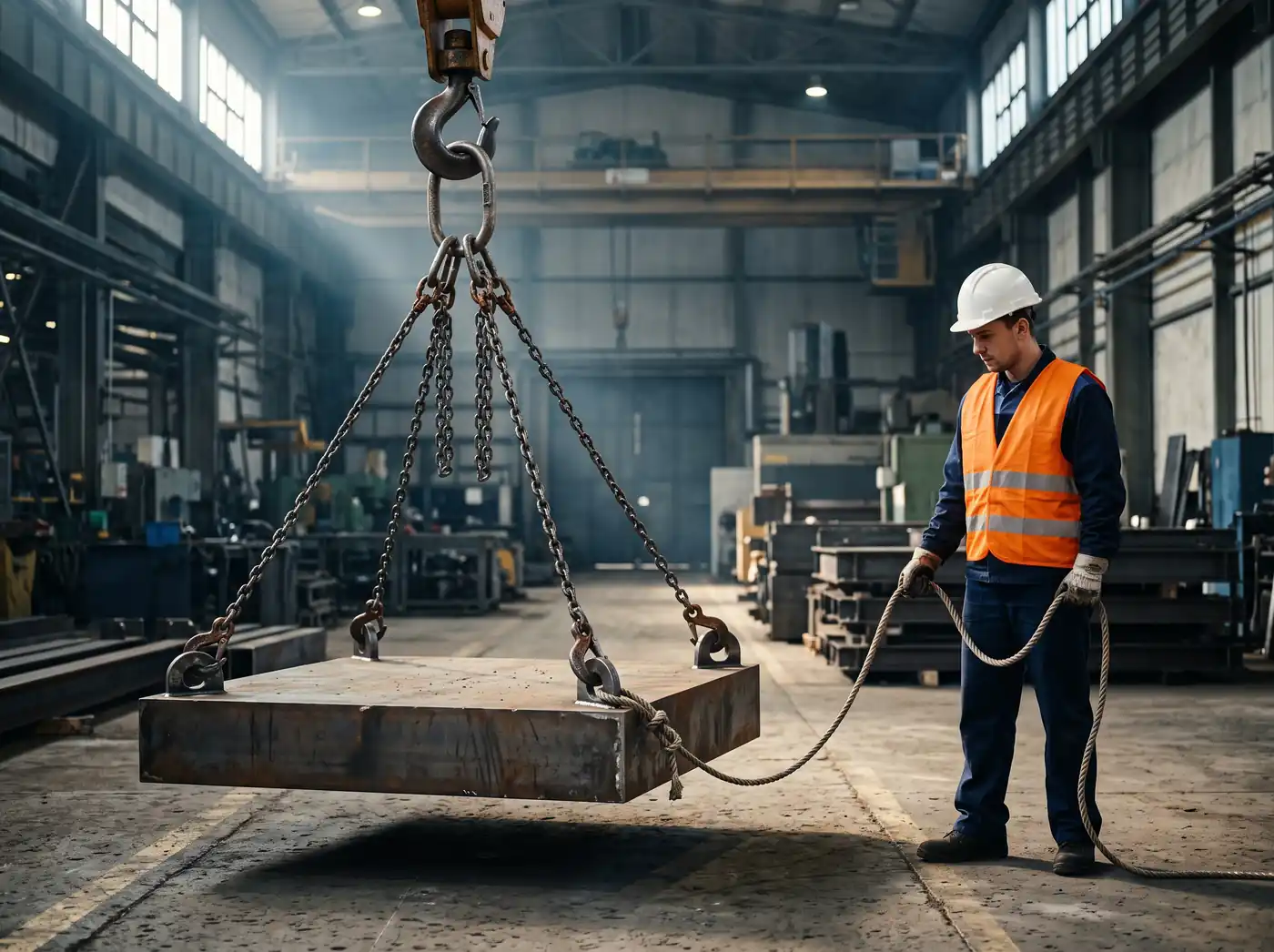
A load slinger works with lifting slings that they must be able to select, inspect and use correctly. The course covers the full range of slings as well as the principles of their safe use.
- Wire ropes and wire-rope slings — strong and durable, suitable for heavier loads; inspected for broken wires and deformations.
- Chain slings — robust and resistant to heat and abrasion; wear and deformation of the links are monitored.
- Textile straps and slings — lightweight and gentle on load surfaces; inspected for cuts, burns and seam damage.
- Hooks, shackles and spreader bars — components for suspending and distributing loads; hooks must have a working safety latch.
Group A versus group B
Under § 17 ods. 2 of Decree No. 508/2009 Coll., loads on group A lifting equipment (a motor-driven crane or hoist with a load capacity of over 1,000 kg, or a manually operated unit of over 5,000 kg) may only be slung by a load slinger holding a valid licence card. For group B equipment (motor-driven, up to 1,000 kg), a written document confirming a knowledge assessment drawn up by an inspection technician is sufficient. The deciding factor is the load capacity of the equipment — not the height, which is a criterion only for mobile elevating work platforms.
Course content
The basic course runs for 20 hours and is based on Decree No. 356/2007 Coll. on educational and training activities. It combines theory with practical preparation and concludes with a written assessment and a practical examination.
Theoretical component
You cover safety regulations, the types and inspection of lifting slings, load weight calculation and centre-of-gravity determination, the effect of the slinging angle on sling loading, signalling during lifting operations, and the principles of safe slinging, lifting and placing of loads.
Practical component and examination
The practical component is essential for a load slinger — it practises the correct selection and inspection of slings, the attaching and suspending of loads, centre-of-gravity estimation and communication with the crane operator. The course concludes with a written test and a practical examination; on successful completion a load slinger's licence card is issued.
Legal basis, obligations and penalties
The activity of a load slinger is governed by binding legal regulations, which must be distinguished from STN technical standards.
Key regulations
Under § 16 ods. 1 písm. a) of Act No. 124/2006 Coll., load slinging on group A equipment requires a load slinger's licence card; § 17 ods. 2 of Decree No. 508/2009 Coll. distinguishes between group A (licence card) and group B (document from an inspection technician). The prerequisites for issuing a licence card are a minimum age of 18 years and medical fitness (§ 16 ods. 2 a 4).
Penalties for breach
If the labour inspectorate finds that loads are being slung without a valid credential, fines are imposed under § 19 of Act No. 125/2006 Coll.:
| Breach | Fine | Legal basis |
|---|---|---|
| Breach of BOZP (OSH) regulations (employer) | up to €100,000 | § 19 ods. 1 písm. a) |
| Accident with serious bodily harm / fatal accident | at least €20,000 / at least €33,000 | § 19 ods. 1 písm. a) |
| Serious breach of BOZP obligations | €1,000 – €200,000 | § 19 ods. 2 písm. b) |
| Operating without a licence card or document | €300 – €33,000 | § 19 ods. 2 písm. a) |
| Managerial employee or statutory representative | up to four times the average monthly earnings | § 19 ods. 1 písm. c) |
Who issues the load slinger's licence card. The load slinger's licence card is issued by a person authorised for education and training, not by the labour inspectorate (§ 15 ods. 2 of Decree No. 508/2009 Coll. in conjunction with § 16 ods. 1 of Act No. 124/2006 Coll.). From 1 April 2021 (Act No. 73/2021 Coll.), the issuing of licence cards and certificates was transferred from labour inspectorates to authorised persons.
Credential, validity and renewal
For group A equipment you receive a load slinger's licence card issued by a person authorised for education and training; for group B equipment a written document from an inspection technician. The licence card is issued for an indefinite period under § 16 ods. 5 of Act No. 124/2006 Coll.
Validity is conditional on the ongoing fulfilment of obligations (§ 16 ods. 12):
- Refresher familiarisation: the statutory minimum is at least once every 3 years (§ 7 ods. 5 of Act No. 124/2006 Coll.); in practice a stricter interval of 2 years from technical standard STN 27 0143 applies for load slingers (not from statute).
- Refresher professional training (AOP): the holder of a load slinger's licence card must complete it within 5 years of issue and subsequently always within 5 years (§ 16 ods. 8 of Act No. 124/2006 Coll.).
- Preventive medical examination (LPP): medical fitness must be renewed within 5 years (§ 16 ods. 6); if it lapses, the licence card ceases to be valid.
We can monitor and remind you of these deadlines for your company, so that your load slingers' licence cards remain valid.
How the course runs – the process
The entire process is guided by our team — from first contact to issue of the licence card in five steps.
Enquiry You contact us and provide the basic details — the number of participants, the type of lifting equipment on which loads are slung (group A or group B by load capacity), and the location where you need the training.
Scheduling We agree a date and scope of the course (basic course 20 hours including the practical component) and send you the form for the medical fitness assessment.
Training at your premises The trainer delivers the theoretical and practical preparation — lifting slings and their inspection, load weight calculation and centre-of-gravity assessment, slinging angles, signalling and communication with the crane operator.
Final knowledge assessment and practical examination Participants complete a written knowledge assessment and a practical examination. The load slinger's professional knowledge is assessed by a person authorised for education and training.
Issue of the licence card Upon successful completion, the load slinger's licence card is issued by a person authorised for education and training; for group B equipment a written document from an inspection technician is issued instead. We will remind you of the deadlines for refresher familiarisation, preventive medical examinations (LPP) and refresher professional training.
Participation conditions, deadlines and legal basis
| Item | Value | Legal basis |
|---|---|---|
| Minimum age | at least 18 years of age | § 16 ods. 2 of Act No. 124/2006 Coll. |
| Medical fitness | medical fitness assessment not more than 6 months old | § 16 ods. 2 a 4 of Act No. 124/2006 Coll. |
| Course scope | basic course 20 hours (including the practical component) | Decree No. 356/2007 Coll. |
| Credential — group A equipment | load slinger's licence card (person authorised for education and training) | § 17 ods. 2 of Decree No. 508/2009 Coll. + § 16 ods. 1 písm. a) of Act No. 124/2006 Coll. |
| Credential — group B equipment | written document from an inspection technician | § 17 ods. 2 of Decree No. 508/2009 Coll. + § 16 ods. 1 písm. c) of Act No. 124/2006 Coll. |
| Refresher familiarisation | statute at least once every 3 years; STN 27 0143 stricter at 2 years | § 7 ods. 5 of Act No. 124/2006 Coll. / STN 27 0143 |
| Refresher professional training (licence card) | within 5 years, then always within 5 years | § 16 ods. 8 of Act No. 124/2006 Coll. |
| Validity of licence card | for an indefinite period (while obligations are met) | § 16 ods. 5 of Act No. 124/2006 Coll. |
Course scope
Participation requirements
Completed compulsory school attendance, age at least 18 years, medical fitness certificate not older than 6 months.
Course scope
Basic course: 8 hours. Repeated familiarization: 3 hours. Update professional training: 4 hours.
Repeated familiarization and update training
Familiarization with regulatory changes every 36 months (Act 124/2006, §7 para. 5). Update training every 5 years (Act 124/2006, §16 para. 8).
Why choose Alpha Safety?
- Certified instructors with years of experience
- Official certificates and credentials issued
- Flexible training schedules
- Training throughout Slovakia
- Individual approach to each participant
Duration
8 hours (basic course)
Format
Online theory + practical training
Related courses
Short answer
The “Load slinger” course is intended for company employees who attach and sling loads onto lifting equipment when working with cranes and hoists. It covers theoretical and practical preparation in safe slinging, slinging gear and signalling. After knowledge verification, the participant obtains a load slinger's licence card, which authorises the slinging of loads on reserved technical lifting equipment (VTZ) in group A under § 17 ods. 2 of Decree No. 508/2009 Coll.
Časté otázky – Load binder
A licence card is needed by every employee who slings and attaches loads onto reserved technical lifting equipment in group A. Under § 17 ods. 2 of Decree No. 508/2009 Coll., such loads may be slung only by a load slinger holding a valid licence card. For group B equipment, a written record of verified professional knowledge drawn up by an inspection technician is sufficient. It is also suitable for employers who, under § 6 a § 12 of Act No. 124/2006 Coll., must ensure that loads are slung by authorised personnel.
It depends on the classification of the equipment. For lifting equipment in group A (load capacity above 1 000 kg), the participant obtains a load slinger's licence card under § 16 ods. 1 písm. a) of Act No. 124/2006 Coll. For group B equipment, a written record of verified professional knowledge drawn up by an inspection technician is sufficient. Both the licence card and the record authorise the slinging of loads to the extent for which they were issued.
The load slinger's licence card is issued by a person authorised to provide education and training, not by the labour inspectorate. This follows from § 15 ods. 2 of Decree No. 508/2009 Coll. in conjunction with § 16 ods. 1 of Act No. 124/2006 Coll. From 1 April 2021, under Act No. 73/2021 Coll., the issuance of licence cards and certificates was transferred from the labour inspectorates to authorised persons.
The statutory minimum for refresher familiarisation is at least once every three years under § 7 ods. 5 of Act No. 124/2006 Coll. For load slingers, a stricter interval is applied in practice — at least once every two years — arising from the technical standard STN 27 0143, not from the law. In addition, the licence-card holder must complete refresher professional training within five years under § 16 ods. 8.
An applicant must be at least 18 years old and medically fit under § 16 ods. 2 of Act No. 124/2006 Coll. Medical fitness is evidenced by a medical assessment no older than six months (§ 16 ods. 4) on the basis of a preventive medical examination in relation to the work.
The basic load slinger course lasts 20 hours and includes both theoretical and practical preparation. It is based on the education and training framework under Decree No. 356/2007 Coll. It concludes with a written knowledge verification and a practical examination. For company groups, we can adapt the organisation and dates to the running of your operation.
The course combines theory and practice: safety regulations, the types and inspection of slinging gear (ropes, chains, slings, hooks), calculating the weight and determining the centre of gravity of the load, the effect of the slinging angle on the load on the slings, communication signalling and the principles of safe slinging, lifting and depositing of loads.
Yes. For a load slinger the practical part is crucial — it trains the correct selection and inspection of slinging gear, attaching and suspending the load, estimating the centre of gravity and communicating with the crane operator. The course concludes with a written test and a practical examination; only after passing them is the load slinger's licence card issued.
The deciding factor is the equipment's load capacity. Group A comprises power-driven cranes and hoists with a load capacity above 1 000 kg (and manually driven ones above 5 000 kg) — there a load slinger's licence card is required. Group B is power-driven equipment up to 1 000 kg — there a written record from an inspection technician is sufficient. This follows from Annex No. 1 and § 17 ods. 2 of Decree No. 508/2009 Coll.
These are two separate professional competences. A load slinger's licence card authorises the slinging and attaching of loads, while operating the crane itself has its own licence card or document under Decree No. 508/2009 Coll. If an employee both slings loads and operates the equipment, they need both competences.
Under § 19 of Act No. 125/2006 Coll., an employer faces a fine of up to EUR 100 000, for a serious breach from EUR 1 000 to 200 000, and for an activity without a licence card from EUR 300 to 33 000. In the case of an accident causing serious harm the fine is at least EUR 20 000, and in the case of death at least EUR 33 000. The licence card is tied to a specific person, so everyone who slings loads must hold one.
Under § 16 ods. 5 of Act No. 124/2006 Coll., the load slinger's licence card is issued for an indefinite period. However, its validity is tied to a preventive medical examination within five years (§ 16 ods. 6), refresher professional training within five years (§ 16 ods. 8) and refresher familiarisation. If these are neglected, the licence card becomes invalid (§ 16 ods. 12).
An applicant should be at least 18 years old, have appropriate basic education and medical fitness for the work documented by a medical assessment. We can specify the exact entry requirements and the required medical assessment for a group of employees according to the job positions at your company.
Yes, we can organise the course for a group of employees directly at your company or operation, including the practical part on your lifting equipment. We adapt the scope and dates to your operation so that work downtime is as small as possible.
Basic course from 74,90 € per person (prices exclude VAT). Refresher training from 21,90 €. Update professional training (AOP) from 44,90 €. We confirm the exact price based on the number of participants and the training format.
Interested in load binder training?
Contact us and we will schedule a training date.