Education and training for operation of mobile elevating work platforms
Get your licence or document for operating mobile elevating work platforms. We'll prepare you and your employees for safe work at height from a platform — complete the training online or in person. After the knowledge assessment you'll receive an operator licence or a written proof of professional competence depending on the platform type.
Interested in this course?
Leave us your contact and we will get back to you with dates, usually within 24 hours.
What the mobile elevating work platform operator course is
The mobile elevating work platform (MEWP) operator course is professional training upon successful completion of which you receive a valid credential authorising you to operate a mobile elevating work platform (internationally known as a MEWP — Mobile Elevating Work Platform) independently and safely. It is designed for workers in construction, maintenance, logistics and installation, as well as for employers who are required by law to ensure that their platforms are operated only by authorised persons.
A motorised mobile elevating work platform with a lifting height above 1.5 m is reserved technical lifting equipment (VTZ) of group A according to Annex 1 of Decree No. 508/2009 Coll. The way in which you demonstrate professional competence depends on whether the platform is intended for operation on public roads. You will learn about platform construction, safe procedures, fall risks and the principles of working at height — theory you can put into practice immediately. See also the related courses on lifting equipment and crane operation and load slinging, or the guide to reserved technical equipment.
Who the course is for
The course addresses two groups — the individual seeking to gain a qualification and improve their employment prospects, and the company that is required by law to ensure authorised operation of its platforms.
For the individual
A credential to operate a mobile elevating work platform significantly broadens your employment opportunities. Workers with this qualification are in demand in construction, external wall insulation and façade installation, building maintenance, warehouses and logistics centres, HVAC and electrical installation, tree pruning and lighting repairs. A valid credential is often a condition of employment and for many employers a prerequisite for higher pay.
For the company and employer
Under § 6 of Act No. 124/2006 Coll. you are required to ensure occupational health and safety (BOZP) at work and to ensure that work equipment is operated only by professionally competent persons. Under § 12 ods. 2 písm. d) of that act, an employee may operate higher-risk work equipment only on the basis of a credential under § 16 ods. 1 and only if you have assigned them to do so. If you fail to fulfil this obligation and the labour inspectorate finds that the platform is being operated by a person without a valid credential, you are exposed to a fine and, in the event of an accident, also to criminal liability. The credential is tied to a specific natural person, not to the company — every worker who operates the platform must hold a valid credential.
Types of mobile elevating work platforms
Mobile elevating work platforms differ in their lifting mechanism, undercarriage and drive type. For correct selection and safe operation it is important to know their types and areas of application — we always tailor the training content to the platforms your company actually uses.
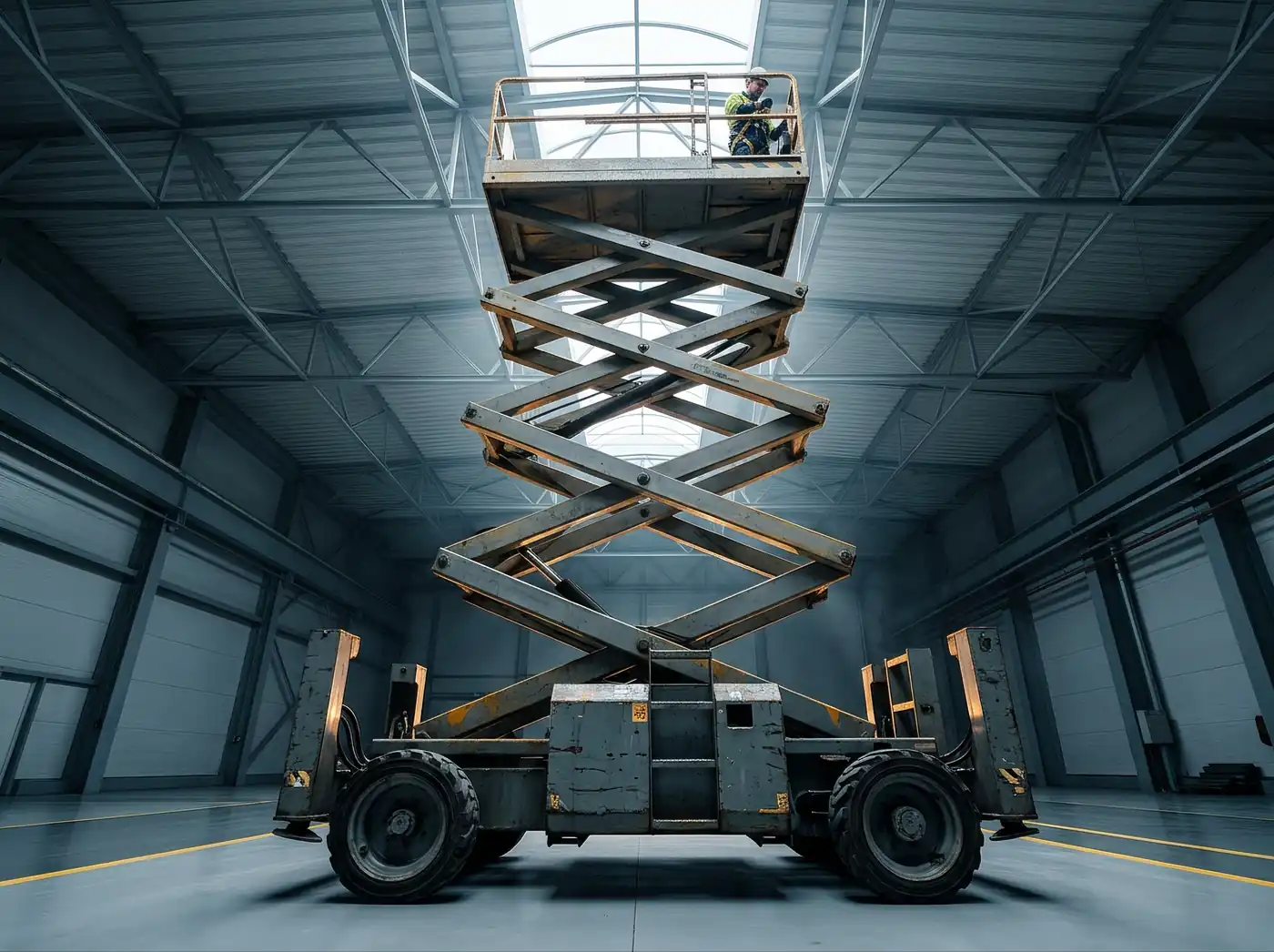
- Scissor lifts are raised vertically up and down by a scissor mechanism. The basket does not swing sideways but offers a large platform area and higher load capacity. Ideal on flat, hard surfaces — in manufacturing and warehouse halls, for installation and maintenance of ceilings or walls. Electric versions are quiet and emission-free indoors; diesel models can also handle outdoor use.
- Articulated (knuckle-boom) lifts have a jointed boom, so the arm can get around obstacles, reach 'round a corner' or over structures; the basket can rotate. Suitable for hard-to-reach locations — tree pruning, work over fences and installation in complex environments.
- Telescopic (boom) lifts have an extendable arm and achieve the greatest working height and outreach. Used on façades, high halls and wherever a long horizontal reach is needed.
- Self-propelled platforms have their own drive and the operator moves them directly from the basket or undercarriage — enabling fast repositioning around the worksite without a tow vehicle.
- Trailer-mounted platforms are towed by a vehicle and stabilised on-site with outriggers. They are cost-effective and suitable for occasional work and moves between multiple locations.
Platforms with a registration number versus those without
From a legislative standpoint the decisive factor is whether the platform is intended for use on public roads. Platforms without a registration number (typically scissor, articulated, telescopic and trailer-mounted types not intended for road use) fall under § 17 ods. 3 of Decree No. 508/2009 Coll. and may be operated by a person holding a written document confirming verification of professional knowledge issued by an inspection technician. Platforms with a registration number on a motorised undercarriage intended for use on public roads fall under § 17 ods. 1 písm. b) of the same decree and require an operator licence card. The type of credential and the procedure for obtaining it therefore depend on whether the platform travels on public roads or not.
Course content
The course is divided into a theoretical and a practical part, and concludes with a knowledge assessment. Its content is based on the requirements of Decree No. 356/2007 Coll. on educational and training activities and on the safety and technical requirements for operating reserved lifting equipment (VTZ).
Theoretical part
It takes you through the legal framework and safety principles: the key regulations (Act No. 124/2006 Coll., Decrees No. 508/2009 Coll. and No. 147/2013 Coll.), the obligations of the operator and employer, the classification and construction of platforms, their technical parameters (basket load capacity, working height, outreach, stability), the operating principle of lifting mechanisms and safety devices. Considerable attention is given to risks: falls from height, platform overturning, contact with power lines, the effects of wind and uneven ground, as well as pre-use operational inspections, reading the manufacturer's manual, use of fall-protection equipment and the procedure for rescuing a person from the basket.
Practical part and final assessment
Practical operation is assessed and hands-on practice takes place on a specific type of platform in cooperation with the employer. A quality provider includes practical demonstrations — a pre-work check, deploying the stabilising legs, controlling movements and the procedure in the event of a fault — beyond the minimum, so that participants are genuinely prepared for real work. The final assessment is normally in written (test) form; at an authorised legal entity the pass mark is typically 80 % of correct answers. Upon successful completion the appropriate credential is issued.
Legal basis, obligations and sanctions
The operation of mobile elevating work platforms is governed by binding legislation. These must be distinguished from technical standards STN (e.g. STN EN 280-1), which provide a technical basis but are not themselves law.
Act No. 124/2006 Coll. on OSH
Under § 16 ods. 1 a designated work resource may be operated only on the basis of a valid licence card, certificate or document. For a platform with a registration number this is a licence card (§ 16 ods. 1 písm. a)); for a platform without a registration number it is a document confirming verification of professional knowledge issued by an inspection technician (§ 16 ods. 1 písm. c)). Under § 16 ods. 2 the conditions for issue include, among other things, an age of at least 18 years and medical fitness. Under § 7 ods. 5 the employer must arrange refresher familiarisation to take place at least once every three years, unless a special regulation lays down a shorter interval — and for work from a platform such a shorter interval (12 months) is indeed laid down.
Decrees No. 508/2009 and No. 147/2013 Coll.
Decree No. 508/2009 Coll. classifies a motorised platform with a lifting height above 1.5 m as reserved technical lifting equipment of group A (Annex 1). Under § 17 ods. 1 písm. b) a platform on a motorised undercarriage intended for use on public roads may be operated only by a person holding a valid licence card; under § 17 ods. 3 a platform not listed in paragraph 1 may be operated by a person holding a written document confirming verification of professional knowledge issued by an inspection technician. Decree No. 147/2013 Coll., in § 3 ods. 1 písm. b), lays down that familiarisation for work from a mobile elevating work platform is carried out at least once every 12 months.
Sanctions under Act No. 125/2006 Coll.
If the labour inspectorate finds that the platform is being operated by a person without a valid credential, the following substantial fines are imposed under § 19 of the Labour Inspection Act:
| Breach | Fine | Legal basis |
|---|---|---|
| Breach of BOZP (OSH) regulations (employer) | up to €100,000 | § 19 ods. 1 písm. a) |
| Accident causing serious bodily harm / causing death | at least €20,000 / at least €33,000 | § 19 ods. 1 písm. a) |
| Managerial employee or statutory body member | up to four times the average monthly earnings | § 19 ods. 1 písm. c) |
| Activity without authorisation, licence card or document | from €300 to €33,000 | § 19 ods. 2 písm. a) |
Beware of a widespread misconception: some providers cite 'Government Regulation No. 356/2006 Coll.' as the legal basis for platform operation. This is incorrect — that regulation governed health protection against carcinogenic and mutagenic factors (chemical risks), was repealed and from 1 June 2024 replaced by Government Regulation No. 121/2024 Coll. It has nothing to do with the authorisation to operate platforms.
Credential, validity and renewal
After successful completion you receive the credential corresponding to the type of platform: for platforms without a registration number this is a written document confirming verification of professional knowledge issued by an inspection technician (§ 17 ods. 3 of Decree No. 508/2009 Coll.); for platforms with a registration number it is a licence card issued by an authorised legal entity. Both are issued for an indefinite period under § 16 ods. 5 of Act No. 124/2006 Coll. From 1 April 2021, licence cards and certificates are issued exclusively by authorised legal entities, not by labour inspectorates (Act No. 73/2021 Coll.).
An indefinite period does not mean no further obligations — and here is the important distinction between the two types of credential:
- Platform without a registration number (document from inspection technician): refresher familiarisation at least once every 12 months is required (§ 3 ods. 1 písm. b) of Decree No. 147/2013 Coll.). Update training under § 16 ods. 8 of Act No. 124/2006 Coll. does not apply to this credential — that provision covers only the licence card, certificate and document under § 16 ods. 1 písm. b)).
- Platform with a registration number (licence card): in addition to refresher familiarisation (12 months), the holder must under § 16 ods. 8 complete update training within five years of the issue of the licence card and then again within five years of each preceding update training.
- Medical fitness is demonstrated by a medical assessment (§ 16 ods. 2 a 4); if the holder loses it, the credential loses its validity.
If you miss the refresher familiarisation (or, in the case of a licence card, the update training), you may not legally operate the platform even if the credential was issued for an indefinite period. We can set up deadline reminders for your company to keep credentials valid.
How the course works — procedure
The whole process is straightforward and our team guides you through it — from first contact to issue of the credential in five steps.
Enquiry You contact us by phone or e-mail and provide the basic details — the number of participants, the type of platform (with or without a registration number) and the location where you need the training.
Scheduling We agree on a suitable date and scope of training. We will advise you on which credential you need for your platforms and send you the form for the medical fitness assessment.
Training at your premises The trainer delivers the theoretical preparation directly at your premises, saving you both time and travel costs. Participants become familiar with the regulations, platform construction, risks and safe operating procedures.
Final knowledge assessment Participants take a written knowledge assessment. For platforms without a registration number the assessment is conducted by an inspection technician; for platforms with a registration number the assessment takes place at an authorised legal entity.
Issue of the credential Following successful completion, we issue the appropriate credential for operating the mobile elevating work platform and alert you to the deadlines for refresher familiarisation and any required update training.
Participation requirements, deadlines and legal basis
| Item | Value | Legal basis |
|---|---|---|
| Minimum age | at least 18 years | § 16 ods. 2 of Act No. 124/2006 Coll. |
| Medical fitness | medical assessment not older than 6 months | § 16 ods. 2 a 4 of Act No. 124/2006 Coll. |
| Credential — platform without a registration number | written document confirming verification of professional knowledge (inspection technician) | § 17 ods. 3 Dec. No. 508/2009 + § 16 ods. 1 písm. c) Act No. 124/2006 |
| Credential — platform with a registration number | licence card | § 17 ods. 1 písm. b) Dec. No. 508/2009 + § 16 ods. 1 písm. a) Act No. 124/2006 |
| Platform classification | VTZ (reserved technical equipment) lifting group A (lifting height above 1.5 m) | Annex No. 1 of Dec. No. 508/2009 Coll. |
| Refresher familiarisation | at least once every 12 months | § 3 ods. 1 písm. b) of Dec. No. 147/2013 Coll. |
| Update training (licence card only) | within 5 years, then always within 5 years | § 16 ods. 8 of Act No. 124/2006 Coll. |
| Credential validity | for an indefinite period (subject to fulfilment of obligations) | § 16 ods. 5 of Act No. 124/2006 Coll. |
Course scope
Participation requirements
Completed compulsory school attendance, age at least 18 years.
Course scope
Basic course: 3 hours. Repeated familiarization: 3 hours.
Repeated familiarization
Familiarization with regulatory changes every 12 months pursuant to Decree No. 147/2013 Coll., §3 para. 1.
Why choose Alpha Safety?
- Certified instructors with years of experience
- Official certificates and credentials issued
- Flexible training schedules
- Training throughout Slovakia
- Individual approach to each participant
Duration
By equipment type
Format
Online and in-person
Related courses
Short answer
The “Operation of mobile elevating work platforms” course is intended for company employees who operate scissor, articulated or telescopic platforms. It covers theory on the types of platforms, their safe operation and the BOZP principles for working at height. The graduate obtains a document of professional competence for operation, which the employer requires for reserved technical lifting equipment (VTZ) under Decree No. 508/2009 Coll.
Časté otázky – Mobile elevating work platforms
The course is intended for company employees who operate self-propelled or transportable work platforms – scissor, articulated and telescopic. It is suitable for construction, assembly, maintenance and warehouse operations where work is carried out at height. A participant must be at least 18 years old and medically fit. The course also addresses employers who, under § 6 a § 12 of Act No. 124/2006 Coll., must ensure their platforms are operated by authorised personnel.
It depends on the type of platform. For a platform without a registration number, the graduate obtains a written record of verified professional knowledge drawn up by an inspection technician under § 17 ods. 3 of Decree No. 508/2009 Coll. (corresponding to § 16 ods. 1 písm. c) of Act No. 124/2006 Coll.). For a platform with a registration number intended for operation on roads, the graduate obtains a licence card under § 16 ods. 1 písm. a) of Act No. 124/2006 Coll. Both are issued for an indefinite period.
A platform with a registration number is mounted on a motor-driven chassis and is intended for operation on roads – it is operated on the basis of a licence card under § 17 ods. 1 písm. b) of Decree No. 508/2009 Coll. A platform without a registration number (typically scissor, articulated, telescopic) is not intended for driving on roads – it is operated on the basis of a written record of verified professional knowledge under § 17 ods. 3 of the same decree. The type of document and the procedure for issuing it depend on this.
Refresher familiarisation for work from a mobile elevating work platform is carried out at least once every 12 months under § 3 ods. 1 písm. b) of Decree No. 147/2013 Coll. For a platform with a registration number (a licence card), the holder must in addition complete refresher professional training within five years under § 16 ods. 8 of Act No. 124/2006 Coll. This refresher professional training does not apply to the record from an inspection technician (a platform without a registration number) – for that, refresher familiarisation once every 12 months is sufficient.
It is technical equipment with a higher degree of hazard under Decree No. 508/2009 Coll. A mobile elevating work platform with a motor drive and a lifting height above 1.5 m is classed among reserved technical lifting equipment in group A under Annex No. 1 of that decree. This is precisely why a licence card or a record of verified professional knowledge is required for its operation.
An applicant must be at least 18 years old and medically fit under § 16 ods. 2 of Act No. 124/2006 Coll. Medical fitness is evidenced by a medical assessment no older than six months (§ 16 ods. 4), issued on the basis of a preventive medical examination in relation to the work.
Participants gain theoretical knowledge of the types and procedures for operating the individual types of mobile elevating work platforms, focusing on health and safety at work. It includes operating principles, pre-use checks, the risks of falling and overturning and safe work at height. The content is based on Decree No. 356/2007 Coll. and we adapt it to the type of platforms your company actually uses.
Yes, we also deliver the training directly at your operation for a group of employees, eliminating travel and lost working time. We agree the date and scope according to the number of operating staff and the type of platforms used. Contact us for the exact scope and a quotation.
A mobile elevating work platform with a lifting height above 1.5 m is reserved technical lifting equipment under Decree No. 508/2009 Coll. Under § 17 of that decree, it may be operated only by a professionally competent person holding a valid document. At the same time, the employer is obliged to familiarise every employee with the BOZP regulations regularly, demonstrably and comprehensibly under § 7 of Act No. 124/2006 Coll.
Under § 19 of Act No. 125/2006 Coll. on labour inspection, an employer faces a fine of up to EUR 100 000; in the case of an occupational accident causing serious harm to health at least EUR 20 000, and in the case of death at least EUR 33 000. For carrying out an activity without authorisation, a licence card or a document, a fine of EUR 300 to 33 000 applies. The document is tied to a specific person, so everyone who operates the platform must hold one.
Yes. The law does not distinguish between frequent and occasional operation. As soon as you operate a mobile elevating work platform with a lifting height above 1.5 m, you are required to hold a valid document under § 16 of Act No. 124/2006 Coll. and § 17 of Decree No. 508/2009 Coll.
No. For platforms without a registration number, the record of verified professional knowledge is drawn up by an inspection technician. For platforms with a registration number, verification takes place at an authorised legal entity. From 1 April 2021, licence cards and certificates are issued exclusively by authorised legal entities, not by labour inspectorates – this change was introduced by Act No. 73/2021 Coll.
A document issued under Slovak regulations is valid in the territory of the Slovak Republic. For work abroad, recognition of the qualification is governed by the rules of the given state and the employer's requirements; the technical basis for the construction and testing of platforms is the standard STN EN 280-1. Before working in another state, we therefore recommend checking the specific requirements.
No. STN EN 280-1 is a Slovak technical standard for mobile elevating work platforms (structural calculations, stability criteria, construction, safety and testing). It is a technical basis, not a legal regulation. The binding obligations for operation follow from Act No. 124/2006 Coll. and Decree No. 508/2009 Coll.
Basic course from 79,90 € per person (prices exclude VAT). Refresher training from 21,90 €. We confirm the exact price based on the number of participants and the training format.
Interested in mobile platform training?
Contact us and we will schedule a training date.