HACCP – Food Safety System in Your Operation
Our company provides comprehensive HACCP systems for restaurants, food service operations, producers and food retailers across Slovakia — from drawing up a tailor-made HACCP plan through operational and sanitation rules to training and advice based on the risks of the specific operation. Everything is handled in accordance with Regulation (EC) No. 852/2004 and Act No. 152/1995 Coll. on foodstuffs, so your operation passes RÚVZ and ŠVPS checks without issues and avoids penalties.
Updated:
Interested in this service?
Leave us your contact and we will get back to you with pricing and dates, usually within 24 hours.
Short answer
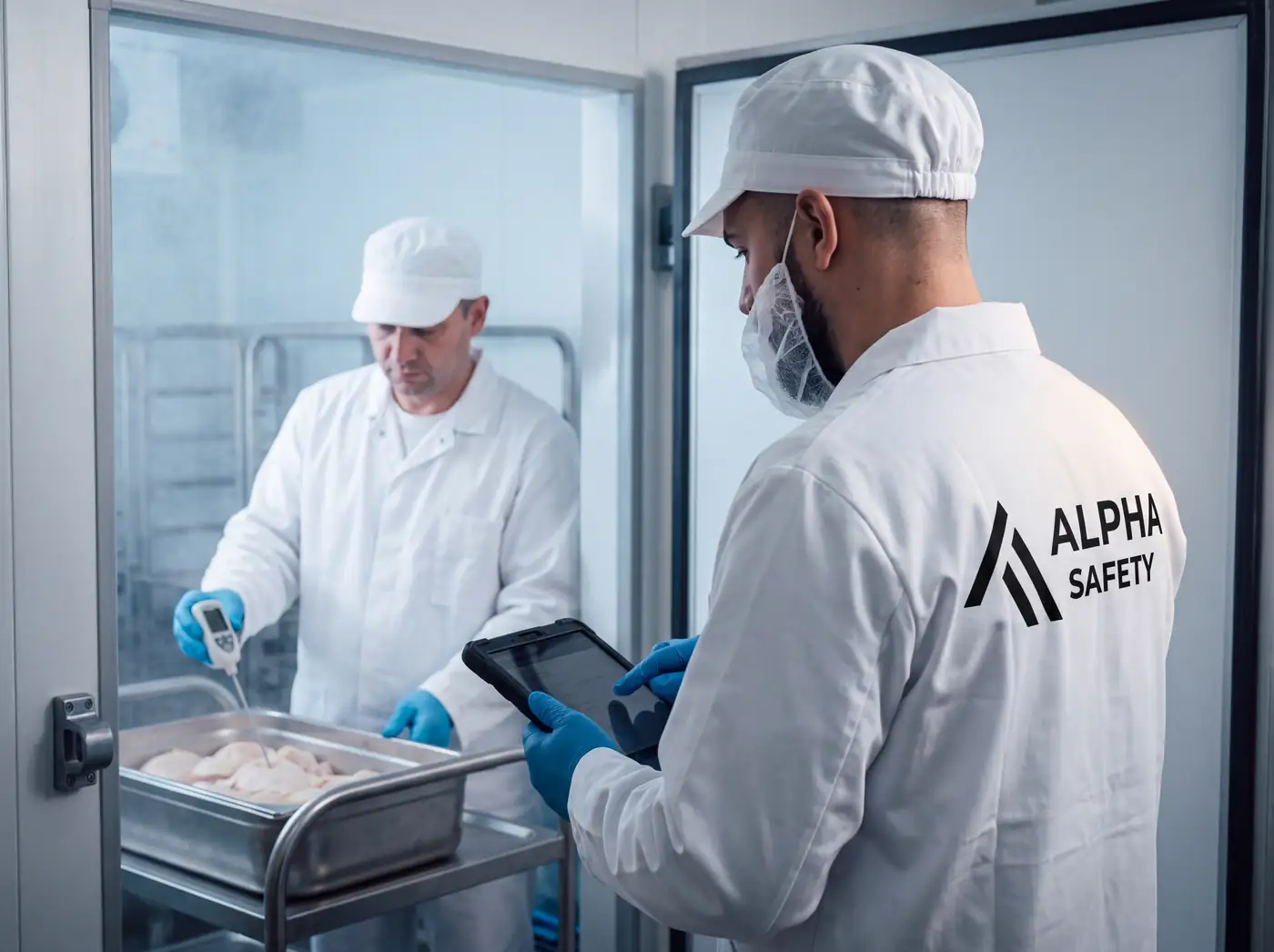
HACCP for catering and the food industry is a hazard analysis and critical control points system that every operation handling food is required to introduce – restaurants, snack bars, cafés, patisseries, stalls, warehouses and production. Alpha Safety prepares personalised HACCP documentation according to the nature of the operation and its risks, implements it in practice, trains the staff, updates the documents when changes occur and assists during an inspection by the regional public health authority. We will prepare a tailored quote after a no-obligation consultation.
What our HACCP documentation service includes
The term HACCP documentation refers to a comprehensive system of procedures that Regulation (EC) No 852/2004 on food hygiene requires of every food business operator. Under čl. 5 ods. 1 of this Regulation, food business operators must put in place, implement and maintain a permanent procedure or procedures based on the HACCP principles. So it is not enough merely to have paper in a binder — the system must genuinely work and reflect what actually happens in your establishment.
As part of the service we prepare your complete documentation turnkey: a bespoke HACCP plan, operating rules, a sanitation programme and a set of record forms tailored to your processes. We do not use generic templates downloaded from the internet — every document is based on a physical inspection of your establishment and on an analysis of its specific hazards.
- Hazard analysis — biological, chemical and physical, at every step of food processing.
- Identification of critical control points (CCP) and critical limits that separate an acceptable state from an unacceptable one.
- HACCP plan with monitoring procedures, corrective actions and verification procedures.
- Operating and sanitation rules including records of cleaning, disinfection and pest control (DDD).
- Record forms for temperatures, goods receipt, use-by date monitoring and staff hygiene.
- Staff training and accompaniment during the inspection by the supervisory authority.
For mass-catering establishments we also prepare operating rules. Act No. 355/2007 Coll. does not impose them on catering establishments — § 26 does not list them among the operator's duties and § 52 ods. 1 písm. e) applies only where another regulation creates the obligation. As an internal hygiene document they are still worthwhile: they unify procedures, make staff training easier and show during an inspection that the operation is under control. For establishments where the law does require them (accommodation facilities, swimming pools, personal-care establishments), we draw them up and submit them to the RÚVZ for approval.
Who is required to have HACCP
The obligation to implement a system based on the HACCP principles is not tied to the size of the establishment or the number of employees. It follows directly from čl. 5 ods. 1 of Regulation (EC) No 852/2004 and applies to every food business operator that handles food in any way after primary production.
In practice this means that HACCP is needed by every establishment that produces, processes, stores, transports, sells or serves food. It therefore covers a broad range of businesses — from a small café to a manufacturing plant.
- Hospitality and mass catering — restaurants, cafés, patisseries, snack bars, canteens, fast-food stands.
- Food production — bakeries, meat processing, dairies, beverage and ready-meal production.
- Shops and retail — grocery stores, butcher's shops, delicatessens, counters with unpackaged goods.
- Warehousing and distribution — storage and transport of food, including refrigerated logistics.
- Catering and mass catering — school and company canteens, transport of ready meals.
- Food e-shops — sale and dispatch of food goods.
An important exception: primary production is exempt from the HACCP obligation. Under čl. 5 ods. 3 of Regulation (EC) No 852/2004, the HACCP principles apply only to the stages following primary production. Primary production itself (e.g. growing crops or rearing animals) is subject to the general hygiene requirements under Annex I to the Regulation. The domestic framework is complemented by Act No. 152/1995 Coll. on food, which in § 4 imposes obligations at all stages of the production, processing and distribution of food.
If you are not sure whether HACCP applies to your establishment, our complete HACCP guide or a no-obligation consultation can help.
The legislation HACCP fulfils
HACCP is not a standalone standard but the way in which an operator complies with several legal rules at once. At its core is the European Regulation (EC) No 852/2004 on food hygiene, which in čl. 5 lays down the obligation to follow procedures based on the HACCP principles and in its Annex II sets the general hygiene requirements for the stages after primary production.
The national bridge is Act No. 152/1995 Coll. on food, which in § 4 ods. 2 requires the operator to carry out its own checks on the safety and quality of food, to keep records of them, and to instruct and train employees in food hygiene. For mass-catering establishments, Act No. 355/2007 Coll. on the protection, promotion and development of public health and the implementing Decree of the MZ SR No. 533/2007 Coll. on the details of requirements for mass-catering establishments also apply.
| Legislation | What it governs | Who it applies to |
|---|---|---|
| Regulation (EC) No 852/2004 on food hygiene | HACCP principles (čl. 5) and general hygiene requirements | All establishments after primary production |
| Act No. 152/1995 Coll. on food | Own checks on food safety and records (§ 4 ods. 2) | Production, processing, distribution, sale |
| Act No. 355/2007 Coll. on the protection of public health | Operating rules and good manufacturing practice (§ 26 ods. 4) | Mass-catering establishments (hospitality) |
| Decree of the MZ SR No. 533/2007 Coll. | Details of requirements for mass-catering establishments | Restaurants, canteens, cafés, snack bars |
| Codex Alimentarius CXC 1-1969 | International food hygiene principles and the 7 HACCP principles | Voluntary professional basis (no sanctions) |
The very structure of the seven HACCP principles and the twelve steps of their application derives from the international recommendation Codex Alimentarius CXC 1-1969. This is a voluntary international standard with no sanctions of its own — it gains binding force only through its incorporation into Regulation 852/2004.
Who inspects your HACCP — RÚVZ or the veterinary authority
There is not a single supervisory authority for HACCP — it depends on what your establishment does. The division of competence is governed by § 23 of Act No. 152/1995 Coll. and in practice creates two separate lines of inspection. Knowing who will come to you matters as early as the documentation stage.
| Type of establishment | Supervisory authority | Legal basis |
|---|---|---|
| Public and mass catering (hospitality) | Regional public health authority (RÚVZ / ÚVZ SR) | § 23 ods. 2 of Act 152/1995 + Act 355/2007 |
| Production, processing and placing food on the market | State Veterinary and Food Administration (ŠVPS) and RVPS | § 23 ods. 1 of Act 152/1995 |
Restaurants, cafés, patisseries, snack bars, stands and canteens are inspected by the regional public health authority (RÚVZ). Production establishments, shops and warehouses that place food on the market fall under the State Veterinary and Food Administration (ŠVPS) and the regional veterinary and food administrations (RVPS).
During an inspection, inspectors typically ask for the HACCP plan, the operating and sanitation rules, completed temperature and cleaning records, proof of staff training and, for hospitality, operating rules approved by the RÚVZ. We prepare your documentation so that it meets the requirements of the relevant authority and, where needed, we accompany you in person during the inspection.
Fines for missing or incorrect HACCP
Missing, out-of-date or merely formally completed HACCP documentation is among the most common inspection findings. Sanctions vary depending on which supervisory authority detects the breach and how serious the failing is.
| Area of breach | Sanction | Legal basis |
|---|---|---|
| Hospitality / mass catering | €150 to €20,000 (up to double for repeat offences) | § 57 ods. 43 písm. a) of Act 355/2007 |
| Food production and sale — lower band | €100 to €1,000 | § 28 ods. 1 of Act 152/1995 |
| Production and sale — middle band | €100 to €100,000 | § 28 ods. 2 of Act 152/1995 |
| Production and sale — upper band | €500 to €200,000 | § 28 ods. 3 of Act 152/1995 |
| Most serious breaches (unsafe food) | €1,000 to €500,000 | § 28 ods. 4 of Act 152/1995 |
| Natural person — non-business | up to €2,000 (up to €4,000 for repeat offences) | § 29 of Act 152/1995 |
For mass-catering establishments the decisive provision is § 57 ods. 43 písm. a) of Act No. 355/2007 Coll., under which the RÚVZ may impose a fine of €150 to €20,000, up to double for a repeat breach. In production and in placing food on the market, sanctions are graded under § 28 of Act No. 152/1995 Coll. — from a band of €100 to €1,000 for less serious failings up to €1,000 to €500,000 for the most serious breaches, such as placing unsafe food on the market.
The cost of professionally drawing up and maintaining HACCP is an order of magnitude lower than the bottom of the fine range — and, above all, it protects you from the reputational damage of having your establishment closed.
HACCP for hospitality versus HACCP for production
Although the principle is the same, HACCP for a restaurant and HACCP for a manufacturing plant differ significantly in both scope and supervision. We have summed up the difference so you know which cluster you belong to.
HACCP for hospitality and mass catering
Restaurants, cafés, patisseries and snack bars work mostly with finished or semi-finished products, and for them the key is maintaining the temperature chain, hygiene and sanitation. What is mandatory for them is the HACCP plan under Art. 5 of Regulation (EC) No 852/2004 and registration of the establishment under § 6 of Act No. 152/1995 Coll. Act No. 355/2007 Coll. also requires them, in § 26 ods. 4 písm. c), to apply the principles of good manufacturing practice and to monitor critical operations. Operating rules are not required of them by law — we will prepare them as a voluntary internal document if you wish.
HACCP for food production
Production establishments (bakeries, meat processing, dairies) have a longer and more complex technological chain, more critical control points and stricter requirements under Annex II to Regulation (EC) No 852/2004. They are supervised by the ŠVPS and RVPS. The documentation is more extensive and places greater emphasis on the traceability of raw materials, allergen management and validation of critical limits.
For smaller establishments, čl. 5 ods. 5 of Regulation (EC) No 852/2004 allows a flexible approach — in some businesses critical control points cannot be identified, and good hygiene practice can replace their monitoring. We can apply this flexibility correctly for you too.
How working with Alpha Safety works
We have set up the cooperation to burden you as little as possible. The first contact and the assessment of your obligations are non-binding and free of charge — only then do we propose a specific scope and a tailored quotation based on the nature of your establishment and its risks.
Initial inspection and process analysis We visit your establishment in person, walk through the food flow from receipt to service, and map the actual conditions and risks.
Hazard analysis and identification of CCP We identify biological, chemical and physical hazards and determine the critical control points with their critical limits.
Drawing up bespoke documentation We prepare the HACCP plan, the operating and sanitation rules and a set of record forms tailored to your establishment.
Implementation and training We put the system into everyday operation and train your staff so that they keep the records correctly and as a matter of course.
Submission to the RÚVZ or preparation for an inspection For hospitality we prepare and submit the operating rules to the RÚVZ; for production we prepare you for an RVPS inspection.
We operate throughout Slovakia, with our seat in Martin and 24/7 availability. The price of HACCP depends on the type and size of your establishment, so we always confirm it only after a no-obligation consultation — no hidden items. You can arrange it via our contact form.
HACCP training and documentation updates
HACCP is not a one-off document but a living system. For it to genuinely protect you and stand up to an inspection, your staff must be trained and the documentation must reflect the current state of the establishment.
Training employees in food hygiene is not optional. It follows from § 4 ods. 2 of Act No. 152/1995 Coll., under which the operator is required to instruct and train employees who come into contact with food in food hygiene. We provide the training, including the proof that demonstrates it was carried out during an inspection. See also our courses and training.
The documentation must be updated at every substantial change. Under the last subparagraph of čl. 5 ods. 2 of Regulation (EC) No 852/2004, when a product, process or any step changes the operator must review and amend the procedure. This applies to a new menu, technology, equipment and product range alike.
- Periodic review of the documentation so that it reflects the actual operation.
- Updates when the product, technology or layout of the establishment changes.
- Refresher training for staff and additional training when new employees join.
- Preparation for inspections and updating of record forms to meet new requirements.
Do fire protection and BOZP also concern you? We can cover all your establishment's obligations under one roof.
How will we help you?
HACCP documentation preparation
Complete preparation of custom HACCP documentation according to the nature of your operation.
Clear and understandable plan
A clear and understandable plan that you can immediately implement in practice.
Staff training
Training of staff for effective system implementation.
Plan update
Updating the plan when technology or operation scope changes.
Support during inspection
Support during health authority inspection including representation and communication.
Why work with us?
- Professionally prepared documentation
- Quick custom preparation
- Training of your staff
- Support during health inspections
- Prevention of fines up to €500,000
Frequently asked questions – HACCP
We determine the price individually according to the type, size and riskiness of your operation – a snack bar has a different scope than a food production facility. That is why we do not quote flat figures. After a no-obligation consultation, where we find out the nature of the operation and the range of products, we will prepare a specific tailored quote. Get in touch with us via the contact form.
The deadline depends on the type and size of the operation and the complexity of the technological procedures. After an inspection or initial consultation, we will give you a binding estimate. We can handle simpler operations (a stall, a small café) quickly, while production operations with several processes require a more thorough hazard analysis and determination of critical control points.
Yes. We prepare documentation for the full spectrum of operations – restaurants, cafés, patisseries, snack bars, canteens, catering, shops, and the production and processing of food. For catering operations, supervision is carried out by the regional public health authority, and for the production and placing of food on the market by the State Veterinary and Food Administration. We always adapt the plan to the specific type of operation.
Yes. Even a food truck, a refreshment stall or a seasonal operation is a public catering establishment that handles food, and it is subject to the obligation to have a procedure based on HACCP principles in place. Supervision is carried out by the competent regional public health authority. We will adapt the documentation to the limited range of products and the conditions of a mobile operation.
Yes. Storage, packaging, transport and the sale of food are stages following primary production, to which the obligation to introduce procedures based on HACCP principles applies under Article 5(1) and (3) of Regulation (EC) No 852/2004 on the hygiene of foodstuffs. For an e-shop we will prepare documentation focused on storage conditions, the temperature chain and dispatch.
Yes. The service includes instructing and training the staff in food hygiene and in how to comply with the implemented HACCP system in practice. This obligation is imposed by § 4 ods. 2 of Act No. 152/1995 Coll. on food. We also hand over a record of the training to you, which proves the obligation has been met at an inspection.
Yes. Act No. 355/2007 Coll. does not impose operating rules on mass-catering establishments — § 26 does not list them among the operator's duties and § 52 ods. 1 písm. e) applies only where another regulation creates the obligation. Even so, we are glad to draw them up for catering businesses as an internal hygiene document: they unify procedures, make staff training easier and demonstrate order in the operation during an inspection. For establishments where the law does require them (accommodation facilities, swimming pools, personal-care and healthcare establishments), we draw them up and submit them to the RÚVZ for approval. In both cases we supplement them with a sanitation programme so that they form a coherent whole with your HACCP documentation.
We will help you respond to the inspection report – we evaluate the shortcomings found, propose and incorporate corrective measures and align the documentation with the actual state of the operation. We accompany you in communication with the authority until the shortcomings are remedied, so that you avoid further sanctions.
Yes. When the range of products, a recipe, a technological procedure or equipment changes, the procedure must be reviewed and adjusted – this follows from Article 5(2) of Regulation (EC) No 852/2004. A HACCP plan must always correspond to the actual state of the operation, which is why we continuously update the documentation when changes occur.
Yes. We will check your current HACCP documentation to see whether it corresponds to the operation's actual processes and the applicable legislation, identify weak points and missing elements, and propose specific additions. This is particularly suitable when taking over an operation, changing the range of products, or before an announced inspection.
Yes. The delivery also includes record forms for monitoring critical control points, a sanitation (cleaning and disinfection) programme and sample records that prove the effective application of the system. The keeping of records and the operator's own food-safety control are required by § 4 ods. 2 of Act No. 152/1995 Coll.
Yes. We can handle a large part of the work remotely – the materials and a description of the processes can be exchanged electronically, and we will send you the documentation in digital form. For more complex or production operations, an in-person inspection is also advisable, so that the hazard analysis precisely matches the actual conditions. We operate across Slovakia.
ISO 22000 is an international, voluntary, certifiable standard for a food safety management system that incorporates HACCP principles. A correctly implemented and maintained HACCP system is a good starting point for it. We will agree the specific scope of the certification preparation individually – get in touch via the contact form and we will go through your needs.
For catering operations, the regional public health authority may impose a fine of EUR 150 to EUR 20,000 for breaching hygiene obligations under § 57 ods. 43 písm. a) of Act No. 355/2007 Coll., and up to double that for a repeated breach. Sanctions also arise under Act No. 152/1995 Coll. on food.
For all operations handling food – restaurants, cafés, patisseries, snack bars, stalls and food trucks, canteens, catering, food shops and e-shops, warehouses, and the production and processing of food. We always adapt the documentation to the type of operation, the range of products and whether supervision is carried out by the RÚVZ or the State Veterinary and Food Administration.
Write to us — we'll get back to you within one business day
Leave us your contact details and we'll get back to you — no commitment.
Need HACCP documentation?
Contact us for a free consultation. We'll propose a solution tailored to your needs.