Fire Equipment Inspections and Checks in Slovakia: Complete Guide (2026)
How often and by whom fire equipment is inspected: fire extinguishers once every 24 months (Decree No. 347/2022 Coll.), hydrants 12 months (699/2004), EPS (726/2002), SHZ (169/2006), fire dampers and closures (478/2008), emergency lighting (121/2002). Frequencies, paragraphs, who may carry out inspections, documents and fines of up to €16,596.
What are fire equipment inspections and checks
Fire equipment inspections and checks are regular professional operations that verify whether fire extinguishers, hydrants, electric fire alarm systems and other equipment remain permanently operational — that is, whether they will actually function at the moment of a fire. This is not a formality at the occupancy inspection, but an ongoing obligation throughout the entire operation of the premises. The term fire equipment is defined by § 2 ods. 4 of Act No. 314/2001 Coll. on fire protection.
Verbatim text of § 2 ods. 4 of Act No. 314/2001 Coll.: "Fire equipment consists of fire-safety equipment, fire extinguishers, fire closures, spark-extinguishing devices in pneumatic conveyors, equipment for supplying water for firefighting, equipment for the permanent supply of electrical energy in the event of fire, fire lifts, evacuation lifts, emergency lighting and other equipment serving the evacuation of persons and firefighting operations."
The narrower term is fire-safety equipment, which comprises fire extinguishers, fixed and semi-fixed fire suppression systems, heat and combustion products extraction systems, electric fire alarm systems, spark-extinguishing devices in pneumatic conveyors and fire closures. It is precisely these items that are subject to the strictest inspection intervals under special technical decrees.
In everyday speech and in price lists the words "inspection" and "check" are used interchangeably. Slovak legislation, however, consistently uses the term "check" (or alternatively "check and maintenance", "inspection", "functional test", "pressure test"). The word "inspection" is the established colloquial and commercial term — in this guide we therefore use them as synonyms, but in legal citations we stay with the statutory term "check".
A separate legal concept is the preventive fire inspection, which is not a technical check of an individual piece of equipment but an internal organisational inspection of the premises at which the fire protection technician establishes whether OPP regulations are being observed, whether equipment is operational and whether escape routes are clear. These two concepts must not be confused — we devote a separate section to them below. The broader context of OPP (fire protection) obligations, documentation and training is covered in our fire protection guide.
Why inspections are mandatory and who must ensure them
The obligation to maintain fire equipment in an operational state and to arrange for its regular checking arises from § 4 a § 5 of Act No. 314/2001 Coll. These obligations apply to every legal entity and natural person — entrepreneur that uses premises or spaces for its activities — this does not depend on the number of employees, but on the mere use of an operation, workshop, shop or warehouse.
Verbatim text of § 5 písm. a) of Act No. 314/2001 Coll. imposes on a legal entity and natural person — entrepreneur the obligation to "procure and install appropriate types of fire-safety equipment, fire water mains, water sources for firefighting, fire-service equipment, extinguishing agents... and keep them in an operational state; the properties, specific operating conditions and the arrangement of regular checks on this equipment shall be laid down by a generally binding legal regulation issued by the ministry."
It is precisely this sentence — "shall be laid down by a generally binding legal regulation issued by the ministry" — that is the reason why the frequency and method of checking each type of equipment is not set by the act itself but by special technical decrees (347/2022 for fire extinguishers, 699/2004 for hydrants, 726/2002 for EPS and others). We will address these in separate sections for each type of equipment.
Concurrently, § 4 of Act No. 314/2001 Coll. imposes the obligation to "operate [equipment] in an operational state, to arrange for checks and maintenance to be carried out by a person with professional competence where this act so provides, and to maintain and keep documentation of its operation". A natural person (non-entrepreneur) has a narrower obligation under § 14 of the act — to procure and keep in an operational state fire extinguishers, extinguishing agents, fire closures and fire water mains.
Key rule: checks and maintenance of fire equipment may only be carried out by a person with professional competence or a special authorisation — not by an internal maintenance worker without authorisation. This is a frequent source of sanctions and also a reason for reducing insurance payouts if it emerges following a loss that the inspection was carried out by an unauthorised person.
How often to inspect fire extinguishers (portable, wheeled, CO₂)
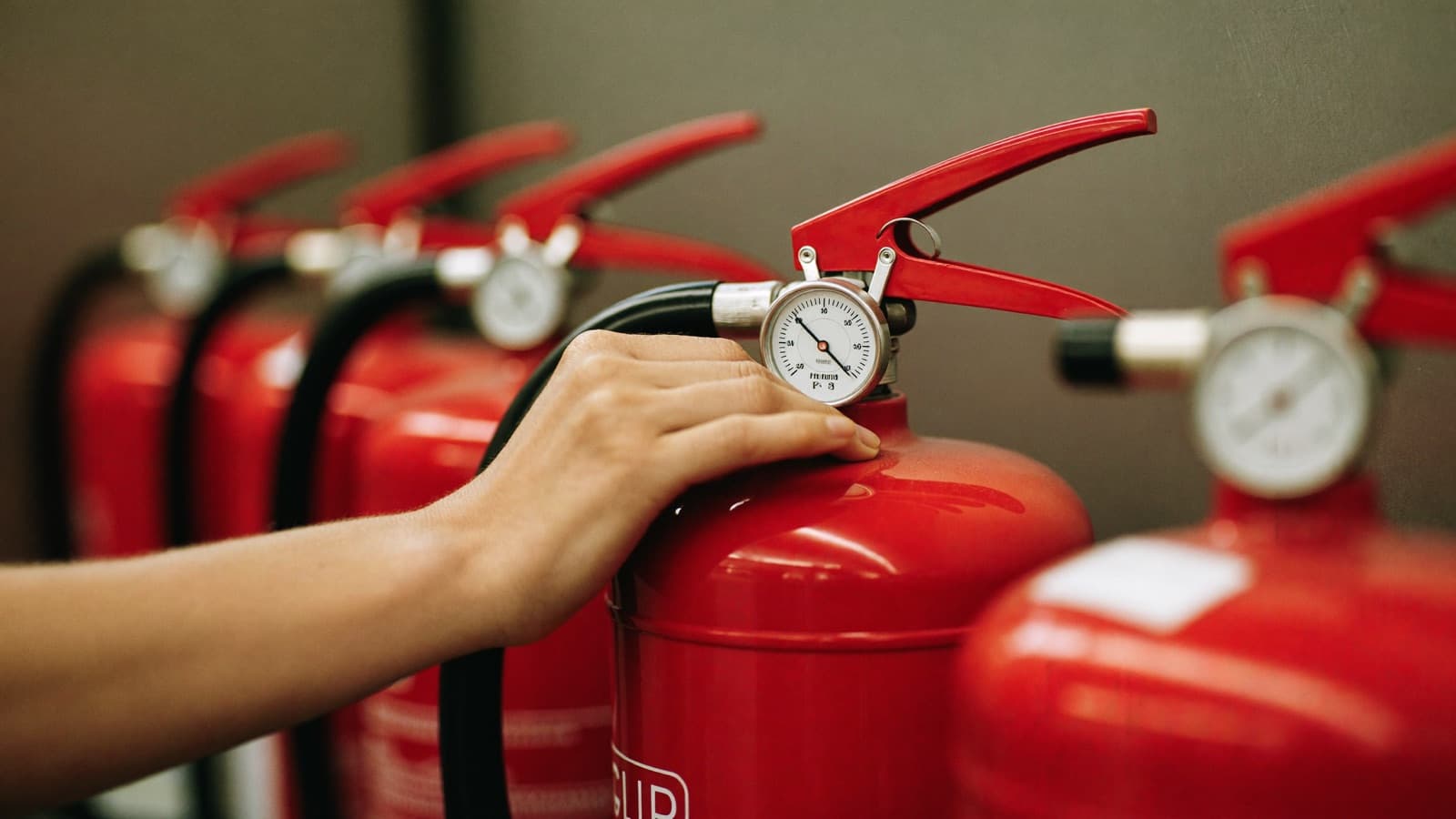
The checking, repair and refilling of fire extinguishers is governed by Decree No. 347/2022 Coll., in force from 1 January 2023. A portable fire extinguisher is, under § 2, an appliance with a total weight of not more than 20 kg; a wheeled extinguisher has a greater weight and is mounted on a wheeled chassis. Portable extinguishers are divided into water, foam, powder, CO₂, halon and clean-agent types.
The most common factual error in the market: the statutory inspection interval for a portable fire extinguisher is 24 months, not 12. Verbatim text of § 9 ods. 4 of Decree No. 347/2022 Coll.: "The periodic check of a portable fire extinguisher shall be carried out on an installed portable fire extinguisher at least once every 24 months, unless a shorter interval is specified in the accompanying documentation or in the operating instructions for the extinguisher having regard to environmental influences..."
For a wheeled fire extinguisher, the interval under § 9 ods. 5 of Decree No. 347/2022 Coll. is likewise 24 months, with one exception — a wheeled fire extinguisher with a CO₂ charge is inspected once every 12 months. This detail is not mentioned by the majority of competitor websites.
Why then do most companies write 12 months? Because fire extinguisher manufacturers standardly specify a shorter, 12-month interval in their operating instructions, which thereby becomes binding on the operator. The conclusion for the operator is therefore precise: the statutory minimum is 24 months, but if the manufacturer specifies 12 months in their instructions (as the majority do), the shorter interval applies — that is, 12 months. The claim that "12 months is required by law" is inaccurate; the law says 24, the shorter interval is set by the manufacturer.
Pressure test of the cylinder and service life of the extinguisher
Three different operations must be distinguished: the check (§ 9), repair and refilling (§ 7) and the pressure test of the cylinder (§ 8). The pressure cylinder of a fire extinguisher is a reserved technical pressure equipment item, and its pressure test is therefore carried out under a special regulation — Decree of the Ministry of Labour, Social Affairs and Family of the Slovak Republic No. 508/2009 Coll. — and not under a fixed numerical interval stated in Decree No. 347/2022.
Standard practice according to manufacturers and servicing companies: water and foam extinguishers — pressure test approximately every ~3 years, others (powder, CO₂, halon) approximately every ~5 years. These intervals are manufacturer/accompanying documentation data, NOT a statutory interval directly in Decree No. 347/2022 Coll. Similarly, the commonly quoted service life (water, powder and foam 20 years, CO₂ 40 years) is manufacturer data — the decree refers only to "the service life determined by the manufacturer" (§ 9 ods. 9 a 10).
Who may carry out the check and what document is produced
The checking, repair and refilling of fire extinguishers may only be carried out by a natural person holding a special authorisation as to professional competence. They issue a certificate of completion of the check (specimen in Annex 4 of the Decree) and affix a check label to the cylinder. The content of the check according to the type of extinguisher is in Annex 7. For repair and refilling a separate certificate is issued.
How often to inspect hydrants and fire water mains
The provision of buildings with water for firefighting is governed by Decree No. 699/2004 Coll. The inspection of fire water mains and hydrants is carried out under § 15 ods. 2 at least once every 12 months. The inspection covers internal hose installations (wall-mounted hydrants, hose reels) as well as external withdrawal points (underground and above-ground hydrants, standpipes, filling points).
At the inspection, the functionality of withdrawal points, shut-off and connecting fittings and valves, hoses and reels, free access, equipment, operating parameters, marking and the readiness of pumping equipment are verified. Part of the inspection of both external and internal withdrawal points is measurement of hydrodynamic and hydrostatic pressure and flow using a calibrated measuring instrument.
Who may carry it out: an authorised person with a calibrated measuring instrument. Document: an inspection record under § 15 ods. 3 of Decree No. 699/2004 Coll., which forms part of the fire protection documentation. Internal fire water mains and separate rising mains are additionally tested for tightness by a pressure test before being put into use, in accordance with the principles applicable to internal drinking-water mains (§ 14).
How fire hoses are tested
Fire hoses installed in hose installations are tested for functionality by a pressure test. Verbatim text of § 14 ods. 4 of Decree No. 699/2004 Coll.: "Fire hoses installed in hose installations are tested for functionality by a pressure test in accordance with the technical standard." The referenced technical standard is STN 92 0801.
Important note on accuracy: Decree No. 699/2004 Coll. does not specify a fixed numerical interval for the pressure test of a hose — it refers to technical standard STN 92 0801. The only interval that is certain by law is the annual inspection of the hose installation as a whole (§ 15 ods. 2). The actual frequency of the hose pressure test is determined by STN 92 0801 and the manufacturer's instructions; stating a numerical interval (e.g. "12 months" or "5 years") as a statutory standard is inaccurate.
For the operator this means in practice: the hose installation as a whole is inspected at the annual hydrant inspection; the actual pressure test of the hose is governed by the technical standard and the manufacturer's instructions. Who may carry it out: an authorised person. Document: a record of the functional test, which is filed in the fire protection documentation.
How often to inspect fire dampers
A fire damper is, under Decree No. 478/2008 Coll. on fire closures, one of the types of fire closure (§ 2) — it closes a permanent opening in a fire-separating construction through which ventilation system ducting passes. For dampers it is necessary to distinguish two separate operations: preventive maintenance and inspection.
Verbatim text of Decree No. 478/2008 Coll. (§ 9 ods. 6): preventive maintenance is carried out "at intervals specified in the operating instructions; if the operating instructions do not specify intervals for preventive maintenance, preventive maintenance is carried out at intervals of at least once every 12 months"; inspection of a fire closure "once every 12 months, if the operating instructions do not specify a shorter inspection interval for the fire closure".
Frequency: preventive maintenance under § 9 ods. 6 písm. a) and inspection under § 9 ods. 6 písm. b) bodu 1 of Decree No. 478/2008 Coll. — both at least once every 12 months, unless the operating instructions specify a shorter interval. Who may carry it out: maintenance is performed by the manufacturer (if reserved by them) or a person trained by the manufacturer responsible for maintaining the fire closure. Document: a record in the operating log of the fire closure.
How often to inspect electric fire alarm systems (EPS)
Electric fire alarm systems are governed by Decree No. 726/2002 Coll. An EPS is not inspected only once a year — the decree specifies multiple intervals: daily, monthly, quarterly and annually (§ 15 ods. 2 písm. a až d). These inspections complement each other and have different scopes.
Verbatim text of § 13 ods. 5 of Decree No. 726/2002 Coll. (on the annual inspection): "When an electric fire alarm system is handed over for operation, an inspection under § 15 ods. 2 písm. d) must be carried out. A further inspection is carried out at least once a year, unless the manufacturer of the electric fire alarm system has specified a shorter interval in the technical documentation having regard to environmental influences." An EPS is operational if it is not signalling a fault and more than one year has not elapsed since the last annual inspection.
Who may carry it out: the daily, monthly and quarterly inspection may be carried out by a trained employee instructed by the manufacturer or a person holding a special authorisation; the annual inspection is carried out exclusively by a natural person holding a special authorisation to inspect EPS equipment, who issues a certificate thereof. EPS components must comply with STN EN 54. Document: a certificate of completion of the inspection and records in the EPS operating log.
How often to inspect fixed and semi-fixed fire suppression systems (SHZ)
Fixed and semi-fixed fire suppression systems are governed by Decree No. 169/2006 Coll. These systems have the most inspection intervals of all fire equipment. Under § 13 ods. 2 písm. a) až f), inspections are carried out daily, weekly, monthly, quarterly, half-yearly and annually.
Verbatim text of § 13 ods. 8 of Decree No. 169/2006 Coll. (on the annual inspection): "The annual inspection and check of a fixed fire suppression system under paragraph 3 is carried out by a natural person holding a special authorisation as to professional competence for the installation and repair of fixed fire suppression systems, who issues a written document thereof."
- Daily and weekly inspection is carried out by persons designated to operate the SHZ.
- Monthly inspection is carried out by persons designated for the maintenance of the SHZ.
- Quarterly and half-yearly inspection is carried out by a trained person designated for maintenance in the presence of a fire protection technician.
- Annual inspection is carried out exclusively by a natural person holding a special authorisation as to professional competence for the installation and repair of SHZ (§ 13 ods. 8).
An SHZ is operational if more than twelve months have not elapsed since its manufacture or last inspection. Document: records in the operating log and a written document of the annual inspection.
How often to inspect emergency lighting
Emergency lighting is expressly a fire equipment item under § 2 ods. 4 of Act No. 314/2001 Coll. It does not have its own special technical decree like fire extinguishers or EPS — its inspection frequency is therefore determined by the general provision of § 13 ods. 1 of Decree No. 121/2002 Coll. on fire prevention.
Under § 13 ods. 1 of Decree No. 121/2002 Coll., the operator of fire equipment arranges for its regular inspection to be carried out at least once every 12 months in accordance with the requirements set out in the operating instructions or in the instructions for use, inspection and maintenance supplied by the manufacturer, importer or contractor. The result of the inspection is recorded in the fire log.
Related technical standards govern the design and parameters of emergency lighting: STN EN 1838, STN EN 50172 and STN EN 62034 (automatic test systems). Who may carry it out: as it is also an electrical installation, the visual inspection may be carried out by a person with electrotechnical competence; work on live parts only by a qualified person. Document: an inspection report and a record in the fire log. The inspection periodicity for emergency lighting with the reference to § 13 of Decree No. 121/2002 and § 2 ods. 4 of Act No. 314/2001 is rarely stated comprehensively by competitors.
How often to inspect fire closures (doors, windows)
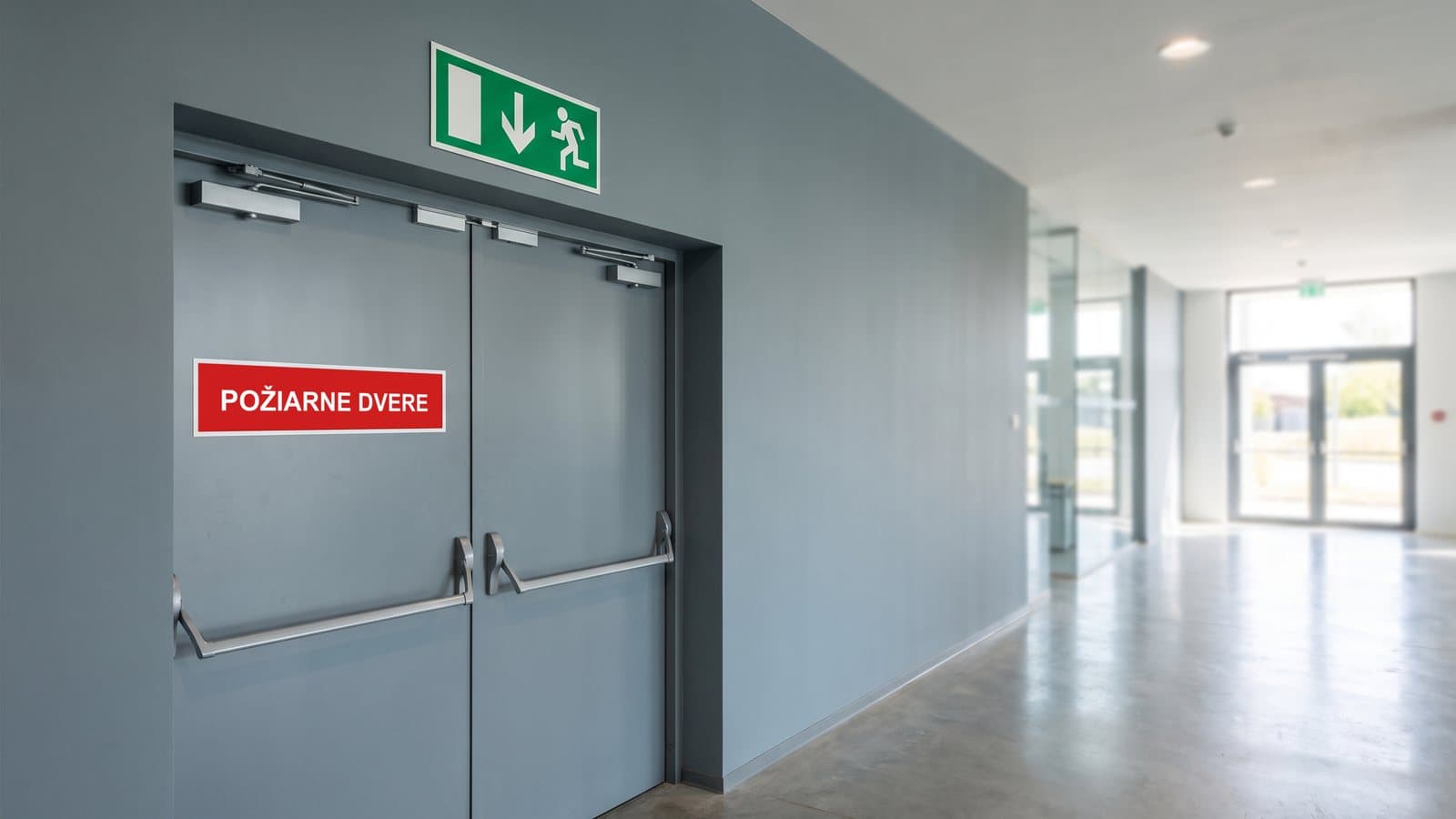
Fire closures under Decree No. 478/2008 Coll. include fire doors, fire windows, fire dampers and conveyor closures. We have dedicated a separate section to the damper; here we focus mainly on fire doors and windows, which form the largest group of closures in buildings.
Frequency: preventive maintenance and inspection of a fire closure is carried out at least once every 12 months, unless the operating instructions specify a shorter interval — the same wording as for dampers (§ 9 ods. 6 of Decree No. 478/2008 Coll.). Who may carry it out: the manufacturer or a person trained by the manufacturer responsible for maintenance. Document: the operating log of the fire closure; the declaration of conformity or certificate and operating instructions are kept for the entire period of operation of the closure.
Preventive fire inspections — not to be confused with an equipment check
A preventive fire inspection is not a technical check of an individual piece of equipment but an internal organisational inspection of the premises at which the fire protection technician establishes whether OPP (fire protection) regulations are being observed, whether equipment is operational and whether escape routes are clear. The obligation arises from § 4 of Act No. 314/2001 Coll.; the intervals are set by § 14 ods. 1 of Decree No. 121/2002 Coll.
| Type of premises or space | Inspection interval | Provision |
|---|---|---|
| Residential buildings and premises/spaces with only occasional workplaces | at least every 12 months | § 14 ods. 1 písm. a) Decree No. 121/2002 Coll. |
| Premises/spaces with only administrative activities | at least every 6 months | § 14 ods. 1 písm. b) Decree No. 121/2002 Coll. |
| Other premises or spaces of a legal entity/entrepreneur | at least every 3 months | § 14 ods. 1 písm. c) Decree No. 121/2002 Coll. |
The content of the inspection includes, among other things, verification of "the functionality of fire-safety equipment, fire water mains and water sources for firefighting" (§ 14 ods. 2 of Decree No. 121/2002 Coll.). Decree No. 121/2002 Coll. is, as at 2026, valid and in force — it has not been repealed by Decree No. 38/2026 Coll., which governs an entirely different area (fire safety in the use of flammable liquids). The inspection is carried out by the fire protection technician and a record of its outcome is made in the fire log.
Planning an inspection or check of a particular piece of equipment? See our fire equipment inspection service — booking, scheduling and a price quotation.
How an inspection proceeds step by step
Although the scope varies according to the type of equipment, the inspection itself generally follows the same sequence of six steps. This sequence also feeds the structured HowTo block for search engines and AI.
Booking and preparation of documentation. The client provides a list of equipment, previous reports and the fire log. The technician verifies in advance the types, numbers and locations of the equipment and the dates of the last inspections.
Visual check and completeness check. The technician assesses the external condition, marking, accessibility, seals and check labels of each piece of equipment and notes visible deficiencies.
Measurement and functional test. Pressure measurement for fire extinguishers, hydrodynamic and hydrostatic pressure and flow measurement for hydrants, functional test of detectors and the control panel for EPS, activation test for SHZ and simulation of power failure for emergency lighting.
Rectification of deficiencies. Replenishment of consumables, replacement of seals, refilling and pressure test, or decommissioning of non-compliant equipment if it fails the test or its manufacturer-determined service life has expired.
Issue of the document and label. The certificate of completion of the inspection, a check label with the date of the last and next inspection, the signature and special authorisation number of the technician.
Entry in the fire log. Recording the outcome in the fire log or operating log and setting the next inspection date.
What the client receives after the inspection
The output of an inspection is not merely a "stamp". The client receives a set of documents that, at a HaZZ inspection as well as in the event of an insurance claim, demonstrate that the equipment was professionally checked and is operational.
- Certificate of completion of the inspection — for fire extinguishers, to the specimen in Annex 4 of Decree No. 347/2022 Coll.
- Check label on the equipment showing the date of the last and next inspection.
- Inspection report or record with proposed corrective measures to address identified deficiencies.
- Record in the fire log or operating log of the equipment.
- For the repair or refilling of a fire extinguisher, a certificate of completion of the repair and refilling (Annex 2 of Decree No. 347/2022 Coll.).
Inspection documents are part of the fire protection documentation. They must be stored, kept accessible and the documentation itself is reviewed at least once every 12 months (§ 31 of Decree No. 121/2002 Coll.). No provision of either the act or the decrees imposes a blanket "5-year" archival period for equipment inspections — this claim, which circulates on some websites, has no basis in any regulation.
What fines apply for neglecting inspections
For neglecting fire equipment inspections, the Fire and Rescue Corps may impose substantial fines. Their level differs according to whether it involves failure to carry out a technical equipment inspection or failure to carry out an organisational preventive inspection — and according to whether the offender is a company or a natural person.
| Entity and breach | Fine | Provision |
|---|---|---|
| Company — failure to ensure regular inspection of the condition of fire equipment | up to €16,596 | § 59 ods. 2 písm. a) Act No. 314/2001 Coll. |
| Company — failure to carry out a preventive fire inspection | up to €8,298 | § 59 ods. 1 Act No. 314/2001 Coll. |
| Natural person — misdemeanour (general) | reprimand or fine up to €99 | § 61 ods. 2 Act No. 314/2001 Coll. |
| Natural person — more serious misdemeanour | up to €165, or up to €331 | § 61 ods. 3 a ods. 4 Act No. 314/2001 Coll. |
| Natural person — on-the-spot fine | up to €100 | § 62 ods. 2 Act No. 314/2001 Coll. |
Note the distinction between a technical inspection and a preventive inspection: failure to ensure regular inspection of the condition of fire equipment falls into the stricter bracket of up to €16,596 (§ 59 ods. 2 písm. a), while failure to carry out the preventive fire inspection itself attracts up to €8,298 (§ 59 ods. 1). In cases of immediate danger, the state fire supervision authority may under § 64 of Act No. 314/2001 Coll. decide to exclude an item from use or to halt operations.
In addition to the direct fine, a neglected inspection has one further consequence that is often overlooked: an invalid or missing inspection report is frequently cited as grounds for reducing an insurance payout in the event of fire damage. The insurer may refuse or reduce the claim if it is established that the equipment was not properly and timely inspected by an authorised person.
Fire statistics in Slovakia (2024)
The current figures show why inspections are not a formality. According to the Report on Operational Activities of the Fire and Rescue Corps of the Slovak Republic for 2024 (Presidium of HaZZ, published 26 January 2025), the number of fires rose substantially year-on-year, although direct losses fell.
The ranking of causes is telling: the most common cause is negligence and carelessness by adults (44.8 %), followed by operational and technical failures (15.8 %), deliberate arson (9.1 %) and failures of heating appliances, flue pipes and chimneys (6.7 %). An operational fire extinguisher, a functional EPS or a clear hydrant determine whether a small, nascent fire is extinguished at source, or grows into damage worth tens of thousands of euros. That is the purpose of regular inspections.
Common myths about fire equipment inspections
When taking over agendas and carrying out audits, we repeatedly encounter the same inaccuracies that circulate on websites and among operators. Here are the most common ones and the reality.
- Myth: "A fire extinguisher must be inspected every 12 months by law." Inaccurate. The statutory interval is 24 months (§ 9 ods. 4 of Decree No. 347/2022 Coll.); 12 months applies only if specified by the manufacturer in the instructions.
- Myth: "Decree No. 719/2002 Coll. still applies." Incorrect. It was repealed from 1 January 2023 and replaced by Decree No. 347/2022 Coll. Citing the repealed decree is a measurable error made by several competitors.
- Myth: "Our maintenance worker can do the inspection." No. The inspection of fire extinguishers, EPS and SHZ may only be carried out by a person holding a special authorisation as to professional competence.
- Myth: "The hose pressure test is required annually by law." Not verified as a statutory interval. Decree No. 699/2004 Coll. refers to STN 92 0801; a fixed numerical interval is not in the decree directly.
- Myth: "I must archive inspection documentation for exactly 5 years." No provision of Act No. 314/2001 Coll. or Decree No. 121/2002 Coll. imposes such a blanket period for equipment inspections; the documentation is reviewed at least once every 12 months (§ 31).
Conclusion and next steps
Fire equipment inspections and checks are not a one-off task at the occupancy inspection but an ongoing statutory obligation throughout the entire operation of the premises. Each type of equipment has its own inspection frequency and its own circle of persons authorised to carry out the inspection: fire extinguishers at least once every 24 months (typically 12 in accordance with the manufacturer), hydrants, dampers, closures and emergency lighting generally once every 12 months, EPS and SHZ at multiple intervals up to the annual inspection by a person with a special authorisation.
Neglecting inspections exposes the company to fines of up to €16,596 (§ 59 ods. 2 of Act No. 314/2001 Coll.) and the risk of reduced insurance payouts. Since nearly half of fires are caused by human failure, it is precisely the operational and regularly inspected piece of equipment that is the most effective instrument for protecting life and property. Related obligations, documentation and training are covered in detail in our fire protection guide.
If you are unsure which equipment you need to inspect and at what intervals, we will assess your situation and propose an inspection schedule. Booking a specific inspection, scheduling and a price quotation can be found on the fire equipment inspection service page.
Súvisiace služby a zdroje
Kontrola požiarnych zariadení (služba)
Objednajte si pravidelné kontroly hasiacich prístrojov, hydrantov, klapiek a EPS vrátane dokladov pre HaZZ a poisťovňu.
Ochrana pred požiarmi (služba)
Externé zabezpečenie celej agendy OPP prostredníctvom technika požiarnej ochrany.
Sprievodca OPP
Výkladový sprievodca povinnosťami firiem na úseku ochrany pred požiarmi.
Sprievodca BOZP
Výkladový sprievodca povinnosťami zamestnávateľa v oblasti bezpečnosti a ochrany zdravia pri práci.
Školenia OPP a BOZP
Vstupné aj opakované školenia zamestnancov a odborná príprava protipožiarnych hliadok.
Slovník pojmov
Výkladový slovník kľúčových pojmov z OPP, BOZP, PZS a VTZ.
Súvisiace články
Stručná odpoveď
Inspections (checks) of fire-safety equipment are mandatory in Slovakia under Act No. 314/2001 Coll. Fire extinguishers are checked at least once every 24 months (Decree No. 347/2022 Coll.), hydrants once every 12 months (Decree No. 699/2004 Coll.), and electrical fire alarm systems (EPS), fixed firefighting systems (SHZ), fire dampers and emergency lighting as a rule once every 12 months. The check may be carried out only by a person holding a special authorisation.
Časté otázky o revíziách požiarnych zariadení
A portable fire extinguisher is checked at least once every 24 months under § 9 ods. 4 of Decree No. 347/2022 Coll. However, if the manufacturer specifies a shorter interval in the accompanying documentation or instructions — commonly 12 months — the shorter one applies. The statutory minimum is therefore 24 months, but in practice most manufacturers prescribe a 12-month interval, which thereby becomes binding.
No. Decree No. 719/2002 Coll. was repealed and, with effect from 1 January 2023, replaced by Decree No. 347/2022 Coll. (the repealing and effect provisions § 12 and § 13). Service companies and retail portals that still cite Decree 719/2002 are quoting an obsolete standard — only the effective wording of Decree 347/2022 applies.
The statutory minimum under § 9 ods. 4 of Decree No. 347/2022 Coll. is once every 24 months. A shorter interval — most often 12 months — is set by the manufacturer in the instructions for use in view of the effect of the environment, and thereby becomes binding on the operator. The claim that 12 months applies 'by law' is therefore inaccurate: the law gives 24 months, while the shorter interval is set by the manufacturer.
A mobile fire extinguisher is checked at least once every 24 months under § 9 ods. 5 of Decree No. 347/2022 Coll. The exception is the mobile CO₂ fire extinguisher, which is checked once every 12 months (§ 9 ods. 5). Most providers do not state this detail.
Decree No. 347/2022 Coll. does not state a numerical interval — for the pressure test of the pressure vessel it refers to a special regulation (Decree No. 508/2009 Coll.), since the cylinder is a reserved pressure technical device. Common practice according to manufacturers is every 3 years for water and foam extinguishers and roughly every 5 years for the rest. These are intervals set by the manufacturer's instructions, not a numerical statutory interval.
Fire water mains and both internal and external hydrants are checked at least once every 12 months under § 15 ods. 2 of Decree No. 699/2004 Coll. The check verifies the functionality of the draw-off points, fittings, hoses and reels, accessibility and operating parameters. The check is carried out by an authorised person with a calibrated measuring instrument.
Fire hoses are tested for functionality by a pressure test in accordance with a technical standard (for example STN 92 0801), referred to in § 14 ods. 4 of Decree No. 699/2004 Coll. The Decree does not state a fixed numerical interval; the exact periodicity is determined by the technical standard and the manufacturer's instructions. What is legally certain is the annual check of the hose equipment as a whole (§ 15 ods. 2).
The EPS is checked daily, monthly, quarterly and annually under § 15 ods. 2 písm. a) to d) of Decree No. 726/2002 Coll.; a further check is carried out at least once a year (§ 13 ods. 5) unless the manufacturer sets a shorter interval. The annual check is carried out by a natural person holding a special authorisation to check EPS equipment, who issues a confirmation of it.
SHZ and semi-fixed firefighting systems are checked at six intervals — daily, weekly, monthly, quarterly, half-yearly and annually — under § 13 ods. 2 písm. a) to f) of Decree No. 169/2006 Coll. The annual check and inspection is carried out exclusively by a natural person holding a special authorisation attesting professional competence for the installation and repair of SHZ (§ 13 ods. 8), who issues a written document of it.
A fire damper is a type of fire closure (§ 2 of Decree No. 478/2008 Coll.). Preventive maintenance is carried out at least once every 12 months under § 9 ods. 6 písm. a) and an inspection once every 12 months under § 9 ods. 6 bodu 1 — unless the operating instructions set a shorter interval. The maintenance is carried out by the manufacturer or a person trained by it who is responsible for maintaining the closure.
Emergency lighting is a fire-safety device under § 2 ods. 4 of Act No. 314/2001 Coll. It is checked at least once every 12 months under § 13 ods. 1 of Decree No. 121/2002 Coll., in accordance with the requirements in the operating instructions or the manufacturer's manual; the result is recorded in the fire logbook. Emergency lighting does not have a separate decree.
Checking, repairing and refilling fire extinguishers and checking other fire-technical equipment may be carried out only by a natural person holding a special authorisation attesting professional competence — not an in-house maintenance worker without authorisation. The annual EPS check is carried out by a person authorised for EPS, the annual SHZ check by a person authorised for the installation and repair of SHZ. A document of the check is issued and a check label is affixed to the equipment.
If a legal person or an entrepreneur who is a natural person fails to ensure regular checks of the condition of fire-safety equipment, a fine of up to 16 596 € applies under § 59 ods. 2 písm. a) of Act No. 314/2001 Coll. For failing to carry out a preventive fire-safety inspection or to keep equipment in working order, a fine of up to 8 298 € applies (§ 59 ods. 1). A missing inspection report is also often grounds for reducing an insurance payout.
A natural person may be fined for offences in the field of fire protection up to 99 € (§ 61 ods. 2), up to 165 € (§ 61 ods. 3) or up to 331 € (§ 61 ods. 4) under Act No. 314/2001 Coll.; in summary (on-the-spot) proceedings a fine of up to 100 € may be imposed (§ 62 ods. 2).
Fire-safety equipment is defined in § 2 ods. 4 of Act No. 314/2001 Coll.: it includes fire-technical equipment, fire extinguishers, fire closures, water-supply equipment for firefighting, emergency lighting and others. Their technical check differs from a preventive fire-safety inspection — an internal organisational inspection under § 14 of Decree No. 121/2002 Coll., which is carried out every 12 months in residential buildings (písm. a), every 6 months in offices (písm. b) and every 3 months in other premises (písm. c). For the broader context see the guide Fire protection.
Need help with workplace safety?
Contact us today and get a free consultation. Our team of experts will help you find a solution tailored to your needs.