BOZP for car repair and tyre shops — vehicle lifts, welding and chemicals
Complete guide to BOZP in a vehicle repair shop: vehicle service lifts as group B VTZ under Decree No. 508/2009 Coll., welding and fire protection, chemical factors and exhaust fumes, tyres, electric vehicles, the PZS and mandatory training.
Interested in this service?
Leave us your contact and we will get back to you with pricing and dates, usually within 24 hours.
A vehicle repair shop — a small operation with concentrated risks
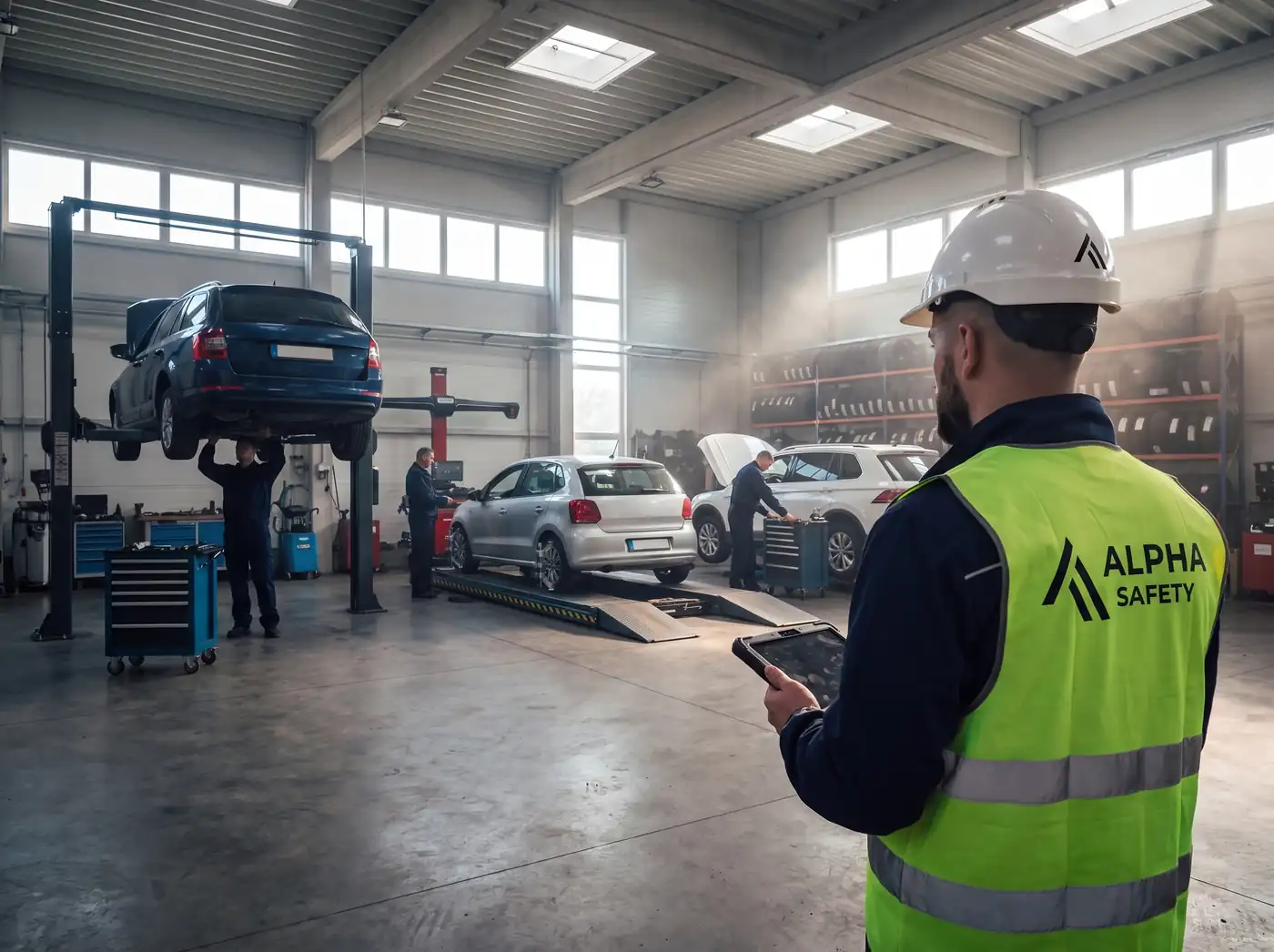
BOZP in vehicle repair applies to car repair shops and tyre shops, car washes, body and paint shops, and vehicle inspection stations. In a small space, more high-risk activities meet here than in many a factory: working under tonnes of raised vehicle, welding next to a fuel tank, chemical substances, the noise of the grinder and, increasingly, the high-voltage systems of electric cars.
A typical vehicle repair shop is also a small business — two to ten mechanics and an owner who repairs cars alongside them. That is exactly why BOZP gets postponed "until later". Yet from the regulatory point of view, the workshop is a fully-fledged operation with reserved technical equipment, chemical factors and activities with an elevated risk of fire — and an inspection approaches it just as strictly as a large factory.
Typical hazards in a car repair shop and tyre shop
The risk assessment of a workshop must cover four large groups of hazards — each with its own regulations and its own most frequent injuries.
Working under a raised vehicle
A vehicle falling from a lift or from unsuitable support is the most serious scenario in a workshop. Vehicle service lifts are reserved technical equipment and must have valid professional inspections and tests; a vehicle on a hydraulic lift without the mechanical safety latch engaged and a car supported only by a trolley jack without axle stands are prohibited conditions that appear most often in practice.
Welding, grinding and bodywork
Welding near the fuel system, grinding with flying sparks and cutting bodywork are among the activities with an elevated risk of fire under Act No. 314/2001 Coll. Added to the fire risk are UV radiation, welding fumes, noise and flying particles — hence protective goggles and a face shield, a welding helmet, gloves and hearing protectors under Government Regulation No. 395/2006 Coll.
Chemical substances, oils and exhaust fumes
Motor oils, thinners, brake fluids, coolants and paints are chemical factors under Government Regulation No. 355/2006 Coll. — they require a list of substances, safety data sheets and suitable OOPP. Diesel engine exhaust emissions are carcinogenic factors under Government Regulation No. 121/2024 Coll.; an engine left running in the hall without extraction is therefore not a trifle but exposure to a carcinogen.
Tyres, batteries and electric vehicles
A tyre bursting during inflation has the force of an explosion — large tyres are inflated in a safety cage. Charging lead-acid batteries releases hydrogen and requires ventilation. Hybrid and electric vehicles add high-voltage systems: work on them may only be carried out by specially prepared staff with suitable tools and procedures — today this topic decides whether a workshop can safely accept a job on an electric car.
Vehicle lifts — reserved technical equipment, not workshop furniture
Stationary, mobile and transportable workshop lifting equipment designed for lifting a vehicle is reserved technical equipment of lifting group B — it is expressly listed in Annex No. 1 II. časť písm. d) bod 3 of Decree No. 508/2009 Coll. A two-post and a scissor lift therefore need professional inspections and professional tests at the intervals set by the annex to the decree, operators familiarised with the manufacturer's instructions and operating documentation.
- Professional inspections and tests — carried out by an inspection technician holding a valid certificate; inspection reports are the first document an inspection asks for in a workshop.
- Daily pre-use check by the operator — the condition of ropes, chains, safety latches and stops before work begins; a damaged lift is not used.
- Mechanical safety latches — a vehicle is never left hanging on the hydraulics alone; when working under the vehicle, the latches must be engaged.
- Trolley jacks and axle stands — a trolley jack is for lifting, not for supporting; work under a vehicle only with axle stands on a load-bearing surface.
Assess the risks of the workshop. The employer assesses the risks under § 6 ods. 1 písm. c) of Act No. 124/2006 Coll. — work under a raised vehicle, welding and grinding, chemical substances and exhaust fumes, noise, and the handling of wheels and batteries. The assessment yields the working procedures, OOPP and training content for each workstation in the workshop.
Arrange inspections of vehicle lifts. Stationary, mobile and transportable workshop lifting equipment designed for lifting a vehicle is reserved technical equipment of lifting group B under Annex No. 1 II. časť písm. d) bod 3 of Decree No. 508/2009 Coll. It must have professional inspections and tests, operators familiarised with the manufacturer's instructions and a visible marking of the load capacity.
Introduce safe procedures for welding and grinding. Welding is an activity with an elevated risk of fire — it requires fire-protection measures under Act No. 314/2001 Coll., in specified cases a fire assistance patrol under Decree No. 121/2002 Coll., and a valid welder's professional competence. When grinding and cutting, protect the eyes, hearing and airways.
Manage chemical factors and exhaust extraction. Oils, thinners, brake fluids and paints are chemical factors under Government Regulation No. 355/2006 Coll.; diesel engine exhaust emissions are carcinogenic factors under Government Regulation No. 121/2024 Coll. Provide exhaust extraction, ventilation, safety data sheets and OOPP under Government Regulation No. 395/2006 Coll.
Ensure safe work with tyres and batteries. Inflate large tyres in a safety cage or with protection against the tyre bead separating from the rim; use wheel balancers and tyre-changing machines in accordance with the manufacturer's instructions (Government Regulation No. 392/2006 Coll.). Ensure ventilation when charging batteries and specially prepared staff for hybrid and electric vehicles.
Arrange inspections of the other VTZ and fire protection. The compressor and pressure vessels are pressure equipment, the workshop's electrical installation and charging stations are electrical equipment, and gas heating is gas equipment under Decree No. 508/2009 Coll. Fire extinguishers are inspected at least once every 24 months under § 9 of Decree No. 347/2022 Coll.
Train mechanics and maintain documentation. Initial familiarisation on starting work and refresher familiarisation at least once every three years (§ 7 ods. 5 of Act No. 124/2006 Coll.), supplemented by professional competences — welding, operation of lifting equipment, electrotechnical competence for work on vehicle electrical systems. The categorisation of work and medical examinations are provided by the PZS.
Welding and activities with an elevated risk of fire
Welding and flame cutting in the workshop are subject to fire-protection measures under Act No. 314/2001 Coll. — assessment of the welding site, removal of flammable substances, fire-fighting equipment at hand and supervision after the work ends. Where the nature of the activity requires it, a fire assistance patrol is established under Decree No. 121/2002 Coll. The welder must hold a valid professional competence and welding equipment must be maintained in accordance with the manufacturer's instructions.
On top of this comes the ordinary OPP agenda of the operation: fire-protection documentation, employee training, fire extinguisher inspections at least once every 24 months (§ 9 of Decree No. 347/2022 Coll.) and order in the storage of oils, thinners and tyres — from the fire point of view, a tyre store is an extremely loaded space. We prepare OPP documentation and training for workshops together with BOZP.
PZS and the categorisation of work in the workshop
The employer must provide an occupational health service from the first employee (§ 30 of Act No. 355/2007 Coll.). Mechanics are typically exposed to noise, vibration from tools, chemical factors and physical load — these factors determine the classification of work into categories under § 31 and Decree No. 448/2007 Coll. and the scope of preventive medical examinations under § 30e. For categories 1 and 2 we provide the PZS on a contracted basis under § 30aa — together with BOZP from a single partner.
VTZ in the workshop — compressor, electrics, gas
- Pressure equipment — the compressor and air receiver are pressure equipment under Decree No. 508/2009 Coll.; the intervals of professional inspections and tests are set by the annex to the decree.
- Electrical equipment — the workshop's electrical installation, welding machines, charging stations for electric vehicles; inspections under standard STN 33 1630:2025, which replaced STN 33 1600 and STN 33 1610 on 1 May 2025 (parallel use permitted until 1 May 2027).
- Gas equipment — gas heating of the hall and technical gases (acetylene, oxygen, argon); store and handle cylinders in accordance with the regulations and the manufacturer's instructions.
- Emission test bays and paint shops — extraction, filtration and ventilation are part of the risk assessment; spray booths have their own operating and fire-safety requirements.
What training do mechanics need?
The basis is initial familiarisation on starting work and refresher familiarisation at least once every three years under § 7 ods. 5 of Act No. 124/2006 Coll. Depending on the activities, professional competences are added: a welding licence, familiarisation with the operation of lifting equipment in accordance with the manufacturer's instructions, electrotechnical competence for work on electrical equipment and special preparation for the high-voltage systems of hybrids and electric cars. Contracted instruction may be delivered only by a person holding an authorisation of the National Labour Inspectorate — Alpha Safety is authorised to carry out education and training.
What fines can a vehicle repair shop face?
The Labour Inspectorate may, under § 19 of Act No. 125/2006 Coll., impose a fine of up to 100,000 euros; for an occupational accident with serious bodily harm at least 20,000 euros and for a fatal accident at least 33,000 euros. The Regional Public Health Authority imposes fines from 150 to 20,000 euros for breaches in the area of health protection (categorisation, chemical factors, PZS) under § 57 ods. 43 písm. a) of Act No. 355/2007 Coll. The most frequently sanctioned shortcomings in workshops: lifts without professional tests, missing safety data sheets and welding without fire-protection measures.
What Alpha Safety will provide for your workshop
Alpha Safety s.r.o. is an external provider of comprehensive safety services for car repair shops, tyre shops, body shops and paint shops throughout Slovakia. We take over the whole agenda — BOZP, OPP, PZS and inspections — in one flat monthly fee, so you can focus on the cars.
- BOZP — risk assessment of the workshop, working procedures for lifts, welding and chemical substances, complete documentation and representation during inspections.
- VTZ inspections — vehicle service lifts, compressors, electrical installations, gas equipment; inspection reports and deadline records.
- OPP — fire-protection documentation, measures for welding, training and fire extinguisher inspections.
- PZS — categorisation of mechanics' work, preventive medical examinations, surveillance over chemical factors and noise.
- Training — employee familiarisation, welders, operation of lifting equipment, preparation for work on electric vehicles.
From our practice
The most frequent finding in workshops: a lift that "works, so nobody deals with it" — without a professional inspection, with an expired test or with no documentation at all. Owners tend to be surprised that a two-post lift is reserved technical equipment with the same regime as a crane in a factory. The second evergreen is winter welding in the corner of the workshop — without assessing the site, without a fire extinguisher at hand.
With chemical factors we find thinners decanted into unmarked bottles and missing safety data sheets; with OOPP, grinding without goggles "because it's just for a moment". After the system is put in place — inspections with deadline records, simple working procedures and short practical training — our clients keep the workshop in order without it costing them time away from repairs.
Súvisiace služby a zdroje
Bezpečnosť a ochrana zdravia pri práci
Externá bezpečnostnotechnická služba pre servisy — posúdenie rizík dielne, pracovné postupy pre zdviháky, zváranie a chémiu, kompletná dokumentácia BOZP.
Revízie VTZ (služba)
Odborné prehliadky a skúšky servisných zdvihákov, kompresorov, elektroinštalácií a plynových zariadení — s evidenciou lehôt, ktorú ustrážime za vás.
Ochrana pred požiarmi (služba)
Protipožiarne opatrenia pri zváraní, dokumentácia OPP, školenia a kontroly hasiacich prístrojov pre dielne a lakovne.
Pracovná zdravotná služba (služba)
Kategorizácia prác mechanikov — hluk, vibrácie, chemické faktory — posudky o riziku a lekárske preventívne prehliadky.
Kurz obsluhy zdvíhacích zariadení
Odborná príprava obsluhy zdvíhacích zariadení vrátane servisných zdvihákov podľa návodu výrobcu a predpisov BOZP.
Kurz elektrotechnickej spôsobilosti
Elektrotechnická spôsobilosť podľa vyhlášky č. 508/2009 Z. z. — základ pre bezpečnú prácu na elektrických zariadeniach vozidiel.
Školenia a kurzy
Vstupné a opakované oboznamovanie mechanikov, školenia o ochrane pred požiarmi — prezenčne aj online.
Pôsobíme po celom Slovensku
Bezpečnosť v tomto odvetví zabezpečujeme vo všetkých krajských mestách aj okresoch — napríklad:
Stručná odpoveď
BOZP in a car repair shop and tyre shop covers inspections of vehicle service lifts, which are reserved technical equipment of lifting group B under Decree No. 508/2009 Coll., fire-protection measures for welding under Act No. 314/2001 Coll., the management of chemical factors including exhaust extraction, and mandatory mechanic training under § 7 of Act No. 124/2006 Coll. The obligations apply from the first employee.
Časté otázky o BOZP v autoservise
Yes. Stationary, mobile and transportable workshop lifting equipment designed for lifting a vehicle is expressly listed in Annex No. 1 II. časť písm. d) bod 3 of Decree No. 508/2009 Coll. as lifting VTZ of group B. A two-post and a scissor lift therefore need professional inspections and professional tests by an inspection technician, operating documentation and operators familiarised with the manufacturer's instructions.
The intervals of professional inspections and professional tests of lifting VTZ are set by the annex to Decree No. 508/2009 Coll. in conjunction with the manufacturer's instructions — as a rule, annual professional inspections. Added to this is the operator's daily pre-use check: the condition of ropes and chains and the function of safety latches and stops. A damaged lift must not be used.
Welding is an activity with an elevated risk of fire under Act No. 314/2001 Coll. — it requires an assessment of the welding site, removal of flammable substances, fire-fighting equipment at hand and supervision after the work ends; in specified cases, a fire assistance patrol under Decree No. 121/2002 Coll. The welder must hold a valid professional competence and the prescribed OOPP.
Oils, thinners, brake fluids and paints are chemical factors under Government Regulation No. 355/2006 Coll. — they require a list of substances, safety data sheets and OOPP. Diesel engine exhaust emissions are carcinogenic factors under Government Regulation No. 121/2024 Coll., so engines in the hall are started only with extraction in place or with the doors open and ventilation.
A tyre bursting or the bead separating from the rim during inflation has the force of an explosion. Large truck tyres are inflated in a safety cage or with restraint, with a pressure gauge and at the prescribed pressure. Tyre-changing machines and wheel balancers are used in accordance with the manufacturer's instructions as work equipment under Government Regulation No. 392/2006 Coll.
Not safely and not in compliance with the regulations. The high-voltage systems of electric and hybrid vehicles may only be disconnected and repaired by staff with special professional preparation, insulated tools and defined procedures — this follows from the employer's obligation to entrust work only to competent persons under Act No. 124/2006 Coll. We will prepare the procedures and training for EV work for you.
A compressor with an air receiver is pressure equipment under Decree No. 508/2009 Coll. — it is subject to professional inspections and tests at the intervals set by the annex to the decree and to checks in accordance with the manufacturer's instructions. During an inspection, the inspection report and operating documentation are presented; a "second-hand compressor with no papers" is a recurring inspection finding.
Initial familiarisation on starting work and refresher familiarisation at least once every three years under § 7 ods. 5 of Act No. 124/2006 Coll. Depending on the activities: a welding licence, familiarisation with the operation of lifting equipment, electrotechnical competence for work on electrical equipment and special preparation for the high-voltage systems of electric vehicles.
Yes. The occupational health service is mandatory from the first employee under § 30 of Act No. 355/2007 Coll. Mechanics are exposed to noise, vibration, chemical factors and physical load — these factors determine the category of the work. For categories 1 and 2, the contracted PZS may be performed by a public health specialist holding a trade licence for supervision of working conditions under § 30aa (2), so you can cover BOZP and the PZS with a single contract.
The flat monthly fee starts from €15 per month excl. VAT and grows with the number of employees and the scope of activities (welding, paint shop, tyre service). The price includes the safety service, documentation, training and representation during inspections; we can add inspections of the lifts and other VTZ in a single package. We will prepare an exact price after a non-binding consultation.
Under § 19 of Act No. 125/2006 Coll., the labour inspectorate may impose a fine of up to EUR 100,000; for an occupational accident with serious bodily harm at least EUR 20,000 and for a fatal accident at least EUR 33,000. The RÚVZ imposes fines from EUR 150 to EUR 20,000 under § 57 ods. 43 písm. a) of Act No. 355/2007 Coll. The most frequent sanctions: lifts without professional tests, missing safety data sheets and welding without fire-protection measures.
Need help with workplace safety?
Contact us today and get a free consultation. Our team of experts will help you find a solution tailored to your needs.