BOZP for warehouses and logistics — VZV, racking and manual handling of loads
A complete BOZP guide to warehouses: the licence and refresher professional training of VZV operators under § 16 of Act No. 124/2006 Coll., professional inspection of racking under STN EN 15635, manual handling limits and inspections of reserved technical equipment.
Interested in this service?
Leave us your contact and we will get back to you with pricing and dates, usually within 24 hours.
Why warehouses are one of the riskiest workplaces
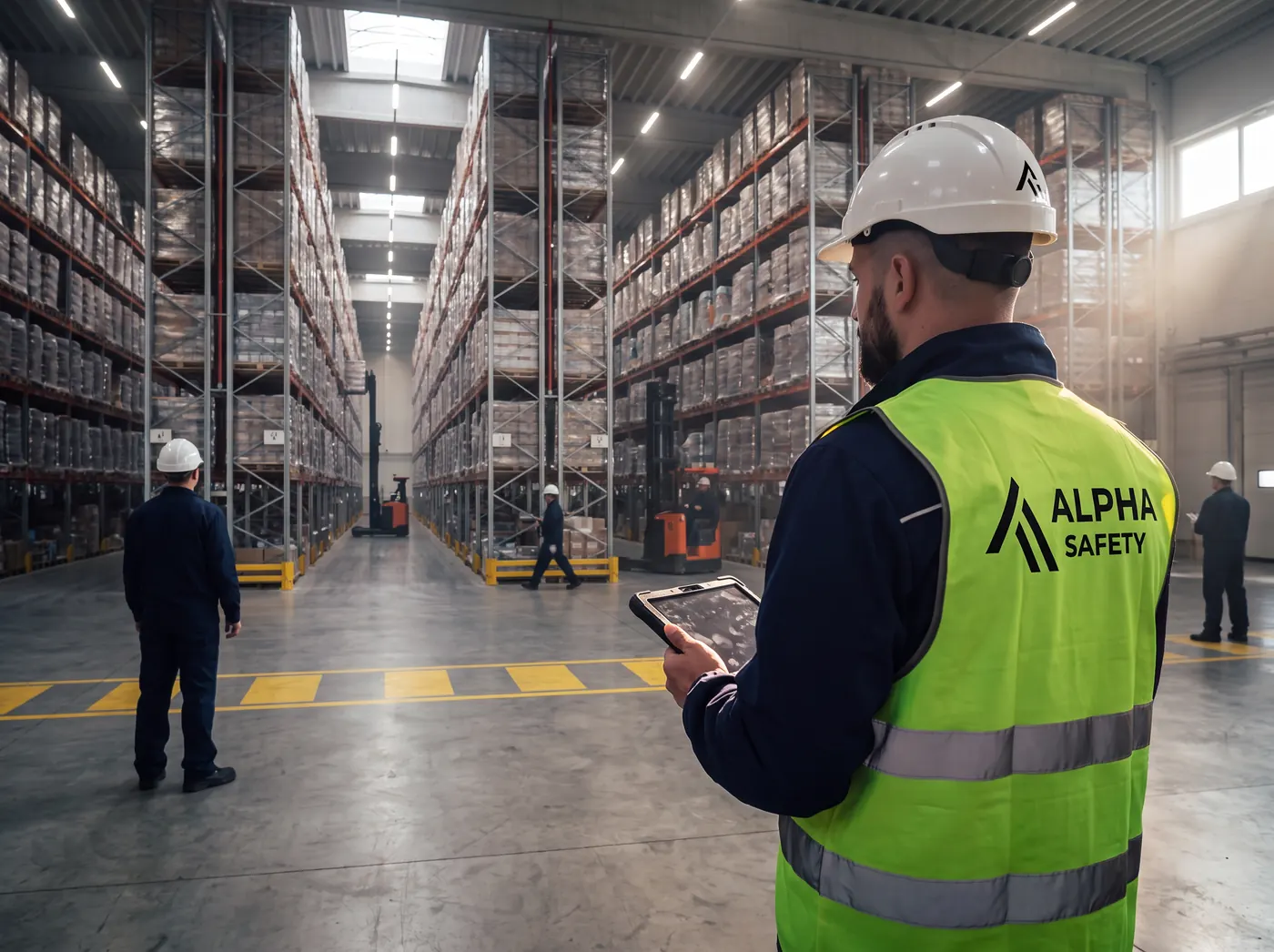
Warehouses and logistics centres rank among the workplaces with the highest concentration of risks in Slovakia. Every day thousands of kilograms of goods are lifted, carried and stacked here, forklift routes and pedestrian routes intersect, and heavy loads are handled at height.
Fatal occupational accidents in 2024 most frequently occurred in the sectors of industrial manufacturing, transport and warehousing, construction and agriculture. Labour inspectorates imposed 2,489 fines in the same year. These figures clearly show that underestimating BOZP (occupational health and safety) in a warehouse means endangering people's health and the company's budget.
Typical risks in a warehouse
Forklift trucks (VZV) — collisions and overturning
The forklift truck (VZV) is the most dangerous machine in a warehouse. The most frequent injuries are a pedestrian being struck, being caught between the truck and a rack, the truck overturning when travelling with a raised load or in a bend, and the load falling from the forks. The risk is increased by limited visibility, excessive speed, unsecured load and the crossing of routes with pedestrians. Government Regulation No. 392/2006 Coll. requires that a suitable and safe work tool, an authorised and trained operator, and the exclusion of persons at risk from the danger zone be ensured.
Falls from racking and collapse of the racking structure
Racking systems carry multi-tonne loads and their failure has catastrophic consequences. The most frequent cause is a truck colliding with an upright, which disrupts the statics of the entire assembly — a damaged upright loses load-bearing capacity by tens of per cent. Further risks include overloading of shelves, incorrectly positioned pallets, missing floor anchoring and damaged beam safety pins. Collapse poses the risk of a worker being buried, a chain reaction in adjacent racks and objects falling on persons in the aisle.
Manual handling of loads — the spine
Even in an automated warehouse a great deal of manual work remains. Repeated lifting, incorrect technique (lifting from a stooped position, trunk rotation under load), excessive weight and high frequency of lifts lead to both acute and chronic injuries to the spine and joints. Government Regulation No. 281/2006 Coll. requires manual handling to be eliminated as a priority by mechanical means, and where that is not possible, to assess the risk and comply with the indicative weight values.
Slips and falls on the same level
The causes are a wet or oily floor, spilled material, loosely routed cables, damaged pallets, level differences and disorder in the aisles. Prevention includes anti-slip and clean flooring, immediate removal of liquid spills, consistent tidiness, adequate lighting and marked routes. Government Regulation No. 391/2006 Coll. requires floors to be firm, stable and non-slip and routes to remain permanently clear.
VZV — licence, AOP and regular checks
This is the area where labour inspectorates find the most deficiencies. Operating a VZV in a warehouse is governed by a precise set of obligations — from the issue of the licence through refresher professional training to daily and periodic checks.
Obtain a valid VZV operator licence. The motorised forklift truck (VZV) operator licence (group 06.1) is issued by a person authorised to provide education and training, following completion of that education and training, verification of knowledge and submission of a medical-fitness certificate (§ 16 of Act No. 124/2006 Coll.). It is issued for an indefinite period; only a person aged over 18, medically fit and authorised by the employer may operate a VZV.
Keep track of the refresher professional training (AOP). Under § 16 ods. 8 of Act No. 124/2006 Coll., the licence holder must complete AOP within five years of the date of issue and thereafter within five years of the previous AOP. AOP lasts at least eight hours. If it is not completed in time, the licence ceases to be valid (§ 16 ods. 11 písm. c)).
Do not overlook the driver's BOZP familiarisation. Independently of AOP, the driver must complete repeated BOZP (occupational health and safety) familiarisation under § 7 ods. 5 of Act No. 124/2006 Coll. at least once every three years. AOP and familiarisation are two separate obligations — fulfilling one does not substitute the other. In parallel, a preventive medical examination in relation to work is required within five years (§ 16 ods. 6).
Carry out technical checks and inspections. Government Regulation No. 392/2006 Coll. requires the truck to be kept in a safe and operational condition. The operator carries out a daily pre-use check (brakes, steering, lifting mechanism, tyres, warning signals). For an electric VZV, the charging station and electrical wiring are subject to professional inspections and tests under Decree No. 508/2009 Coll.
Observe the safety-operation prohibitions. It is prohibited to carry persons on the truck or on the load, to overload the truck beyond the capacity shown in the load diagram, to lift persons on the forks without a certified cage, to travel with a raised load, and to leave the truck with the engine running and the parking brake not engaged.
A driving licence is not enough to operate a VZV. The operator must hold a valid motorised forklift truck operator licence for group 06.1 under Decree No. 356/2007 Coll. — and that licence is valid only if AOP and the medical examination are kept up to date.
Racking systems — safety and checks
The safety of warehouse racking is governed by the standard STN EN 15635 (Static steel storage systems — use and maintenance). This is supplemented by STN EN 15620 (tolerances and deformations), STN EN 15512 (design principles) and STN EN 15629 (specification). Racking is regarded as a work tool and is therefore subject to Government Regulation No. 392/2006 Coll. and Act No. 124/2006 Coll. as well.
- Routine visual inspection — an authorised internal employee, recommended approximately once a week; rapid detection of visible damage and deformation.
- Professional inspection (racking inspection) — a professionally competent person, at least once every 12 months; assesses the verticality of uprights, deformations, condition of safety pins, anchoring and legibility of load-capacity labels.
- Extraordinary inspection — after a truck collision, after racking has been relocated, or after another extraordinary event.
Important rule: damaged components must not be repaired by welding or straightening — they must be replaced with original parts. Inspections are recorded (racking operating log).
Manual handling — indicative weights
The precise limits are set by Annex No. 2 to Government Regulation No. 281/2006 Coll. The maximum load weight is a value that must not be exceeded under any circumstances; the limits decrease with age.
| Group (18 – 29 years) | Favourable conditions | Unfavourable conditions |
|---|---|---|
| Men — individual load | 50 kg | 40 kg |
| Women — individual load | 15 kg | 10 kg |
| Men — total-shift weight | 10 000 kg | 8 000 kg |
| Women — total-shift weight | 6 500 kg | 5 500 kg |
| One-handed lifting in a seated position | 5 kg | 5 kg |
The employer is required as a priority to eliminate manual handling by organisational measures and mechanical means — pallet trucks and hand trucks, lifting tables, conveyors and vacuum manipulators. Training in correct lifting technique, rotation of postures and provision of health surveillance are important.
VTZ inspections, marking and fire protection
Reserved technical equipment (VTZ) in the warehouse — lifting equipment, electrical wiring and charging stations — is subject to professional inspections and tests under Decree No. 508/2009 Coll., within the scope and intervals set out in Annexes Nos. 5 to 10. For electrical equipment in a masonry operational building the interval is 5 years, but in a space with a fire hazard (external influence BE2) it is reduced to 2 years. Inspections are arranged by an inspection technician holding a valid certificate.
Safety and health marking is governed by Government Regulation No. 387/2006 Coll. — prohibition, warning, mandatory and information signs, safety colours and light or acoustic signals. Requirements for routes are set by Government Regulation No. 391/2006 Coll.: the key requirement is to separate pedestrian and forklift traffic, mark walkways and use mirrors at bends.
Fire protection (OPP) is governed by Act No. 314/2001 Coll. Portable fire extinguishers are checked at least once every 24 months under § 9 ods. 4 of Decree No. 347/2022 Coll. (unless the manufacturer specifies a shorter interval); they must be accessible and their location marked with a pictogram. The warehouse must have OPP documentation, a fire evacuation plan and permanently clear escape routes. Flammable substances are stored separately from ignition sources.
PZS and health surveillance in the warehouse
The occupational health service (PZS) is mandatory from the first employee under § 30 of Act No. 355/2007 Coll. — including warehouse staff, forklift drivers and workers on employment agreements. In the warehouse, correct categorisation of work is key: dominant manual handling of loads, constrained postures and repeated lifting lead to overloading of the spine and joints. These factors are generally reflected in work category 1 or 2.
- Categorisation of work under § 31 of Act No. 355/2007 Coll. and Decree No. 448/2007 Coll. — assessment of the load (handling, noise from trucks, draughts, cold in freezer stores).
- Simplified model for categories 1 and 2 — some activities may also be carried out by a safety technician or a public health officer, without the more costly team with a specialist physician.
- Preventive medical examinations in relation to work under § 30e; for forklift truck drivers, medical fitness is a condition for the validity of the licence.
- Ergonomics — when classifying into a category, spine-injury prevention is also assessed (mechanisation, rotation of activities, training in lifting technique).
Training for warehouses — VZV, BOZP, OPP
- VZV operator training (group 06.1) under Decree No. 356/2007 Coll. — theoretical and practical section, extension courses and refresher professional training.
- Initial and repeated BOZP familiarisation under § 7 ods. 5 of Act No. 124/2006 Coll. — at least once every three years, more frequently for high-risk activities.
- Fire protection (OPP) training under Act No. 314/2001 Coll. — training of employees and professional training of fire-watch teams.
Alpha Safety will cover all these areas under one roof, including maintaining records of licence validity, so you do not miss a deadline for AOP, the medical examination or periodic familiarisation.
What Alpha Safety will arrange for your warehouse
Alpha Safety provides comprehensive BOZP and OPP (fire protection) services for warehouses and logistics centres so that you have all your obligations fulfilled and documented in one place.
- Comprehensive BOZP warehouse audit — risk assessment (trucks, racking, handling, floors, marking), review of documentation and licence validity, report with corrective measures and priorities.
- VZV training (group 06.1) — basic and extension courses, repeated familiarisation and AOP including the practical section directly at your site.
- VTZ inspections — professional inspections and tests of lifting and electrical equipment including chargers for electric VZV and deadline monitoring.
- BOZP and OPP documentation — risk assessment, operating regulations, directives, fire evacuation plan and records of racking checks.
Case studies — Slovak distribution centres
Distribution centre audit. During the entry audit we identified damaged uprights on pallet racking following truck collisions with no record kept, missing load-capacity labels, unmarked separation of pedestrian and forklift traffic, and three trucks with drivers whose AOP deadline had elapsed. After the remediation — replacement of damaged components, introduction of visual and professional racking checks, marking of traffic routes and retraining of operators — the site met the requirements and reduced the risk of racking collapse and collision.
VZV and AOP training. For a logistics company we arranged comprehensive retraining of operators directly at their site, resolved invalid and missing licences, aligned AOP and medical examination deadlines, and set up a records system that automatically alerts the employer to approaching deadlines.
Súvisiace služby a zdroje
Bezpečnosť a ochrana zdravia pri práci
Komplexný BOZP audit skladu, posúdenie rizík, dokumentácia a zastupovanie pri inšpekcii práce pre logistické prevádzky.
Revízie VTZ (služba)
Odborné prehliadky a skúšky zdvíhacích a elektrických zariadení vrátane nabíjačiek elektrických VZV a stráženie revíznych lehôt.
Pracovná zdravotná služba
Kategorizácia prác, dohľad nad pracovnými podmienkami a koordinácia lekárskych preventívnych prehliadok pre zamestnancov skladu.
Sprievodca BOZP
Výkladový sprievodca povinnosťami zamestnávateľa v oblasti bezpečnosti a ochrany zdravia pri práci.
Školenia a kurzy
Kurzy obsluhy VZV (skupina 06.1), aktualizačná odborná príprava, BOZP a ochrana pred požiarmi — prezenčne aj online.
Slovník pojmov
Výkladový slovník kľúčových pojmov z BOZP, OPP, PZS a VTZ.
Pôsobíme po celom Slovensku
Bezpečnosť v tomto odvetví zabezpečujeme vo všetkých krajských mestách aj okresoch — napríklad:
Stručná odpoveď
BOZP for a warehouse covers the safe operation of forklift trucks with a valid licence card, regular checks of racking systems, correct manual handling of loads, statutory inspections of reserved technical equipment (VTZ), safety marking, and the separation of pedestrian and forklift traffic. The operator licence card for powered industrial trucks is issued for an indefinite period, but its validity is tied to refresher professional training every five years under § 16 ods. 8 of Act No. 124/2006 Coll. Employee BOZP training is carried out at least once every three years under § 7 ods. 5 of the same Act.
Časté otázky o BOZP v sklade
Under § 16 of Act No. 124/2006 Coll., the operator licence card for powered industrial trucks is issued for an indefinite period. Its validity, however, is tied to completing refresher professional training and a medical examination at five-year intervals. If the driver fails to complete these, the card ceases to be valid.
AOP stands for refresher professional training. Under § 16 ods. 8 of Act No. 124/2006 Coll., the cardholder must complete it within five years of the card being issued and thereafter always within five years of the previous AOP. It lasts at least eight hours. Without it the card ceases to be valid.
Under Annex No. 2 to Government Regulation No. 281/2006 Coll., for men aged 18 to 29 the maximum load weight is 50 kg under favourable conditions and 40 kg under unfavourable conditions. For women in the same age group it is 15 kg and 10 kg respectively. When lifting with one hand while seated, the maximum is 5 kg. The values decrease with age.
Yes. Under standard STN EN 15635, an expert inspection of racking must be carried out by a competent person at least once every 12 months. In addition, a weekly visual check by a designated employee and an extraordinary inspection after a truck impact or relocation of the racking are recommended.
Yes. Charging stations and electrical distribution systems are subject to professional inspections and tests under Decree No. 508/2009 Coll. In an ordinary masonry building the interval is five years; in an area with a fire hazard (external influence BE2) it is two years. They are carried out by an inspection technician holding a valid certificate.
Under § 19 of Act No. 125/2006 Coll., the labour inspectorate may impose a fine of up to EUR 100,000 on an employer for breaching BOZP regulations. The driver additionally risks having the card withdrawn by the labour inspectorate. If the breach results in an occupational accident causing death or serious damage to health, the penalties are stricter.
No. A road driving licence is not enough to operate a forklift truck. The operator must hold a valid operator licence card for powered industrial trucks issued within group 06.1 under Decree No. 356/2007 Coll., be over 18 years of age, medically fit and authorised by the employer.
Under Government Regulation No. 387/2006 Coll., traffic routes are permanently marked with safety colour, and under Government Regulation No. 391/2006 Coll. they are sized according to the number of users and the type of traffic. It is recommended to separate pedestrian and forklift traffic and to maintain sufficient clear space.
The type and number are determined by the fire-safety design under Act No. 314/2001 Coll. Warehouses commonly use powder extinguishers and carbon-dioxide (snow) extinguishers for electrical equipment. They must be accessible and their location marked with a pictogram.
A portable fire extinguisher is inspected at least once every 24 months under § 9 ods. 4 of Decree No. 347/2022 Coll. If the manufacturer specifies a shorter interval in the accompanying documentation, for example 12 months, that shorter interval applies. The inspection may only be carried out by a person holding a valid special authorisation.
Yes. Every warehouse employee must be familiarised under § 7 of Act No. 124/2006 Coll. — initially and at refresher intervals at least once every three years. This familiarisation is independent of the forklift licence card and also applies to employees who do not operate a truck.
When storing and handling chemical substances, you must work from the safety data sheets, assess the risk, and ensure separated and labelled storage, suitable personal protective equipment and ventilation. Areas for storing hazardous substances are marked with a warning sign under Government Regulation No. 387/2006 Coll.
Need help with workplace safety?
Contact us today and get a free consultation. Our team of experts will help you find a solution tailored to your needs.