BOZP for transport and road hauliers — drivers, loading and working time
Complete guide to BOZP in transport: drivers' working time under Act No. 462/2007 Coll. and Regulation (EC) No 561/2006, company car driver familiarisation, the driver qualification card, loading and cargo securing, VTZ inspections and the PZS.
Interested in this service?
Leave us your contact and we will get back to you with pricing and dates, usually within 24 hours.
Transport — a sector where work happens on wheels and around them
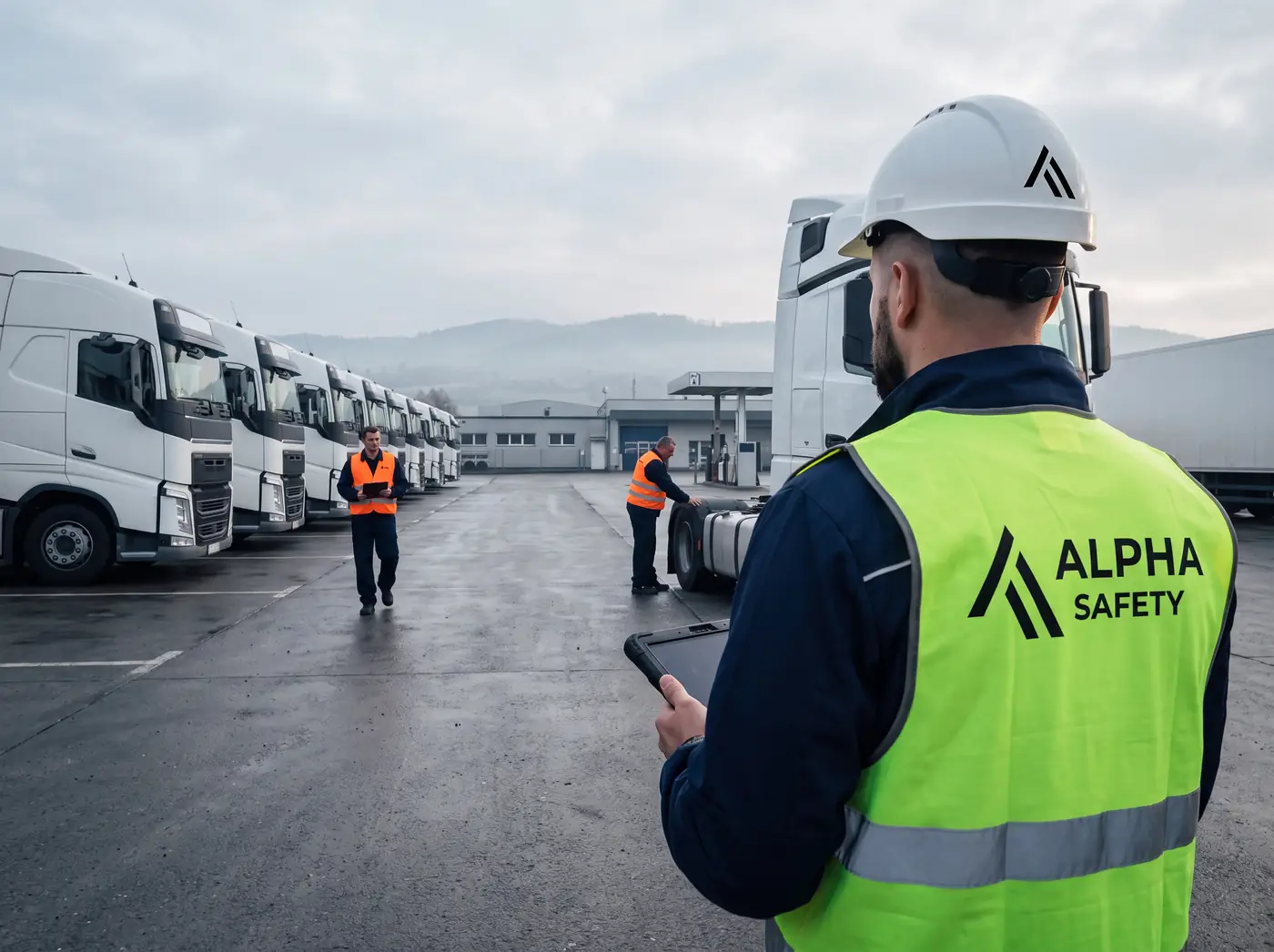
BOZP in transport applies to road hauliers and freight forwarders, bus transport, courier and delivery services, and every company with its own vehicle fleet. What makes the sector specific is that the highest-risk workplace — the vehicle and the space around it — changes every day: different premises, a different ramp, different terrain and different weather. On top of road accidents come injuries during loading, unloading, reversing on premises and jumping down from the load bed or ramp.
Transport is also the sector with the densest network of regulations beyond ordinary BOZP: drivers' working time, tachographs, qualification cards, cargo securing and the transport of dangerous goods. That is why it pays to have a system in which BOZP, working time and qualifications fit together — not three separate binders.
Typical hazards in transport
The risk assessment of a transport company must cover both driving and everything that happens when the vehicle is stationary — that is exactly where most occupational accidents occur.
Vehicle movement on the premises and reversing
A collision between a reversing vehicle and a pedestrian is among the most serious scenarios in logistics premises. The solution is a set of site traffic and operating rules: separate routes for pedestrians and vehicles, one-way circuits, mirrors and lighting, high-visibility vests and the rule that reversing is carried out only with a banksman or with technical support (camera, sensors).
Loading, unloading and cargo securing
Working on the ramp, on the load bed and at the side boards means a risk of falling from height, being crushed by a load and handling injuries. Manual handling of loads is governed by Government Regulation No. 281/2006 Coll.; work equipment — ramps, dock levellers, trucks, tail lifts — by Government Regulation No. 392/2006 Coll. Incorrectly secured cargo endangers the driver while driving and everyone who opens the side board or the semi-trailer doors on arrival.
Fatigue, night work and mental workload
Driver fatigue is a safety factor equal to the technical condition of the vehicle. The driving times, breaks and rest periods of professional drivers are governed by Regulation (EC) No 561/2006, the working time of employees in transport by Act No. 462/2007 Coll. Night work under § 98 of the Labour Code and the mental workload of traffic and deadlines are reflected in the categorisation of work and in medical examinations.
Servicing, maintenance and handling equipment
Having your own workshop means working under a raised vehicle, with pressure equipment and with batteries. Workshop vehicle lifts and tail lifts are reserved technical equipment of lifting group B under Decree No. 508/2009 Coll.; operating forklift trucks in the warehouse and during transhipment requires a valid licence card under § 16 of Act No. 124/2006 Coll.
Drivers' working time — Act No. 462/2007 and tachographs
The working time of employees in transport is governed by Act No. 462/2007 Coll. on the organisation of working time in transport — it supplements the Labour Code with special rules for mobile workers. For drivers of goods vehicles over 3.5 tonnes and buses, the directly applicable rules of Regulation (EC) No 561/2006 on driving times, breaks and rest periods apply, and compliance is recorded by the tachograph.
From the BOZP perspective this is not a formal record-keeping exercise: exceeded driving times and shortened rest periods are a direct cause of microsleep and accidents. Compliance with working time in transport is checked by the labour inspectorate alongside police roadside checks — so sanctions can come from two directions at once. Setting up journey planning, records and internal rules therefore belongs in the BOZP system of a transport company just as much as the risk assessment.
Assess the risks of the transport operation. The employer assesses the risks under § 6 ods. 1 písm. c) of Act No. 124/2006 Coll. — vehicle movement and reversing on the premises, loading and unloading, work on ramps, coupling vehicle combinations, vehicle maintenance and the movement of pedestrians between vehicles. The result is a set of site traffic and operating rules and safe working procedures.
Set up drivers' working time and rest periods. The working time of employees in transport is governed by Act No. 462/2007 Coll. on the organisation of working time in transport; the driving times, breaks and rest periods of professional drivers of goods vehicles over 3.5 tonnes and buses are governed by Regulation (EC) No 561/2006 and recorded by the tachograph. Driver fatigue is a direct safety factor, not just a payroll agenda.
Ensure the qualification of professional drivers. Drivers in goods and passenger transport are subject to mandatory initial qualification and periodic training under Act No. 280/2006 Coll. (the driver qualification card). Alongside this, they undergo BOZP familiarisation under § 7 of Act No. 124/2006 Coll. — initial on starting work and refresher at least once every three years.
Instruct company car drivers. Employees who drive a company vehicle of up to 3.5 tonnes alongside their main job (sales representatives, service technicians, managers) undergo company car driver familiarisation. It is not a separate course under a special regulation, but part of familiarisation under § 7 of Act No. 124/2006 Coll., which the Labour Inspectorate asks for during an inspection.
Ensure safe loading, unloading and cargo securing. Manual handling of loads is governed by Government Regulation No. 281/2006 Coll., and the use of ramps, dock levellers and handling equipment by Government Regulation No. 392/2006 Coll. Cargo must be secured against shifting and overturning; operating forklift trucks requires a valid licence card under § 16 of Act No. 124/2006 Coll.
Arrange inspections of equipment and the workshop facilities. Vehicle tail lifts and workshop vehicle lifts are reserved technical equipment of lifting group B under Decree No. 508/2009 Coll., workshop compressors and pressure vessels are pressure equipment, and electrical installations are subject to inspections. Address the fuel store and battery charging from the fire-protection perspective as well.
Provide the PZS and train crews and dispatchers. The categorisation of work under § 31 of Act No. 355/2007 Coll. takes into account drivers' night work, mental workload, vibration and prolonged sitting; preventive medical examinations in relation to work are carried out under § 30e. BOZP training is repeated at least once every three years and documented.
Company car drivers — the most frequently forgotten obligation
A company car driver (vodič-referent) is an employee who drives a company vehicle of up to 3.5 tonnes alongside their main job — a sales representative, a service technician, a project manager with a company car. The regulations do not recognise a separate "company car driver course" as a standalone statutory obligation — it is part of familiarisation under § 7 of Act No. 124/2006 Coll.: the employer must familiarise the employee with the regulations and principles of safe work, which also cover driving a vehicle on a business trip.
In practice this means: initial familiarisation on starting work, refresher familiarisation at least once every three years (§ 7 ods. 5), with content focused on the rules for using company vehicles, pre-drive vehicle checks, breaks, phone use, alcohol and the procedure after an accident — and a signed record of all of it. This record is exactly what the Labour Inspectorate asks for first when investigating an employee's road accident. We deliver company car driver familiarisation in person and online.
This applies to practically every company with a company car — not only hauliers. If your people drive company vehicles and you have no record of company car driver familiarisation, you have a gap that an inspection will find on the first attempt.
Professional drivers — the KKV and medical fitness
Drivers in goods transport and bus drivers are subject to mandatory initial qualification and periodic training under Act No. 280/2006 Coll. — demonstrated by the driver qualification card (KKV). The card is a condition for practising the profession, but it does not replace BOZP familiarisation under § 7 of Act No. 124/2006 Coll. — the company needs both.
- Medical and psychological fitness — professional drivers undergo medical examinations and psychological assessments under the road traffic regulations; alongside these, preventive medical examinations in relation to work are carried out under § 30e of Act No. 355/2007 Coll.
- Transport of dangerous goods (ADR) — requires special training of the driver and a safety adviser under the ADR Agreement; if you carry dangerous goods only occasionally, check whether the exemptions apply to you — we will advise you.
- Agency and seasonal drivers — the user employer is responsible for their familiarisation just as for core employees; for foreign drivers, the linguistic comprehensibility of training is a statutory requirement.
Warehouse, ramp and handling equipment
Every haulier has at least a piece of a warehouse — a transhipment area, a ramp, a pallet rack. The same rules apply here as in logistics: work equipment under Government Regulation No. 392/2006 Coll., manual handling under Government Regulation No. 281/2006 Coll. and forklift truck licence cards under § 16 of Act No. 124/2006 Coll. For a full-scale warehouse we recommend the dedicated page BOZP for warehousing and logistics.
- Vehicle tail lifts are lifting VTZ of group B (Annex No. 1 II. časť písm. d) bod 4 of Decree No. 508/2009 Coll.) — they need professional inspections and an operator familiarised with the manufacturer's instructions.
- Ramps and dock levellers — regular checks of their technical condition, an anti-slip surface, and securing the vehicle against movement during loading (wheel chocks, parking brake).
- Falls from the load bed and semi-trailer — climb up and down only using a ladder or steps, jumping down is prohibited; do the sheeting from a safe position, not from the side board.
OPP and the haulier's workshop facilities
A fuel store, battery charging, welding during maintenance and parking vehicles in the hall — all of these are activities addressed by fire protection under Act No. 314/2001 Coll. OPP documentation, employee training and the professional training of fire patrols are governed by Decree No. 121/2002 Coll.; fire extinguishers are inspected at least once every 24 months under § 9 of Decree No. 347/2022 Coll.
In the workshop, reserved technical equipment is added on top: compressors and pressure vessels (pressure), electrical installations and charging stations (electrical), gas heating of the hall (gas) — all with intervals for professional inspections and tests under Decree No. 508/2009 Coll. We can provide VTZ inspections together with BOZP and OPP in one flat monthly fee.
PZS and the categorisation of drivers' work
The employer must provide an occupational health service from the first employee under § 30 of Act No. 355/2007 Coll. For drivers, the categorisation of work under § 31 takes into account in particular night work, mental workload, whole-body vibration and prolonged sitting; for warehouse staff and mechanics, physical load, noise and chemical factors. For categories 1 and 2, the contracted PZS may also be performed by a public health specialist holding a trade licence for supervision of working conditions under § 30aa (2) — so you have both BOZP and PZS from a single partner.
What fines apply for breaches of the regulations?
The Labour Inspectorate may, under § 19 of Act No. 125/2006 Coll., impose a fine of up to 100,000 euros; for an occupational accident with serious bodily harm at least 20,000 euros, and for a fatal accident at least 33,000 euros. In addition, the labour inspectorate checks compliance with Act No. 462/2007 Coll. on working time in transport, and the police check driving times under Regulation (EC) No 561/2006 — breaches of tachograph rules are sanctioned separately.
After every more serious road accident involving a company vehicle comes the question: "When was the driver last given familiarisation, and how can you prove it?" The answer must be a signed record — not a recollection.
What Alpha Safety will provide for your transport company
Alpha Safety s.r.o. is an external provider of comprehensive safety services for road hauliers, freight forwarders and companies with vehicle fleets throughout Slovakia — from a single company car to a fleet of trucks.
- BOZP — external safety service (BTS), risk assessment of transport and premises, site traffic and operating rules, accident investigation and representation during inspections.
- Driver familiarisation — company car drivers and professional crews, in person or online, with records that stand up to inspection.
- OPP — fire-protection documentation for halls, workshops and fuel stores, training and fire patrols.
- PZS — categorisation of drivers' and workshop work, preventive medical examinations in relation to work.
- VTZ inspections — tail lifts, workshop vehicle lifts, compressors, electrical installations and gas equipment.
- Licence cards — forklift trucks, load slingers and other professional competences for the warehouse and transhipment.
From our practice
The most frequent finding in transport companies: perfectly kept tachographs, but no record of BOZP familiarisation — companies assume the driver qualification card covers everything. It does not: the KKV and familiarisation under § 7 are two different obligations, and an inspection asks about both. The second evergreen is company car drivers, whom the company often does not even know it has.
On premises, the recurring findings are missing site traffic and operating rules, reversing without a banksman and jumping down from ramps and load beds. In workshops we find tail lifts and vehicle lifts without professional inspections — few people know they are reserved technical equipment. The good news: the whole system can be built at a haulier within a few weeks, and from then on we simply maintain it.
Súvisiace služby a zdroje
Bezpečnosť a ochrana zdravia pri práci
Externá bezpečnostnotechnická služba pre dopravcov — posúdenie rizík areálu a jázd, dopravno-prevádzkové pravidlá a kompletná dokumentácia BOZP.
Oboznámenie vodičov-referentov
Povinné oboznámenie zamestnancov, ktorí vedú služobné vozidlá do 3,5 tony — prezenčne aj online, so záznamom, ktorý obstojí pri kontrole.
Pracovná zdravotná služba (služba)
Kategorizácia prác vodičov a dielne — nočná práca, psychická záťaž, vibrácie — a koordinácia lekárskych preventívnych prehliadok.
Ochrana pred požiarmi (služba)
Požiarna dokumentácia pre haly, dielne a sklady pohonných látok, školenia zamestnancov a odborná príprava hliadok.
Revízie VTZ (služba)
Odborné prehliadky a skúšky zdvíhacích čiel, servisných zdvihákov, kompresorov, elektroinštalácií a plynových zariadení.
Kurz obsluhy vysokozdvižných vozíkov
Preukaz na motorové vozíky podľa § 16 zákona č. 124/2006 Z. z. pre sklad a prekládku — základné kurzy aj aktualizačná odborná príprava.
BOZP pre sklady a logistiku
Samostatný sprievodca pre skladovú časť prevádzky — regály, manipulačná technika a bezpečný sklad.
Pôsobíme po celom Slovensku
Bezpečnosť v tomto odvetví zabezpečujeme vo všetkých krajských mestách aj okresoch — napríklad:
Stručná odpoveď
BOZP in transport applies to road hauliers, freight forwarders, courier services and every company with company vehicles. Alongside the obligations under Act No. 124/2006 Coll., it covers drivers' working time under Act No. 462/2007 Coll. and Regulation (EC) No. 561/2006, the driver qualification card of professional drivers under Act No. 280/2006 Coll. and the familiarisation of company car drivers, which is part of BOZP training under § 7 of Act No. 124/2006 Coll.
Časté otázky o BOZP v doprave
Yes — not as a separate course under a special regulation, but as part of familiarisation under § 7 of Act No. 124/2006 Coll. The employer must familiarise every employee who drives a company vehicle with the rules of safe work, including the use of vehicles — on starting work and repeatedly at least once every three years — and keep a record of it. This record is exactly what the labour inspectorate asks for first after an accident.
An employee who drives a company vehicle of up to 3.5 tonnes alongside their main job — a sales representative, a service technician, a manager with a company car. They do not need a driver qualification card like a professional driver, but they must undergo BOZP familiarisation focused on driving a vehicle. This applies to practically every company with a company car, not only hauliers.
Special rules for organising the working time of mobile employees in transport — it supplements the Labour Code with working-time limits, breaks and records specific to transport. For drivers of goods vehicles over 3.5 tonnes and buses, the directly applicable rules of Regulation (EC) No. 561/2006 on driving times, breaks and rest periods, recorded by the tachograph, apply in addition.
Professional drivers in goods transport and bus drivers do — mandatory initial qualification and periodic training are governed by Act No. 280/2006 Coll. The qualification card, however, does not replace BOZP familiarisation under § 7 of Act No. 124/2006 Coll. — the company needs both, and an inspection asks about the two obligations separately.
Manual handling of loads is governed by Government Regulation No. 281/2006 Coll., and the use of ramps, dock levellers and handling equipment by Government Regulation No. 392/2006 Coll. During loading, the vehicle must be secured against movement, the cargo secured against shifting, and no one jumps down from the load bed — you climb down using the steps or a ladder. Operating a forklift truck requires a valid licence card.
Yes. A tail lift for loading and unloading cargo and workshop vehicle lifts are reserved technical equipment of lifting group B under Annex No. 1 II. časť písm. d) of Decree No. 508/2009 Coll. They need professional inspections and tests and operators familiarised with the manufacturer's instructions — during an inspection, the inspection reports are presented first.
Through site traffic and operating rules based on the risk assessment: separate routes for pedestrians and vehicles, one-way circuits, high-visibility vests, lighting and the principle that reversing is carried out only with a banksman or technical support. A collision between a reversing vehicle and a pedestrian is among the most serious occupational accidents in logistics.
The transport of dangerous goods is governed by the ADR Agreement — it requires a specially trained driver, correct marking and equipment of the vehicle and, in most cases, a safety adviser as well. For occasional transport of small quantities it is worth checking the ADR exemptions; we will assess whether they apply to your transport.
It depends on the factors: night work, mental workload, whole-body vibration and prolonged sitting are the reasons why drivers often fall into category 2. The categorisation is carried out by the occupational health service under § 31 of Act No. 355/2007 Coll.; for categories 1 and 2 it may also be provided on a contracted basis by a public health specialist holding a trade licence for supervision of working conditions under § 30aa (2).
The flat monthly fee starts from €15 per month excl. VAT and grows with the number of employees, vehicles and sites. The price includes the safety service, documentation including site traffic and operating rules, driver familiarisation and representation during inspections. We will prepare an exact price after a short non-binding consultation.
Under § 19 of Act No. 125/2006 Coll., the labour inspectorate may impose a fine of up to EUR 100,000; for an occupational accident with serious bodily harm at least EUR 20,000 and for a fatal accident at least EUR 33,000. Breaches of working time in transport under Act No. 462/2007 Coll. and breaches of driving times under Regulation (EC) No. 561/2006 found during roadside checks are sanctioned separately.
Need help with workplace safety?
Contact us today and get a free consultation. Our team of experts will help you find a solution tailored to your needs.