BOZP for retail and stores — goods, racking and casual workers
Complete guide to BOZP in retail: goods handling under Government Regulation No. 281/2006 Coll., racking and ladders, night work and adolescent casual workers under the Labour Code, store fire protection, the PZS, VTZ inspections and mandatory training.
Interested in this service?
Leave us your contact and we will get back to you with pricing and dates, usually within 24 hours.
Retail — the most operations, the most underestimated BOZP
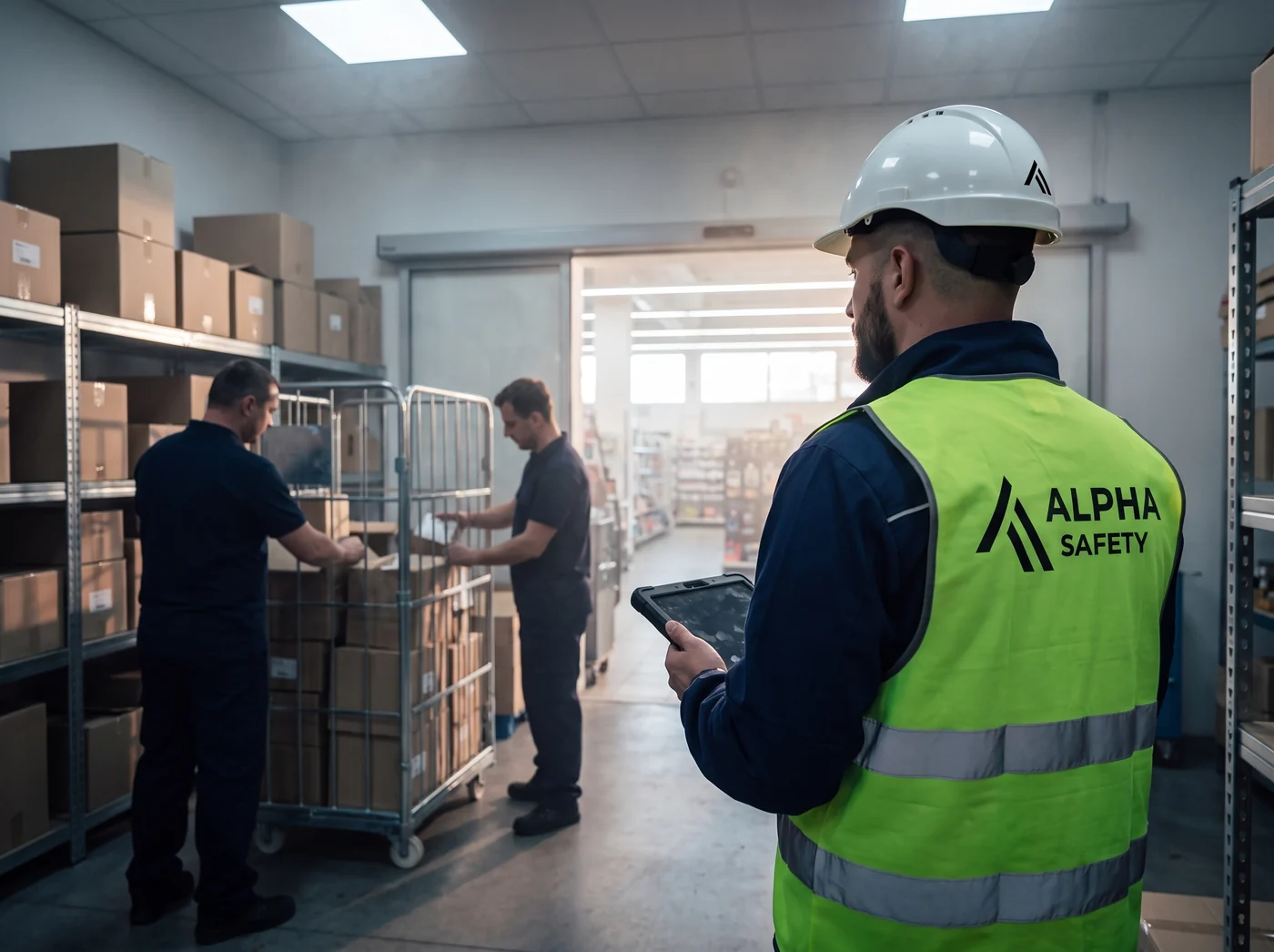
BOZP in retail applies to retail stores, retail chains, wholesalers, builders' merchants and furniture stores, and the collection points and back-of-house facilities of e-shops. Retail employs hundreds of thousands of people in thousands of operations — and that is exactly why it is the sector where safety is most often postponed: "nothing ever happens here". The statistics say otherwise: goods handling, falls from ladders and slips are among the most frequent occupational accidents of all.
From the regulatory point of view, a store is three workplaces in one: the sales floor with public movement, the stockroom with racking and handling, and the ramp with deliveries. Each has its own risks, and the BOZP documentation must cover all three — including casual workers, who come and go faster than an attendance sheet can be printed.
Typical hazards in the store and stockroom
Goods handling and loads
Unloading pallets, restocking shelves and carrying packages is manual handling of loads under Government Regulation No. 281/2006 Coll. Long-term overloading of the spine is the most frequent cause of damage to health in retail — prevention lies in handling trolleys, correct placement of goods (heavy in the middle, light at the top and the bottom) and lifting technique that employees must genuinely be taught, not just mentioned in a directive.
Ladders, mobile steps and racking
A fall from a ladder while restocking upper shelves and an overturned or overloaded rack are the typical accident scenarios of stores and stockrooms. Ladders, mobile steps and racking are work equipment under Government Regulation No. 392/2006 Coll. — they are checked in accordance with the manufacturer's instructions, have their load capacity marked, and damaged items are taken out of service immediately. Climbing on racking and standing on crates is a prohibited practice that every operation knows.
Slips, falls and public movement
A wet floor after cleaning, spilled goods and cables in the aisles endanger employees and customers alike. The employer is responsible for the safe condition of the workplace; towards the public it additionally bears liability for damage. The solution is prosaic — anti-slip surfaces, immediate clean-up, warning signs and order in the aisles — but it must be put in place as a system, not left to chance.
The checkout, night restocking and lone workers
Checkout work means long periods of standing or sitting and contact with the public, including conflict situations and the risk of robbery. Night restocking and stocktaking are night work under § 98 of the Labour Code. An employee alone in the store or stockroom after closing time is a lone worker — they need a functioning way of calling for help.
Loads and ergonomics — the most expensive "minor" injuries
Government Regulation No. 281/2006 Coll. on minimum safety and health requirements for the manual handling of loads requires the employer to avoid manual handling wherever possible — and where it cannot be avoided, to reduce the risk through work organisation, aids and training. The indicative weight values under the annex to the regulation take account of sex, frequency and working posture.
- Pallet and handling trucks — the basic aid of any store; a low-lift pallet truck does not require a forklift licence card, a powered forklift truck does (§ 16 of Act No. 124/2006 Coll.).
- Placement of goods — heavy items at waist height, light ones at the top and the bottom; oversized goods in pairs or with a trolley.
- Physical load of women and adolescents — stricter limits apply to women and adolescents; an adolescent must not be assigned work disproportionate to their physical development (§ 175 of the Labour Code).
- Checkout ergonomics — alternating sitting and standing, reach distances and breaks reduce the load on the spine and shoulders during scanning.
Assess the risks of the store and its back-of-house areas. The employer assesses the risks under § 6 ods. 1 písm. c) of Act No. 124/2006 Coll. — goods handling, work on ladders and steps, the condition of racking, slips on the floor, checkout work and night-time restocking. The assessment covers the sales floor, the stockroom and the loading ramp.
Set up safe goods handling. Manual handling of loads is governed by Government Regulation No. 281/2006 Coll. — limit the weights, use trolleys and pallet trucks, and teach employees safe lifting technique. Heavier goods are placed on the middle shelves, lighter goods at the top and the bottom.
Check racking, ladders and mobile steps. Racking, ladders and mobile steps are work equipment under Government Regulation No. 392/2006 Coll. — they are used and checked in accordance with the manufacturer's instructions, and damaged items are taken out of service. Racking must have its load capacity marked and be anchored; any impact of a truck against racking is always investigated.
Address night work and adolescent employees. Night work is work between 10 p.m. and 6 a.m. (§ 98 of the Labour Code) and is taken into account in the categorisation of work and in medical examinations. Adolescent employees and casual workers under 18 must not be assigned night work or overtime (§ 174), and they undergo a preventive medical examination before starting work and regularly at least once a year (§ 176).
Ensure fire protection of the store. Fire-protection documentation, employee training and preventive inspections are governed by Act No. 314/2001 Coll. and Decree No. 121/2002 Coll. Escape routes and exits must be permanently clear — an obstructed emergency exit in the stockroom is the most frequent inspection finding. Fire extinguishers are inspected at least once every 24 months.
Arrange inspections of VTZ and refrigeration. The store's electrical installation, lifts, the tail lifts of delivery vehicles and gas appliances are reserved technical equipment under Decree No. 508/2009 Coll. with intervals for professional inspections and tests. In food stores, also check the regime of refrigeration equipment and refrigeration plant rooms.
Provide the PZS and train everyone, including casual workers. The occupational health service is mandatory from the first employee (§ 30 of Act No. 355/2007 Coll.); work in retail generally falls into category 1 or 2, which is covered by a contracted PZS under § 30aa. Every person — including casual workers on work agreements and agency employees — undergoes BOZP familiarisation on starting work and refresher familiarisation at least once every three years.
Adolescents, casual workers and night work
Retail is the largest employer of casual workers — and it is exactly here that most formal errors arise. Every casual worker on a work agreement and every agency employee undergoes BOZP familiarisation on starting work, with a record and signature; the shortened version "we showed them around the store" does not stand up to inspection.
- Adolescents (under 18) — must not work overtime or at night and cannot be ordered to be on stand-by (§ 174 of the Labour Code); they must not perform work disproportionate to their physical and mental development (§ 175).
- Medical examinations of adolescents — before transfer to other work and regularly at least once a year (§ 176 of the Labour Code).
- Night work of adults — work between 10 p.m. and 6 a.m. (§ 98) is taken into account in the categorisation of work and in preventive medical examinations.
- Records — a list of adolescent employees with their dates of birth is a statutory obligation of the employer (§ 171 ods. 2 of the Labour Code).
Food stores — where BOZP meets hygiene
Alongside BOZP, a food store also deals with food hygiene: the HACCP system under Article 5 of Regulation (EC) No 852/2004, the temperature chains of refrigeration equipment and a sanitation programme. From the occupational safety point of view, this adds work in the cold at frozen-food sections, slicers and delicatessen machines with protective features, and anti-slip floors in the back-of-house areas. We prepare HACCP documentation together with BOZP — so the store has both agendas from a single source and without contradictions.
OPP — in retail, escape routes are everything
A store is a space with public movement — people who do not know the escape routes and who rely on the staff in the event of a fire. Fire-protection obligations are laid down in § 4 and § 5 of Act No. 314/2001 Coll., and documentation and training in Decree No. 121/2002 Coll. The staff must know where the fire extinguishers are, how to open the emergency exits and how to direct customers out.
- Escape routes and exits — permanently clear and marked; pallets and cardboard "just for a moment" by the emergency exit are the most frequent finding of every inspection.
- Fire extinguishers — inspected at least once every 24 months under § 9 of Decree No. 347/2022 Coll., accessible and in their brackets.
- Stockrooms and cardboard — packaging and cardboard represent a high fire load; store them away from escape routes and heat sources.
- Fire-protection training — all employees including casual workers; the OPP documentation is kept by a fire protection technician.
VTZ in retail — electrics, lifts, refrigeration
- Electrical equipment — the store's electrical installation, lighting, checkout zones; inspections under standard STN 33 1630:2025, which replaced STN 33 1600 and STN 33 1610 on 1 May 2025 (parallel use permitted until 1 May 2027).
- Lifting equipment — goods lifts and lifting platforms in the back-of-house areas are VTZ under Decree No. 508/2009 Coll.; the tail lifts of delivery vehicles belong to group B (Annex No. 1 II. časť písm. d) bod 4).
- Gas equipment — gas heating and appliances; for larger refrigeration systems, check the regime of the refrigeration plant room — we will assess what is subject to professional inspections.
- Racking — not VTZ, but work equipment: checks in accordance with the manufacturer's instructions, marked load capacity, records of damage after truck impacts.
PZS and the categorisation of work in retail
The occupational health service is mandatory from the first employee (§ 30 of Act No. 355/2007 Coll.). Work in retail generally falls into category 1 or 2 — physical load during handling, work in the cold at frozen-food sections and night work are the factors that determine the classification under § 31 and Decree No. 448/2007 Coll. For categories 1 and 2 we provide the PZS on a contracted basis under § 30aa — categorisation, risk assessment reports and coordination of medical examinations.
What fines can a retail operation face?
The Labour Inspectorate may, under § 19 of Act No. 125/2006 Coll., impose a fine of up to 100,000 euros; for an occupational accident with serious bodily harm at least 20,000 euros and for a fatal accident at least 33,000 euros. The Regional Public Health Authority imposes fines from 150 to 20,000 euros (§ 57 ods. 43 písm. a) of Act No. 355/2007 Coll.) — in retail most often for missing categorisation of work and PZS. Breaches involving adolescents are particularly sensitive — night work by a casual worker under 18 is a breach that an inspection judges strictly.
What Alpha Safety will provide for your store
Alpha Safety s.r.o. is an external provider of comprehensive safety services for stores, retail chains, wholesalers and e-shops throughout Slovakia — from a single operation to a network of dozens of branches with unified documentation.
- BOZP — risk assessment of the sales floor, stockroom and ramp, directives for handling and work at height, accident investigation and representation during inspections.
- OPP — fire-protection documentation, escape routes, staff training including casual workers.
- PZS — categorisation of work, risk assessment reports, preventive medical examinations (categories 1 and 2 on a contracted basis).
- VTZ inspections — electrical installations, lifts, tail lifts, gas equipment.
- Training — familiarisation of employees and casual workers, first aid, operation of handling equipment.
- HACCP — for food stores, food hygiene documentation from a single source.
From our practice
In stores we most commonly encounter three things: obstructed emergency exits in the stockroom, casual workers with no record of familiarisation, and ladders or steps in a condition no one would want to use — and yet they are used daily. In retail chains the problem tends to be "desk-made" documentation from headquarters that does not fit the specific operation.
Repeated findings from inspections: missing categorisation of work and PZS, night restocking work left unaddressed, and racking without marked load capacity and with visible damage from truck impacts. All of these are shortcomings we can remove within weeks — and the store then passes inspections without stress and without sanctions.
Súvisiace služby a zdroje
Bezpečnosť a ochrana zdravia pri práci
Externá bezpečnostnotechnická služba pre predajne a reťazce — posúdenie rizík predajnej plochy, skladu a rampy, kompletná dokumentácia BOZP.
Ochrana pred požiarmi (služba)
Požiarna dokumentácia predajne, únikové cesty, školenia personálu vrátane brigádnikov a kontroly hasiacich prístrojov.
Pracovná zdravotná služba (služba)
Kategorizácia prác v obchode — fyzická záťaž, práca v chlade, nočná práca — a lekárske preventívne prehliadky vrátane mladistvých.
HACCP a hygiena potravín (služba)
Systém HACCP podľa nariadenia (ES) č. 852/2004 pre potravinové predajne — analýza rizík, kritické body a evidencie z jednej ruky s BOZP.
Revízie VTZ (služba)
Odborné prehliadky a skúšky elektroinštalácií, výťahov, zdvíhacích čiel a plynových zariadení obchodných prevádzok.
Kurz obsluhy vysokozdvižných vozíkov
Preukaz na motorové vozíky podľa § 16 zákona č. 124/2006 Z. z. pre sklady predajní a veľkoobchody.
Školenia a kurzy
Vstupné a opakované oboznamovanie zamestnancov a brigádnikov, prvá pomoc, školenia o ochrane pred požiarmi — prezenčne aj online.
Pôsobíme po celom Slovensku
Bezpečnosť v tomto odvetví zabezpečujeme vo všetkých krajských mestách aj okresoch — napríklad:
Stručná odpoveď
BOZP in retail applies to retail stores, chains, wholesalers and the back-of-house facilities of e-shops. The basis is a risk assessment under Act No. 124/2006 Coll., safe goods handling under Government Regulation No. 281/2006 Coll., checks of racking and ladders, clear escape routes and the familiarisation of all employees including casual workers. Adolescents under 18 must not work at night or overtime and undergo a medical examination once a year under the Labour Code.
Časté otázky o BOZP v obchode
The same as every employer: a risk assessment, BOZP documentation, initial and refresher familiarisation, an occupational health service from the first employee and fire documentation. The scope is adapted to the size of the operation — a small store does not need thick binders, but the documents must fit its real risks: goods handling, ladders, escape routes.
Yes. Every employee, including casual workers on work agreements and agency employees, must receive initial familiarisation with BOZP rules before starting work under § 7 of Act No. 124/2006 Coll. — with a record and signature. A verbal "showing them around the store" does not stand up to inspection. Refresher familiarisation follows at least once every three years.
You must not assign night work (between 10 p.m. and 6 a.m.) to an adolescent — § 174 of the Labour Code prohibits it, as it does overtime and stand-by duty. The only exception is night work of up to one hour for adolescents over 16 where it is needed for their vocational training. An adolescent also must not perform work disproportionate to their development under § 175.
The employer arranges an assessment of the adolescent's medical fitness before transfer to other work and regularly, at least once a year, under § 176 of the Labour Code. The adolescent is obliged to undergo the examinations, and the employer follows the medical reports when assigning work. The employer also keeps records of adolescent employees with their dates of birth.
Manual handling of loads is governed by Government Regulation No. 281/2006 Coll. — the employer should avoid it wherever possible (trolleys, pallet trucks) and otherwise reduce the risk through work organisation and training in lifting technique. The indicative weight values under the annex take account of sex, frequency and posture; stricter limits apply to women and adolescents.
A hand-operated low-lift pallet truck may be used by any employee after familiarisation. A powered forklift truck may only be operated by a person holding a valid licence card under § 16 of Act No. 124/2006 Coll. — even in a store's small stockroom. We can provide the licence cards and refresher professional training as part of our courses.
Racking, ladders and mobile steps are work equipment under Government Regulation No. 392/2006 Coll. — they are checked in accordance with the manufacturer's instructions and damaged items are taken out of service. Racking must have its load capacity marked, and its condition is checked after every truck impact. The practical standard is a regular documented racking inspection at least once a year.
Fire-protection documentation, employee training, clear and marked escape routes and exits, accessible fire extinguishers inspected no more than 24 months ago (§ 9 of Decree No. 347/2022 Coll.) and the storage of flammable materials. An emergency exit obstructed by pallets is the most frequent finding — and a reason for an immediate sanction.
Yes. Every operation that stores or sells food must have an HACCP system in place under Article 5 of Regulation (EC) No. 852/2004 — a hazard analysis, critical control points and temperature records. BOZP and HACCP are two separate agendas with two supervisory authorities; we prepare them together so the documents do not contradict each other.
The flat monthly fee starts from €15 per month excl. VAT and grows with the number of employees and sites. The price includes the safety service, documentation tailored to the store, familiarisation of employees and casual workers, and representation during inspections. For store networks we prepare unified documentation with local specifics. We will give you an exact price after a non-binding consultation.
Under § 19 of Act No. 125/2006 Coll., the labour inspectorate may impose a fine of up to EUR 100,000; for an occupational accident with serious bodily harm at least EUR 20,000 and for a fatal accident at least EUR 33,000. The RÚVZ imposes fines from EUR 150 to EUR 20,000 (§ 57 ods. 43 písm. a) of Act No. 355/2007 Coll.). Breaches involving adolescents — for example night work by a casual worker under 18 — are judged strictly.
Need help with workplace safety?
Contact us today and get a free consultation. Our team of experts will help you find a solution tailored to your needs.